

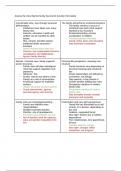
Assess the view that the family has lost its function (30 marks)
Functionalist view- loss through structural The family still performs emotional functions
differentiation - The family remains a source of
- Institutions have taken over many emotional care and moral support
family roles - Murdock's four functions
- Parsons- education, health and - Emotional bonding, primary
welfare can be handled by other socialisation of children
bodies - Functions persist informally
- Nhs, schools, benefits replace - Social media, peers and education
traditional family structures + may dominate socialisation
functions
- Some functions have been lost
- Parsons- two irreplaceable functions
(socialisation and stabilisation)
- Ignores family diversity
Marxist + feminist view- family supports Personal life perspective- meaning over
power structures structure
- Family view still plays ideological - Family functions vary depending on
roles that support capitalism and personal meaning and emotional
patriarchy ties
- Althusser- ISA - Smart relationships are defined by
- Ansley- women are takers of shit connection, not biology
- Family as a unit of consumption - Step parents, cl;ose friends or
- Emotional support for exploited chosen families fulfilling key roles
workers - Recognises variation in modern
- Hidden structural functions persist family roles
- Overly deterministic, ignores - Recognises variation in modern
personal agency and diversity family roles
- May downplay broader societal
pressures and inequality
Family roles are changing/expanding Postmodern and new right perspectives
- Family now handles more - Family life has diversified but is still
responsibilities central, or in decline, depending on
- Modified extended families the view
- Fletcher- role of grandparents - Giddens- negotiated family
- Functions have adapted, not lost - New right- decline due to welfare
- Not all families have the capacity- dependence
class and gender inequalities limit - Pure relationships, lone parenthood,
this divorce
- Families adapt to change
- New right- changes reflect
breakdown, not progress
Functionalist view- loss through structural The family still performs emotional functions
differentiation - The family remains a source of
- Institutions have taken over many emotional care and moral support
family roles - Murdock's four functions
- Parsons- education, health and - Emotional bonding, primary
welfare can be handled by other socialisation of children
bodies - Functions persist informally
- Nhs, schools, benefits replace - Social media, peers and education
traditional family structures + may dominate socialisation
functions
- Some functions have been lost
- Parsons- two irreplaceable functions
(socialisation and stabilisation)
- Ignores family diversity
Marxist + feminist view- family supports Personal life perspective- meaning over
power structures structure
- Family view still plays ideological - Family functions vary depending on
roles that support capitalism and personal meaning and emotional
patriarchy ties
- Althusser- ISA - Smart relationships are defined by
- Ansley- women are takers of shit connection, not biology
- Family as a unit of consumption - Step parents, cl;ose friends or
- Emotional support for exploited chosen families fulfilling key roles
workers - Recognises variation in modern
- Hidden structural functions persist family roles
- Overly deterministic, ignores - Recognises variation in modern
personal agency and diversity family roles
- May downplay broader societal
pressures and inequality
Family roles are changing/expanding Postmodern and new right perspectives
- Family now handles more - Family life has diversified but is still
responsibilities central, or in decline, depending on
- Modified extended families the view
- Fletcher- role of grandparents - Giddens- negotiated family
- Functions have adapted, not lost - New right- decline due to welfare
- Not all families have the capacity- dependence
class and gender inequalities limit - Pure relationships, lone parenthood,
this divorce
- Families adapt to change
- New right- changes reflect
breakdown, not progress


