

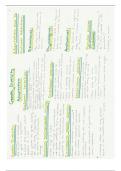
Summary 3.4.4 Genetic diversity and adaptation
Genetic diversity as the number of different alleles of genes in a population. Genetic diversity is a factor enabling natural selection to occur. The principles of natural selection in the evolution of populations. Random mutation can result in new alleles of a gene. Many mutations are harmful but, in certain environments, the new allele of a gene might benefit its possessor, leading to increased reproductive success. The advantageous allele is inherited by members of the next generation. As a result, over many generations, the new allele increases in frequency in the population. Directional selection, exemplified by antibiotic resistance in bacteria, and stabilising selection, exemplified by human birth weights. Natural selection results in species that are better adapted to their environment. These adaptations may be anatomical, physiological or behavioural. Students should be able to: use unfamiliar information to explain how selection produces changes within a population of a species interpret data relating to the effect of selection in producing change within populations show understanding that adaptation and selection are major factors in evolution and contribute to the diversity of living organisms.
Document information
- Study Level
-
A/AS Level
- Subject
-
A Level Biology
- Uploaded on
- July 10, 2025
- Number of pages
- 1
- Written in
- 2024/2025
- Type
- Summary


