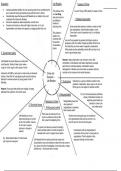
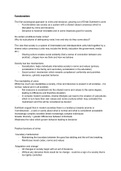
Evaluation Left Realists Causes of Crime
● Accepts authorities definition of crime as being street crime committed by the They believe crime Lea and Young (1984) identify 3 causes of crime:
poor, instead of looking at powerful groups and their harm to others. is a real thing,
● Interactionists argue that because Left Realists rely on statistics, they can’t and prison alone is
understand the motives of offenders. an ineffective 1. Relative Deprivation
● Not all who experience relative deprivation commit crime. method at
● Focuses more heavily on cities with higher crime rates, so it is not reducing crime. Some people feel deprived in relation to others or their
representative and makes crime appear as a bigger problem than it is. own expectations, which therefore leads to crime.
They believe it Crime has its roots in deprivation but it is not directly
needs to be responsible.
combined with Lea and Young explain the paradox that today’s society is
the practice prosperous and crime ridden. People are better off but due to
of restorative the media they are more aware in regards to possessions.
justice. What people see they potentially cannot afford so they turn to
3. Government policy crime to get what they want.
However, relative deprivation may not lead to crime. Bad
Left Realists had more influence on policy than
combination is individualism and relative deprivation as people
most theorists. Similar to New Labour views –
want their own individual desires. Individualism causes
‘tough on crime, tough on the causes of crime’.
disintegration of families and communities so weakens informal
Introduction of ASBOs, crack down on hate crime and domestic Crime and controls and an increase in anti-social behaviour.
violence. ‘New Deal’ for unemployed youth and anti-truanting Deviance -
attempts to reverse exclusion of young people at risk of
offending.
Left Realism 2. Subculture Subculture is a group’s collective solution to the
problems of deprivation. Some may turn to crime to
fill the gap or even religion for spiritual comfort.
However, Young says that policies are nostalgic. It largely
addresses the symptoms, but not the cause.
3. Marginalisation For LR, criminal subcultures still follow
values of mainstream society, but
Marginalised groups lack legitimate opportunities are
Solutions to Crime
clear goals and blocked so crime is the
2. Structural issues
organisations to represent next viable option.
1. Policing and control
their interests within.
Police clear-up rates are too low
Left Realists do not see to act as a deterrent and too little Workers have clear goals (pay and conditions)
improved policing and control time is spent investigating crime. and organisations (trade unions) so there is no
as the main solution. Causes need to resort to crime to achieve goals.
of crime lie in unequal
structure so change is The public must become involved in deciding
needed. police priorities instead. Currently the public is Unemployed youth are marginalised in
alienated with a lack of support around police. comparison as they have no clear goals nor
organisations. Their frustration is then
E.g. Tackle discrimination, Provide decent
Left Realists think that policing should be made more expressed through criminal means.
jobs, Improve housing etc.
accountable to local communities and deal with local concerns
(e.g. spend more time investigating, involve the public, change
priorities etc). - We should work as a team
● Accepts authorities definition of crime as being street crime committed by the They believe crime Lea and Young (1984) identify 3 causes of crime:
poor, instead of looking at powerful groups and their harm to others. is a real thing,
● Interactionists argue that because Left Realists rely on statistics, they can’t and prison alone is
understand the motives of offenders. an ineffective 1. Relative Deprivation
● Not all who experience relative deprivation commit crime. method at
● Focuses more heavily on cities with higher crime rates, so it is not reducing crime. Some people feel deprived in relation to others or their
representative and makes crime appear as a bigger problem than it is. own expectations, which therefore leads to crime.
They believe it Crime has its roots in deprivation but it is not directly
needs to be responsible.
combined with Lea and Young explain the paradox that today’s society is
the practice prosperous and crime ridden. People are better off but due to
of restorative the media they are more aware in regards to possessions.
justice. What people see they potentially cannot afford so they turn to
3. Government policy crime to get what they want.
However, relative deprivation may not lead to crime. Bad
Left Realists had more influence on policy than
combination is individualism and relative deprivation as people
most theorists. Similar to New Labour views –
want their own individual desires. Individualism causes
‘tough on crime, tough on the causes of crime’.
disintegration of families and communities so weakens informal
Introduction of ASBOs, crack down on hate crime and domestic Crime and controls and an increase in anti-social behaviour.
violence. ‘New Deal’ for unemployed youth and anti-truanting Deviance -
attempts to reverse exclusion of young people at risk of
offending.
Left Realism 2. Subculture Subculture is a group’s collective solution to the
problems of deprivation. Some may turn to crime to
fill the gap or even religion for spiritual comfort.
However, Young says that policies are nostalgic. It largely
addresses the symptoms, but not the cause.
3. Marginalisation For LR, criminal subcultures still follow
values of mainstream society, but
Marginalised groups lack legitimate opportunities are
Solutions to Crime
clear goals and blocked so crime is the
2. Structural issues
organisations to represent next viable option.
1. Policing and control
their interests within.
Police clear-up rates are too low
Left Realists do not see to act as a deterrent and too little Workers have clear goals (pay and conditions)
improved policing and control time is spent investigating crime. and organisations (trade unions) so there is no
as the main solution. Causes need to resort to crime to achieve goals.
of crime lie in unequal
structure so change is The public must become involved in deciding
needed. police priorities instead. Currently the public is Unemployed youth are marginalised in
alienated with a lack of support around police. comparison as they have no clear goals nor
organisations. Their frustration is then
E.g. Tackle discrimination, Provide decent
Left Realists think that policing should be made more expressed through criminal means.
jobs, Improve housing etc.
accountable to local communities and deal with local concerns
(e.g. spend more time investigating, involve the public, change
priorities etc). - We should work as a team