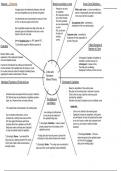
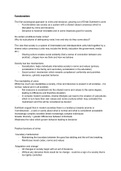
However… (Criticisms) Marxism according to crime Some Crime Definitions…
- It largely ignores the relationship between crime and - People turn to crime White collar crime - a crime committed by a
non-class inequalities such as ethnicity and gender. for capitalism person of respectability and high social status
- R/C make and enforce in the course of their occupation
- It is deterministic and over-predicts the amount of crime law in their interests
in W/C; not all poor people commit crime. - The W/C population
Occupational crime - committed by
are over-represented
employees for their own personal gain
- Not all capitalist societies have high crime rates, for in crime
example Japan and Switzerland only have a mere - R/C use the law
fraction of the US crime rate. to keep and Corporate crime - committed by
maintain employees for their organisation in
- Ignores intraclass crime, e.g. W/C against W/C. control pursuit of its goals
↑ (Left realists argue that Marxism ignores it) 3 Main Elements of
Evaluation
Marxism in Crime
Marxism offers a useful
explanation of the relationship between - Criminogenic Capitalism (Capitalism is
crime and capitalist society. inevitable in society because it is
It shows the link between law making and enforcement criminogenic; it causes crime.)
and the interests of the capitalist class. By doing so, it puts - The State and Law Making
into a wider structural context the insights of labelling theory - Ideological Functions of Crime and Law
Crime and
regarding the selective enforcement of the law.
Deviance -
Marxist Theory
Ideological Functions of Crime and Law Criminogenic Capitalism
- Based on exploitation of the working class.
- May give rise to working-class in response to poverty
- Sometimes laws are passed which are purely to make the - Crime is the only way to get the consumer goods
W/C feel like they are beneficiaries of capitalism (workers promoted by capitalism
rights, etc.) However these are rarely enforced. The State and - Alienation may lead to frustration and non-utilitarian crime
Law Making
- This creates false consciousness in the working class. HOWEVER…
- Law making and enforcement - Crime is not confined to the working-class
- Due to selective enforcement, crime is is only serving the interests of - Capitalism is based on competition, profit, greed
portrayed as a working class issue and thus the capitalist/ruling class. and self-interest. In terms of businesses they need
W/C turn against themselves and blame to win at all costs so white collar corporate crime
criminals rather than capitalism and the R/C. ↑ (Sociologist) Chambliss - ‘Laws to protect occurs (e.g. tax evasion, health and safety
Media also makes criminals seem ‘disturbed’ private property form the foundation of the breaches)
so they are blamed instead of capitalism. capitalist economy’.
- Ruling class also have the power to prevent the ↑ (Sociologist) Gordon - ‘Crime is a
↑ (Sociologist) Pearce - ‘Laws benefit the rational response to the capitalist system
introduction of laws which threaten their interests
ruling class (e.g. keeping workers fit for work). and is found in all classes’
‘Caring’ laws create a false consciousness (Not just the working class)!
amongst workers.
↑ (Sociologist) Snider - ‘The ruling class are reluctant to
pass laws which could negatively impact profitability’.
- It largely ignores the relationship between crime and - People turn to crime White collar crime - a crime committed by a
non-class inequalities such as ethnicity and gender. for capitalism person of respectability and high social status
- R/C make and enforce in the course of their occupation
- It is deterministic and over-predicts the amount of crime law in their interests
in W/C; not all poor people commit crime. - The W/C population
Occupational crime - committed by
are over-represented
employees for their own personal gain
- Not all capitalist societies have high crime rates, for in crime
example Japan and Switzerland only have a mere - R/C use the law
fraction of the US crime rate. to keep and Corporate crime - committed by
maintain employees for their organisation in
- Ignores intraclass crime, e.g. W/C against W/C. control pursuit of its goals
↑ (Left realists argue that Marxism ignores it) 3 Main Elements of
Evaluation
Marxism in Crime
Marxism offers a useful
explanation of the relationship between - Criminogenic Capitalism (Capitalism is
crime and capitalist society. inevitable in society because it is
It shows the link between law making and enforcement criminogenic; it causes crime.)
and the interests of the capitalist class. By doing so, it puts - The State and Law Making
into a wider structural context the insights of labelling theory - Ideological Functions of Crime and Law
Crime and
regarding the selective enforcement of the law.
Deviance -
Marxist Theory
Ideological Functions of Crime and Law Criminogenic Capitalism
- Based on exploitation of the working class.
- May give rise to working-class in response to poverty
- Sometimes laws are passed which are purely to make the - Crime is the only way to get the consumer goods
W/C feel like they are beneficiaries of capitalism (workers promoted by capitalism
rights, etc.) However these are rarely enforced. The State and - Alienation may lead to frustration and non-utilitarian crime
Law Making
- This creates false consciousness in the working class. HOWEVER…
- Law making and enforcement - Crime is not confined to the working-class
- Due to selective enforcement, crime is is only serving the interests of - Capitalism is based on competition, profit, greed
portrayed as a working class issue and thus the capitalist/ruling class. and self-interest. In terms of businesses they need
W/C turn against themselves and blame to win at all costs so white collar corporate crime
criminals rather than capitalism and the R/C. ↑ (Sociologist) Chambliss - ‘Laws to protect occurs (e.g. tax evasion, health and safety
Media also makes criminals seem ‘disturbed’ private property form the foundation of the breaches)
so they are blamed instead of capitalism. capitalist economy’.
- Ruling class also have the power to prevent the ↑ (Sociologist) Gordon - ‘Crime is a
↑ (Sociologist) Pearce - ‘Laws benefit the rational response to the capitalist system
introduction of laws which threaten their interests
ruling class (e.g. keeping workers fit for work). and is found in all classes’
‘Caring’ laws create a false consciousness (Not just the working class)!
amongst workers.
↑ (Sociologist) Snider - ‘The ruling class are reluctant to
pass laws which could negatively impact profitability’.