Social Influence
- Minority Influence
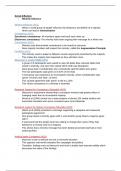
Minority Influence (AO1)
- Where a small group of people influence the behaviour and beliefs of a majority,
which can lead to internalisation
Consistency (AO1)
Synchronic consistency- All members agree and back each other up
Diachronic consistency- The minority have been arguing their message for a while now
Commitment (AO1)
- Minority must demonstrate commitment to be heard by everyone
- More majority members will respect the minority, called the Augmentation Principle
Flexibility (AO1)
- The minority need to adapt to different counter-arguments presented by the majority
- This makes the majority feel respected so they will listen more
Moscovici’s study (1969) (AO1)
- A group of 6 participants were asked to view 36 slides blue coloured slides that
varied in intensity, and were then asked which slide was blue/green
- Each group had 2 confederates who consistently said the slides were green
- The true participants said green on 8.42% of the trials
- A 2nd group was exposed to an inconsistent minority, where confederates said
‘green’ 24 times and ‘blue’ 12 times
- This caused agreement with ‘green’ to fall to 1.25%
- This shows consistency in a minority is essential
Research Support for Consistency (Strength) (AO3)
- Moscovici’s experiment showed that a consistent minority had greater effect of
changing views that an inconsistent majority
- Wood et al (1994) carried out a meta-analysis of almost 100 similar studies and
found that minorities who werre consistent were most influential
Research support for Deeper Processing (Strength) (AO3)
- Martin et al (2003) presented a message supporting a viewpoint and measured
participants agreement
- One group heard a minority agree with it, and another group heard a majority agree
with it
- It was found that the people were less willing to change their views if they had
listened to a minority and not a majority
- This shows that a minority message has been deeply processed and had a more
enduring effect
Artificial tasks (Limitation) (AO3)
- Moscovic’s task is artificial and not a real-world situation
- This opposes real-world examples like campaigns and politics
- Therefore, findings such as Mosocvici and Asch’s studies lack external validity which
decreases the value of the findings
- Minority Influence
Minority Influence (AO1)
- Where a small group of people influence the behaviour and beliefs of a majority,
which can lead to internalisation
Consistency (AO1)
Synchronic consistency- All members agree and back each other up
Diachronic consistency- The minority have been arguing their message for a while now
Commitment (AO1)
- Minority must demonstrate commitment to be heard by everyone
- More majority members will respect the minority, called the Augmentation Principle
Flexibility (AO1)
- The minority need to adapt to different counter-arguments presented by the majority
- This makes the majority feel respected so they will listen more
Moscovici’s study (1969) (AO1)
- A group of 6 participants were asked to view 36 slides blue coloured slides that
varied in intensity, and were then asked which slide was blue/green
- Each group had 2 confederates who consistently said the slides were green
- The true participants said green on 8.42% of the trials
- A 2nd group was exposed to an inconsistent minority, where confederates said
‘green’ 24 times and ‘blue’ 12 times
- This caused agreement with ‘green’ to fall to 1.25%
- This shows consistency in a minority is essential
Research Support for Consistency (Strength) (AO3)
- Moscovici’s experiment showed that a consistent minority had greater effect of
changing views that an inconsistent majority
- Wood et al (1994) carried out a meta-analysis of almost 100 similar studies and
found that minorities who werre consistent were most influential
Research support for Deeper Processing (Strength) (AO3)
- Martin et al (2003) presented a message supporting a viewpoint and measured
participants agreement
- One group heard a minority agree with it, and another group heard a majority agree
with it
- It was found that the people were less willing to change their views if they had
listened to a minority and not a majority
- This shows that a minority message has been deeply processed and had a more
enduring effect
Artificial tasks (Limitation) (AO3)
- Moscovic’s task is artificial and not a real-world situation
- This opposes real-world examples like campaigns and politics
- Therefore, findings such as Mosocvici and Asch’s studies lack external validity which
decreases the value of the findings