

The Market Mechanism (aka price mechanism)
LO: The rationing, incentive and signalling functions of prices in allocating resources
and coordinating the decisions of buyers and sellers in a market economy
Signalling function
• Price changes sends contrasting messages to consumers and producers about
whether to enter or to leave the market
o Rising prices signals to consumers to leave the market or reduce demand
o Rising prices signals to producers to enter the market
o Falling prices signals to consumers to enter the the market
o Falling prices signals to producers to leave the market
Incentive function
• An incentive is something that motivates a producer to follow a course of action
or to change behaviour. Price changes are that motivation
o Higher prices provide an incentive to existing producers to supply more
i.e. potentially more revenue and more profit
Rationing function
• Whenever resources are partially scare, demand exceeds supply and prices are
driven up, rationing demand for that resource
o Price rise discourages demand, conserves the resource, spreads use over
time i.e rationing the good
o The greater the scarcity, the higher the price, the more the resource is
rationed
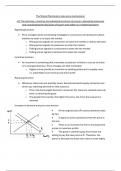
Increase in demand and price mechanism
• At the original price (P) excess demand exists
(Q-QD)
• A signal is sent to producers that the price is
too low
• There is an incentive for firm to increase their
prices to maximize profits
• The good is rationed away from those not
willing to pay the new price at P1. Therefore, the
petrol is allocated to those who value it most highly
LO: The rationing, incentive and signalling functions of prices in allocating resources
and coordinating the decisions of buyers and sellers in a market economy
Signalling function
• Price changes sends contrasting messages to consumers and producers about
whether to enter or to leave the market
o Rising prices signals to consumers to leave the market or reduce demand
o Rising prices signals to producers to enter the market
o Falling prices signals to consumers to enter the the market
o Falling prices signals to producers to leave the market
Incentive function
• An incentive is something that motivates a producer to follow a course of action
or to change behaviour. Price changes are that motivation
o Higher prices provide an incentive to existing producers to supply more
i.e. potentially more revenue and more profit
Rationing function
• Whenever resources are partially scare, demand exceeds supply and prices are
driven up, rationing demand for that resource
o Price rise discourages demand, conserves the resource, spreads use over
time i.e rationing the good
o The greater the scarcity, the higher the price, the more the resource is
rationed
Increase in demand and price mechanism
• At the original price (P) excess demand exists
(Q-QD)
• A signal is sent to producers that the price is
too low
• There is an incentive for firm to increase their
prices to maximize profits
• The good is rationed away from those not
willing to pay the new price at P1. Therefore, the
petrol is allocated to those who value it most highly


