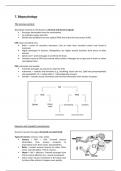
7. Biopsychology
The nervous system:
Specialised network of cells based on chemical and electrical signals
Processes information from the environment.
Co-ordinates organs and cells.
Divided into peripheral nervous system (PNS) and central nervous system (CNS).
CNS: brain and spinal cord
Brain = centre of conscious awareness. Has an outer layer (cerebral cortex) only found in
mammals.
Highly developed in humans; distinguishes our higher mental functions from those of other
animals.
Spinal cord = sends messages to and from the brain.
Connects nerves to PNS and controls reflex actions. Messages do not get sent to brain so action
can happen faster.
PNS: autonomic and somatic
Transmits messages via neurons to and from CNS.
Autonomic = controls vital functions (e.g., breathing, heart rate etc). Split into parasympathetic
and sympathetic. PS = resting state; S = physiologically aroused.
Somatic = controls muscle movement and receives information from sensory receptors.
NS
CNS PNS
BRAIN SPINAL AUTONOMIC SOMATIC
CORD
SYMPATHETIC PARASYMPATHETIC
Neurons and synaptic transmission:
Neurons transmit messages chemically and electrically.
Types of neurons: sensory, relay, motor Receptor Sensory neuron
Stimulus]
Sensory = PNS -> CNS. Transmit sensory Information
information from sensory receptors to relayed to
brain
brain/spinal cord. Short axons, long dendrites. Relay neuron Spinal cord
Relay = connect sensory neurons to motor. Short
axons, short dendrites. 97% of neurons.
Motor = CNS -> effectors. Transmit messages from
CNS to control effectors (i.e., muscle movement). Effector
Motor neuron
Some motor neurons terminate in the spinal cord
to allow reflex actions to happen more quickly.
, Location of neurons:
Sensory = PNS in clusters
called ganglia.
Relay = brain and visual
system.
Motor = CNS (cell body);
axons in PNS.
Neuron structure: <1mm-1m
Cell body includes
nucleus (contains genetic
material of cell).
Dendrites = send nerve
impulses towards cell
body (from nearby
neurons).
Axon = send nerve
impulses away from
body, down neuron (protected by myelin sheath – fatty layer with nodes of Ranvier to speed up
transmission of impulse.
End of axon = terminal button; communicates with next neuron across synapse.
Electrical transmission: firing a neuron
In its resting state, the inside of a cell is negatively charged, while the outside is positively
charged.
When activated by a stimulus, the inside becomes positively charged for a split second. This
causes action potential, and an electrical impulse is fired down the axon, to the end of the
neuron.
Synaptic transmission: neural network communication
Signals in neurons are electrically transmitted; Dendrite
between (in synapse) it is done chemically. Neurotransmitters
1. Neuron in resting state; inside is negatively
P-S receptor sites
charged.
2. Neuron activated by a stimulus and becomes
Electrical
positively charged for a split second. This fires Electrical
impulse
impulse
the electrical impulse down axon to pre-
synaptic terminal. Axon
3. This triggers release of neurotransmitters from
synaptic vesicles (sacs). Pre-synaptic
terminal
4. Neurotransmitters diffuse across synapse and
are taken up by the post-synaptic receptor sites
Synaptic vesicle
on P-S membrane (on the dendrites of the next
neuron). Different NTs have different structures Synapse
to fit into P-S receptor site (lock + key) and
have
specialist functions.
6. The chemical message is converted back into an electrical one and fired down the axon of the P-S
neuron.
7. NTs are broken down and reabsorbed by P-S neuron to be rebuilt and reused.
Excitation/inhibition:
NTs either have an excitatory or inhibitory effect on the neighbouring neuron.
Excitatory = receiving neuron will be more positively charged and more likely to fire (e.g.,
adrenaline).
The nervous system:
Specialised network of cells based on chemical and electrical signals
Processes information from the environment.
Co-ordinates organs and cells.
Divided into peripheral nervous system (PNS) and central nervous system (CNS).
CNS: brain and spinal cord
Brain = centre of conscious awareness. Has an outer layer (cerebral cortex) only found in
mammals.
Highly developed in humans; distinguishes our higher mental functions from those of other
animals.
Spinal cord = sends messages to and from the brain.
Connects nerves to PNS and controls reflex actions. Messages do not get sent to brain so action
can happen faster.
PNS: autonomic and somatic
Transmits messages via neurons to and from CNS.
Autonomic = controls vital functions (e.g., breathing, heart rate etc). Split into parasympathetic
and sympathetic. PS = resting state; S = physiologically aroused.
Somatic = controls muscle movement and receives information from sensory receptors.
NS
CNS PNS
BRAIN SPINAL AUTONOMIC SOMATIC
CORD
SYMPATHETIC PARASYMPATHETIC
Neurons and synaptic transmission:
Neurons transmit messages chemically and electrically.
Types of neurons: sensory, relay, motor Receptor Sensory neuron
Stimulus]
Sensory = PNS -> CNS. Transmit sensory Information
information from sensory receptors to relayed to
brain
brain/spinal cord. Short axons, long dendrites. Relay neuron Spinal cord
Relay = connect sensory neurons to motor. Short
axons, short dendrites. 97% of neurons.
Motor = CNS -> effectors. Transmit messages from
CNS to control effectors (i.e., muscle movement). Effector
Motor neuron
Some motor neurons terminate in the spinal cord
to allow reflex actions to happen more quickly.
, Location of neurons:
Sensory = PNS in clusters
called ganglia.
Relay = brain and visual
system.
Motor = CNS (cell body);
axons in PNS.
Neuron structure: <1mm-1m
Cell body includes
nucleus (contains genetic
material of cell).
Dendrites = send nerve
impulses towards cell
body (from nearby
neurons).
Axon = send nerve
impulses away from
body, down neuron (protected by myelin sheath – fatty layer with nodes of Ranvier to speed up
transmission of impulse.
End of axon = terminal button; communicates with next neuron across synapse.
Electrical transmission: firing a neuron
In its resting state, the inside of a cell is negatively charged, while the outside is positively
charged.
When activated by a stimulus, the inside becomes positively charged for a split second. This
causes action potential, and an electrical impulse is fired down the axon, to the end of the
neuron.
Synaptic transmission: neural network communication
Signals in neurons are electrically transmitted; Dendrite
between (in synapse) it is done chemically. Neurotransmitters
1. Neuron in resting state; inside is negatively
P-S receptor sites
charged.
2. Neuron activated by a stimulus and becomes
Electrical
positively charged for a split second. This fires Electrical
impulse
impulse
the electrical impulse down axon to pre-
synaptic terminal. Axon
3. This triggers release of neurotransmitters from
synaptic vesicles (sacs). Pre-synaptic
terminal
4. Neurotransmitters diffuse across synapse and
are taken up by the post-synaptic receptor sites
Synaptic vesicle
on P-S membrane (on the dendrites of the next
neuron). Different NTs have different structures Synapse
to fit into P-S receptor site (lock + key) and
have
specialist functions.
6. The chemical message is converted back into an electrical one and fired down the axon of the P-S
neuron.
7. NTs are broken down and reabsorbed by P-S neuron to be rebuilt and reused.
Excitation/inhibition:
NTs either have an excitatory or inhibitory effect on the neighbouring neuron.
Excitatory = receiving neuron will be more positively charged and more likely to fire (e.g.,
adrenaline).