These materials are the intellectual property of Lotus Mohammad and are for personal use only. Any reproduction,
distribution, or sharing without explicit written permission is strictly prohibited.
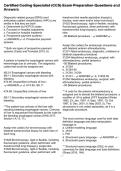
Detailed 16 marker plans for Memory (Paper 1)
Describe and evaluate research into coding, capacity and duration of the short-term
memory (16)
AO1
S- Coding is the format in which information is stored
E- In the short term memory, information is stored acoustically, meaning based on being audibly
om
similar - This was concluded from Baddley 1966 who tested memory recall in different word
conditions
AO1
l.c
S- Capacity is how much information the memory can store
E- The short term memory has a limited capacity of 2+/- 7 items - This was concluded from
Miller 1956 who hypothesised chucking as the reason for this capacity
ai
AO1 gm
S- Duration is how long the information is held in the memory store
E- The short term memory has a duration of 18-30 seconds, after which, information is either
discarded or transferred to the long term memory - This was concluded from Peterson and
Peterson, who tested memory of syllables
@
AO3
P- One strength of capacity in particular is supporting evidence.
72
E- For instance, Jacobs 1887 did the digit span test to understand how many digits a person
can remember with no rehearsal (short term memory), he found that on average, the capacity
ct
for digits was 9.3 items, and for letters, the span was 7.3.
E- This is a strength as his findings are within the range of Miller’s conclusions of capacity being
+/- 7 items, increasing the reliability of Miller’s conclusions as the values are repeatable, and
so
increasing the overall validity.
L- Therefore, the fact that the capacity of the short term memory is +/- 7 is deemed accurate
tu
and valid due to Miller’s study having strong overall validity and reliability.
AO3
lo
P- However, a weakness of Baddley’s coding conclusion is methodological issues
E- For example, his use of random, meaningless word lists means that he used artificial stimuli,
also, the task itself is quite artificial as it does not reflect real life tasks.
E- This means that the ecological validity of his study decreases as the task lacks mundane
realism, making the conclusions of the short term’s coding being acoustic is less generalisable.
L- Thus, findings from this study have limited validity, so are less credible when explaining
coding of the short term memory, and this study has limited application, so is less useful in
studying aspects of the short term memory
distribution, or sharing without explicit written permission is strictly prohibited.
Detailed 16 marker plans for Memory (Paper 1)
Describe and evaluate research into coding, capacity and duration of the short-term
memory (16)
AO1
S- Coding is the format in which information is stored
E- In the short term memory, information is stored acoustically, meaning based on being audibly
om
similar - This was concluded from Baddley 1966 who tested memory recall in different word
conditions
AO1
l.c
S- Capacity is how much information the memory can store
E- The short term memory has a limited capacity of 2+/- 7 items - This was concluded from
Miller 1956 who hypothesised chucking as the reason for this capacity
ai
AO1 gm
S- Duration is how long the information is held in the memory store
E- The short term memory has a duration of 18-30 seconds, after which, information is either
discarded or transferred to the long term memory - This was concluded from Peterson and
Peterson, who tested memory of syllables
@
AO3
P- One strength of capacity in particular is supporting evidence.
72
E- For instance, Jacobs 1887 did the digit span test to understand how many digits a person
can remember with no rehearsal (short term memory), he found that on average, the capacity
ct
for digits was 9.3 items, and for letters, the span was 7.3.
E- This is a strength as his findings are within the range of Miller’s conclusions of capacity being
+/- 7 items, increasing the reliability of Miller’s conclusions as the values are repeatable, and
so
increasing the overall validity.
L- Therefore, the fact that the capacity of the short term memory is +/- 7 is deemed accurate
tu
and valid due to Miller’s study having strong overall validity and reliability.
AO3
lo
P- However, a weakness of Baddley’s coding conclusion is methodological issues
E- For example, his use of random, meaningless word lists means that he used artificial stimuli,
also, the task itself is quite artificial as it does not reflect real life tasks.
E- This means that the ecological validity of his study decreases as the task lacks mundane
realism, making the conclusions of the short term’s coding being acoustic is less generalisable.
L- Thus, findings from this study have limited validity, so are less credible when explaining
coding of the short term memory, and this study has limited application, so is less useful in
studying aspects of the short term memory