NR577 Midterm Exam Study Guide
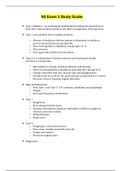
Week 1: Health Promotion for Adolescents and Adults ▪ Principles of primary care-Two most important outcomes of primary care – Reduction of risk factors & mortality rates in vulnerable populations. Primary care focuses on -Health Promotion- Prevention of illness- Management of those who become sick- Advocacy for all patients- Community involvement. Primary care should be -accountable; acceptable; appropriate; continuous; accessible; affordable; adequate; complete; available ▪ Adolescence- is a period when individuals pass from childhood into adulthood. 1. Goals of adolescence-Completion of puberty & growth- social, emotional & cognitive development- development of abstract thinking; establishment of independent identity- preparation for career or life work. 2. Bright Futures- Tool resource kit, includes core forms, supplemental visit documentation forms, screening tools, and supplemental educational handouts. Materials are broken down by age so that documentation and assessments are appropriate to age and development. Guidelines for Health supervision of infants, children and adolescents, available to providers 3. Morbidity and mortality- Morbidity- any physical or psychological state considered to be outside the realm of normal well-being. Mortality- The state of being subject to death. ▪ Adolescent assessments 1. Tanner Stages for Males and Females – STAGES FEMALE BOTH MALE STAGE I NO BREAST NO PUBIC HAIR NO GENITAL GROWTH STAGE II BREAST BUDDING DOWNY HAIR Enlarged of testes and increased scrotal pigmentation STAGE III Enlarged of areola and breast tissue Scant hair; increase in amount and pigment Enlarged of penis and testes STAGE IV Separation of areola and nipple from breast mound; most girls experience menarche Adult type; incomplete distribution Elongation of penis and enlargement of testes; development of axillary and facial hair STAGE V Fully developed breast; single breast contour with nipple protrusion Adult distribution Adult size; increase in body and facial hair; increase in muscle 2 | P a g e D= Drugs; 2. HEADSS assessment- An interview approach used to quickly obtain historical psychosocial data from an adolescent. H=Home environment; E= Education/employment; A= Activities; S= Sexuality/ Suicide/ Depression; S= Safety ▪ Health promotion for adolescents and adults 1. Vaccines-An immunization is a suspension of microorganism that can be inactivated, partially inactivated, or attenuated. The purpose is to create an antigen-antibody response within the body for recognition in future exposure and either reduced disease or no disease symptoms. 2. Screen guidelines- Screen guidelines: a. Screening Guidelines for men and women ages 13-64: The U.S. Preventive Services Task Force (USPSTF) and Centers for Disease Control and Prevention (CDC) provide guidelines for preventive health screenings for men and women ages 13 to 64. These guidelines may include: Blood pressure screening Cholesterol screening Colorectal cancer screening Diabetes screening HIV testing Lung cancer screening (for current or former smokers) Depression screening It's important to note that screening recommendations may vary based on individual risk factors, such as age, family history, lifestyle, and personal health history. b. Immunizations for patients ages 13-64: The CDC recommends that all individuals ages 13 to 64 receive certain immunizations to protect against vaccine-preventable diseases. These may include: Influenza (flu) vaccine Tetanus, diphtheria, and pertussis (Tdap) vaccine Human papillomavirus (HPV) vaccine Measles, mumps, and rubella (MMR) vaccine Herpes zoster (shingles) vaccine Meningococcal vaccine Again, immunization recommendations may vary based on individual risk factors and previous vaccination history. It is important to discuss with your healthcare provider what immunizations are right for you. Week 2: Reproductive Health Part 1 3 | P a g e ACOG Clinical Practice Guidelines: Sexual History: The American College of Obstetricians and Gynecologists (ACOG) recommends that healthcare providers take a comprehensive sexual history from all patients, regardless of age or sexual orientation. This includes information about the patient's sexual partners, contraception use, sexually transmitted infections (STIs), and any sexual health concerns. A sexual history can help identify potential health risks and inform screening and preventive measures. Pap Smear: A Pap smear, also known as a Pap test, is a screening test for cervical cancer. The ACOG recommends that women start getting Pap smears at age 21 and continue to get tested regularly, depending on their age and individual risk factors. Women under the age of 30 are typically tested every three years, while women over the age of 30 may only need to be tested every five years if they have had three consecutive normal test results and no history of cervical cancer or high-risk human papillomavirus (HPV). It is important to note that the frequency of Pap smears may vary based on individual risk factors, and women should discuss their specific needs with their healthcare provider. The ACOG also recommends that women over the age of 65 with three or more normal Pap test results and no history of cervical cancer may stop getting Pap smears if they have not been vaccinated against HPV. ▪ Contraceptives- ORAL, condoms, hormonal ring, IUD, Contraceptive injections, implant, patch ▪ Pregnancy- 1-7 weeks -leg buds-heart forms- arms spinal cord & brain appear. Presumptive signs: changes experienced b pt that leads to suspicion of pregnancy. Probable signs: changes seen on physical exam that leads to suspicion of pregnancy. Positive signs: signs that only explained by pregnancy, 1. Pregnancy Naegele’s Rule- Estimated date od delivery- Add seven days to last menstrual period, subtract three months and add one year. EXAMPLE: LMP- AUGUST 10TH, 2019 =AUGUST 17TH 2019- THREE MONTHS, = MAY 17, 2019 PLUS ONE YEAR = 5/17/2020 ▪ Infertility- is defined as being unable to become pregnant within one year of regular and unprotected intercourse. Causes of infertility may be hormonal, mechanical, or structural. ▪ Mechanical: abnormal/ insufficient sperm; abnormal /insufficient eggs. Hormonal: Anovulation resulting from low progesterone-Abnormal hypothalamus-hypothyroidism-hyperprolactinemia; Structural: uterine fibroids-vaginal septum-adhesions-scarred/absent fallopian tubes. ▪ Polycystic Ovarian Syndrome (PCOS)-An Endocrine disorder that causes enlarged ovaries and ovarian cysts. Approximately 5-10% of women of child bearing age are affected by PCOS. Hypothesis include: insulin resistance-low grade inflammation-heredity-excess androgen-low estrogen. ▪ Amenorrhea -Absence of a menstrual period. Classified as primary or secondary 1. Diagnosis: A diagnosis of amenorrhea typically involves a medical history and physical examination, as well as tests to measure hormone levels, such as follicle-stimulating 4 | P a g e hormone (FSH) and luteinizing hormone (LH), and possibly imaging tests such as ultrasound. 2. Treatment: The treatment of amenorrhea depends on the underlying cause. Hormonal imbalances can be treated with medications, such as hormonal contraceptives or hormone replacement therapy. Structural problems, such as uterine fibroids or uterine anomalies, may require surgery. 3. Management: Lifestyle changes, such as reducing stress and maintaining a healthy weight, may help regulate menstrual cycles. For women with amenorrhea due to overexercise or low body weight, treatment may involve increasing caloric intake and reducing exercise levels. Women with amenorrhea should also use contraception to prevent pregnancy, as their menstrual cycles may not return for several months or longer. Bacterial Vaginosis (BV) is a common vaginal infection caused by an overgrowth of bacteria in the vagina. Diagnosis: BV is diagnosed through a physical examination, including a vaginal pH test, and microscopic examination of vaginal discharge. Treatment: BV can be treated with antibiotics, such as metronidazole or clindamycin, either orally or vaginally. Management: To reduce the risk of recurrence of BV, it is important to practice good hygiene, avoid douching, and use condoms during sexual activity. Women who have BV should avoid using scented hygiene products and change out of wet clothing as soon as possible. Additionally, it is important to complete the full course of antibiotics as prescribed, even if symptoms have improved. Dysfunctional Uterine Bleeding (DUB): is a condition characterized by irregular or heavy menstrual bleeding, which can occur due to hormonal imbalances. Diagnosis: DUB is diagnosed through a medical history, physical examination, and laboratory tests to measure hormone levels and rule out other causes of abnormal bleeding. Treatment: Treatment for DUB typically involves hormone therapy, such as oral contraceptives or progestin therapy, to regulate the menstrual cycle and reduce bleeding. In severe cases, a hysterectomy (surgical removal of the uterus) may be necessary. Management: To manage symptoms of DUB, women can use over-the-counter pain relievers, wear pads or tampons, and avoid using tampons overnight. Women with DUB should also maintain a healthy lifestyle, including a balanced diet and regular exercise, and reduce stress. It is important to follow up regularly with a healthcare provider to monitor the effectiveness of treatment and make any necessary adjustments.
Written for
- Institution
- Chamberlain College Of Nursing
- Module
- NR 577/ NR577
Document information
- Uploaded on
- March 25, 2025
- Number of pages
- 9
- Written in
- 2024/2025
- Type
- Exam (elaborations)
- Contains
- Questions & answers
Subjects
-
nr577
-
nr577 midterm exam study guide