Price determination in a competitive market
The determinants of the demand for goods and services
Demand is the quantity consumers are able + willing to buy at a given price.
Demand varies with price.
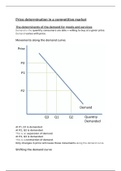
Movements along the demand curve:
At P1, Q1 is demanded.
At P2, Q2 is demanded.
This is an expansion of demand.
At P3, Q3 is demanded.
This is a contraction of demand.
Only changes in price will cause these movements along the demand curve.
Shifting the demand curve
,Price changes don’t shift the demand curve.
A shift from D1 to D2 is an inward shift in demand. Less is demanded at P1.
A shift from D1 to D3 is an outward shift in demand. More is demanded at
P1.
Factors that shift the demand curve
PIRATES:
P- Population
● Larger population - more demand
● Population structure e.g. ageing population affects demand.
I- Income
● More disposable income - afford more goods - more demand
● A consumer’s wealth affects their demand - spend more as wealth
increases
R- Related goods
● Substitutes can replace a good. If the price of the substitute falls, the
demand of the original good falls
● A complement goes with another good. If the price of strawberries
increases, demand for cream falls
, A- Advertising
● This will increase consumer loyalty and demand
T- Tastes and fashions
● E.g. demand falls for physical books as consumers prefer e-books
E- Expectations
● This is of future price changes
● If shares are expected to increase, demand is likely to increase
S- Seasons
● E.g. summer - demand for ice cream increases
Diminishing marginal utility:
As an extra unit is consumed, the marginal utility i.e. the benefit derived
from consuming the good, falls. Therefore, consumers are willing to pay
less for the good. Eventually the utility derived will become zero.
Prices, incomes and cross elasticities of demand
Price elasticity of demand
The responsiveness of a change in demand to a change in price.
A price elastic good is very responsive. The change in price leads to an even
bigger change in demand. PED is >1.
The determinants of the demand for goods and services
Demand is the quantity consumers are able + willing to buy at a given price.
Demand varies with price.
Movements along the demand curve:
At P1, Q1 is demanded.
At P2, Q2 is demanded.
This is an expansion of demand.
At P3, Q3 is demanded.
This is a contraction of demand.
Only changes in price will cause these movements along the demand curve.
Shifting the demand curve
,Price changes don’t shift the demand curve.
A shift from D1 to D2 is an inward shift in demand. Less is demanded at P1.
A shift from D1 to D3 is an outward shift in demand. More is demanded at
P1.
Factors that shift the demand curve
PIRATES:
P- Population
● Larger population - more demand
● Population structure e.g. ageing population affects demand.
I- Income
● More disposable income - afford more goods - more demand
● A consumer’s wealth affects their demand - spend more as wealth
increases
R- Related goods
● Substitutes can replace a good. If the price of the substitute falls, the
demand of the original good falls
● A complement goes with another good. If the price of strawberries
increases, demand for cream falls
, A- Advertising
● This will increase consumer loyalty and demand
T- Tastes and fashions
● E.g. demand falls for physical books as consumers prefer e-books
E- Expectations
● This is of future price changes
● If shares are expected to increase, demand is likely to increase
S- Seasons
● E.g. summer - demand for ice cream increases
Diminishing marginal utility:
As an extra unit is consumed, the marginal utility i.e. the benefit derived
from consuming the good, falls. Therefore, consumers are willing to pay
less for the good. Eventually the utility derived will become zero.
Prices, incomes and cross elasticities of demand
Price elasticity of demand
The responsiveness of a change in demand to a change in price.
A price elastic good is very responsive. The change in price leads to an even
bigger change in demand. PED is >1.