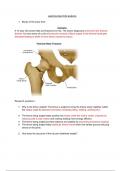
Muscles of the lower limb
Scenario:
A runner complains of a weak hip abduction and a Trendelenburg gait. You suspect gluteus
medius weakness
Research Questions:
1. Why is the lower limb divided into compartments?
The lower limb is divided into compartments to organize the muscles, nerves and blood vessels
efficiently while allowing specialized functions.
● Functional grouping of the muscles - Each compartment contains muscles with similar
actions and nerve supply making movement more efficient. For example the anterior
compartment of the leg contains the dorsiflexors e.g tibialis anterior while the posterior
compartment contains the plantarflexors e.g gastrocnemius
● Efficient blood supply and intervention - Each compartment has a dedicated artery vein
and nerve ensuring proper circulation and neural control
● Structural stability- The fascia surrounding compartments reduces friction between the
muscles allowing smooth movement
● Prevention from infection and injury spread- The compartment barriers limit spread of
infections or bleeding by helping localize damage
● Clinical significance - Compartment syndrome - The right ridged fascia can sometimes
trap swelling or bleeding increasing pressure and compromising blood flow leading to
compartment syndrome which requires urgent treatment.
, Which muscles control hip movements?
The hip joint allows for a wide range of movements controlled by several groups:
● Hip flexion (Bringing the thigh forward
primary : ILiopsoas (psoas major, iliacus)
Assistants : Rectus femoris, sartorius, tensor fasciae latae (TFL) pectineus
Scenario:
A runner complains of a weak hip abduction and a Trendelenburg gait. You suspect gluteus
medius weakness
Research Questions:
1. Why is the lower limb divided into compartments?
The lower limb is divided into compartments to organize the muscles, nerves and blood vessels
efficiently while allowing specialized functions.
● Functional grouping of the muscles - Each compartment contains muscles with similar
actions and nerve supply making movement more efficient. For example the anterior
compartment of the leg contains the dorsiflexors e.g tibialis anterior while the posterior
compartment contains the plantarflexors e.g gastrocnemius
● Efficient blood supply and intervention - Each compartment has a dedicated artery vein
and nerve ensuring proper circulation and neural control
● Structural stability- The fascia surrounding compartments reduces friction between the
muscles allowing smooth movement
● Prevention from infection and injury spread- The compartment barriers limit spread of
infections or bleeding by helping localize damage
● Clinical significance - Compartment syndrome - The right ridged fascia can sometimes
trap swelling or bleeding increasing pressure and compromising blood flow leading to
compartment syndrome which requires urgent treatment.
, Which muscles control hip movements?
The hip joint allows for a wide range of movements controlled by several groups:
● Hip flexion (Bringing the thigh forward
primary : ILiopsoas (psoas major, iliacus)
Assistants : Rectus femoris, sartorius, tensor fasciae latae (TFL) pectineus