Learning lower limb anatomy
1. Bones of the lower limb
Scenario:
A 70 year old woman falls and fractures her hip. The doctor diagnoses a femoral neck fracture
(broken hip) and warns of a risk of avascular necrosis ( Blood supply to the femoral head gets
disrupted leading to death of bone tissue caused by injury)
Research questions :
1. Why is the femur angled? The femur is angled to bring the knees closer together called
the Valgus angle to optimize locomotion (crawling,rolling, walking, climbing etc) :
● The femur being angled helps position the knees under the body’s center of gravity by
reducing side to side motion and making walking more energy efficient.
● The femur being angled provides balance and stability by preventing excessive swaying
● The femur being angled helps distribute forces evenly when foot strikes ground reducing
stress on the joints.
2. How does the structure of the hip joint distribute weight?
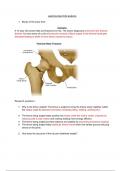
, ● The hip joint distributes weight with the acetabulum and femoral head alignment. The
acetabulum (hip socket) is deep cup shaped allowing the femoral head (ball) to fit
securely
This design spreads weight evenly across the
joint surface reducing stress on any single point.
● The hip joint distributes weight with the cartilage and synovial fluid (lubricant found in
joints) for shock absorption.
The articular cartilage covering the femoral head and acetabulum helps absorb impact and
reduce friction. The synovial fluid lubricates the joint allowing smooth movement and further
distributing forces.
, ● The structure of the hip joint distributes weight with the trabecular bone structure for load
and distribution
Inside the femoral head and neck the trabecular (spongy) bone is arranged in a pattern that
resists compression forces. This structure channels weight efficiently from the pelvis down to the
femur
1. Bones of the lower limb
Scenario:
A 70 year old woman falls and fractures her hip. The doctor diagnoses a femoral neck fracture
(broken hip) and warns of a risk of avascular necrosis ( Blood supply to the femoral head gets
disrupted leading to death of bone tissue caused by injury)
Research questions :
1. Why is the femur angled? The femur is angled to bring the knees closer together called
the Valgus angle to optimize locomotion (crawling,rolling, walking, climbing etc) :
● The femur being angled helps position the knees under the body’s center of gravity by
reducing side to side motion and making walking more energy efficient.
● The femur being angled provides balance and stability by preventing excessive swaying
● The femur being angled helps distribute forces evenly when foot strikes ground reducing
stress on the joints.
2. How does the structure of the hip joint distribute weight?
, ● The hip joint distributes weight with the acetabulum and femoral head alignment. The
acetabulum (hip socket) is deep cup shaped allowing the femoral head (ball) to fit
securely
This design spreads weight evenly across the
joint surface reducing stress on any single point.
● The hip joint distributes weight with the cartilage and synovial fluid (lubricant found in
joints) for shock absorption.
The articular cartilage covering the femoral head and acetabulum helps absorb impact and
reduce friction. The synovial fluid lubricates the joint allowing smooth movement and further
distributing forces.
, ● The structure of the hip joint distributes weight with the trabecular bone structure for load
and distribution
Inside the femoral head and neck the trabecular (spongy) bone is arranged in a pattern that
resists compression forces. This structure channels weight efficiently from the pelvis down to the
femur