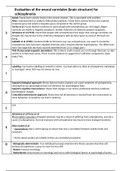
Evaluation of the neural correlates (brain structure) for
schizophrenia
Juckel: Found lower activity levels in the ventral striatum. This is associated with avolition.
Allen: Scanned brains of auditory hallucination patients. Found lower activity levels in the superior
temporal gyrus and anterior cingulate gyrus compared to the control group.
Torrey et al: Found that the ventricles of some people with schizophrenia are 15% bigger. Bigger
ventricles are linked to negative symptoms. Smaller ventricles are linked to positive symptoms.
S Johnstone et al (1976): Found that people with schizophrenia have larger than average ventricles. He
thought this may be due to the ventricles enlarging to take up extra space as areas of the brain are
dying.
Suddath et al (1990): Conducted MRI on MZ twins (one was schizophrenia, one wasn’t). Found the
schizophrenic twin had more enlarged ventricles and a reduced anterior hypothalamus. The differences
were very large that the twins could be identified from 12/15 image pairs
TMS (Transcranial magnetic simulation): This is where small currents are run through the brain, to alter
activity in certain brain areas. There is some evidence to suggest this is effective compared to sham
P (fake) TMS.
Labelling: Can lead to labelling of oneself or others. Can lead others to think of schizophrenic individuals
as ‘damaged’ when that may not always be true.
I
Supports biological approach: Shows that our brains anatomy can cause symptoms of schizophrenia,
showing that our physiological state can influence our psychological state.
Supports cognitive neuroscience: Shows that changes in our brains anatomical structure produces
A psychological changes.
Contradicts behaviourist approach: Shows that not all behaviour is learned from the environment as
some behaviour is caused by our brain’s anatomy
N/A
C
Johnstone et al/Torry et al:
✘Correlation/causation: Enlarged ventricles may be a result of suffering from schizophrenia, and not a
cause of schizophrenia. And not everyone with schizophrenia was found to have enlarged ventricles.
Allen/Juckel et al:
E ✔Standardised: Had a control group to ensure that was a correlation between activity levels and
symptoms
✔All the above studies are reliable as they use controlled procedures
D - Biologically deterministic: If an individual has large ventricles this theory assumes that they will
develop schizophrenia. Leaves no room for free will
- Nature: Focuses on biology
- Reductionist: Only focuses on neurology and not on other biological factors or psychological factors
schizophrenia
Juckel: Found lower activity levels in the ventral striatum. This is associated with avolition.
Allen: Scanned brains of auditory hallucination patients. Found lower activity levels in the superior
temporal gyrus and anterior cingulate gyrus compared to the control group.
Torrey et al: Found that the ventricles of some people with schizophrenia are 15% bigger. Bigger
ventricles are linked to negative symptoms. Smaller ventricles are linked to positive symptoms.
S Johnstone et al (1976): Found that people with schizophrenia have larger than average ventricles. He
thought this may be due to the ventricles enlarging to take up extra space as areas of the brain are
dying.
Suddath et al (1990): Conducted MRI on MZ twins (one was schizophrenia, one wasn’t). Found the
schizophrenic twin had more enlarged ventricles and a reduced anterior hypothalamus. The differences
were very large that the twins could be identified from 12/15 image pairs
TMS (Transcranial magnetic simulation): This is where small currents are run through the brain, to alter
activity in certain brain areas. There is some evidence to suggest this is effective compared to sham
P (fake) TMS.
Labelling: Can lead to labelling of oneself or others. Can lead others to think of schizophrenic individuals
as ‘damaged’ when that may not always be true.
I
Supports biological approach: Shows that our brains anatomy can cause symptoms of schizophrenia,
showing that our physiological state can influence our psychological state.
Supports cognitive neuroscience: Shows that changes in our brains anatomical structure produces
A psychological changes.
Contradicts behaviourist approach: Shows that not all behaviour is learned from the environment as
some behaviour is caused by our brain’s anatomy
N/A
C
Johnstone et al/Torry et al:
✘Correlation/causation: Enlarged ventricles may be a result of suffering from schizophrenia, and not a
cause of schizophrenia. And not everyone with schizophrenia was found to have enlarged ventricles.
Allen/Juckel et al:
E ✔Standardised: Had a control group to ensure that was a correlation between activity levels and
symptoms
✔All the above studies are reliable as they use controlled procedures
D - Biologically deterministic: If an individual has large ventricles this theory assumes that they will
develop schizophrenia. Leaves no room for free will
- Nature: Focuses on biology
- Reductionist: Only focuses on neurology and not on other biological factors or psychological factors