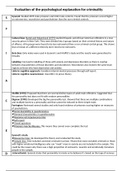
Evaluation of the psychological explanation for criminality
Eysenck: Studied 2070 male prisoners and 2422 male controls. Found that the prisoners scored higher
S on extraversion, neuroticism and psychoticism than the non-criminal controls.
P
Cultural bias: Bartol and Holanchock (1979) studied Hispanic and African-American offenders in a max
security prison in New York. They were divided into 6 groups based on their criminal history and nature
of offence. All 6 groups were found to be less extraverted than a non criminal control group. This shows
that criminals of a different ethnicity don’t tend to be extroverts
I Beta bias: Only males were used in Eysenck’s and Moffitt’s study and the results were generalised to
females.
Labelling: Can lead to labelling of those with anxiety and depressive disorders as there is overlap
between characteristics of those disorders and neuroticism. Neuroticism also involves the same brain
regions as those who have depression and anxiety.
Links to cognitive approach: Considers internal mental processes through self report.
Links to cognitive neuroscience: Uses EEG’s to prove theory.
A
Moffitt (1993): Proposed that there are several distinct types of adult male offenders. Suggested that
the personality test does not fit with modern personalities
Digman (1990): Developed the big five personality test. Showed that there are multiple combinations
C and multiple facets to a personality and that cannot be reduced to three simple traits
Farrington: Reviewed several studies and only found evidence of prisoners scoring higher on measures
of psychoticism.
✘Social desirability in questionnaires
✘Demand characteristics in questionnaires
✘Response set/acquiescence bias
✘Self-report
✘Closed questions
✘Prisoners may be illiterate: This means they cannot even complete the test
E
Eysenck’s study
✘Researcher bias: He developed the theory and conducted the study
✘Sample bias: Only included convicted criminals in prison. Means that more secluded criminals or those
with higher emotional intelligence who can “mask” more in society are not included in the sample. This
could be the reason why there was a high proportion of extroverts, neurotic and emotionally immature
people in the sample.
D -Interactionist: Eysenck states that personality is innate as he believes it’s based on the type of nervous
Eysenck: Studied 2070 male prisoners and 2422 male controls. Found that the prisoners scored higher
S on extraversion, neuroticism and psychoticism than the non-criminal controls.
P
Cultural bias: Bartol and Holanchock (1979) studied Hispanic and African-American offenders in a max
security prison in New York. They were divided into 6 groups based on their criminal history and nature
of offence. All 6 groups were found to be less extraverted than a non criminal control group. This shows
that criminals of a different ethnicity don’t tend to be extroverts
I Beta bias: Only males were used in Eysenck’s and Moffitt’s study and the results were generalised to
females.
Labelling: Can lead to labelling of those with anxiety and depressive disorders as there is overlap
between characteristics of those disorders and neuroticism. Neuroticism also involves the same brain
regions as those who have depression and anxiety.
Links to cognitive approach: Considers internal mental processes through self report.
Links to cognitive neuroscience: Uses EEG’s to prove theory.
A
Moffitt (1993): Proposed that there are several distinct types of adult male offenders. Suggested that
the personality test does not fit with modern personalities
Digman (1990): Developed the big five personality test. Showed that there are multiple combinations
C and multiple facets to a personality and that cannot be reduced to three simple traits
Farrington: Reviewed several studies and only found evidence of prisoners scoring higher on measures
of psychoticism.
✘Social desirability in questionnaires
✘Demand characteristics in questionnaires
✘Response set/acquiescence bias
✘Self-report
✘Closed questions
✘Prisoners may be illiterate: This means they cannot even complete the test
E
Eysenck’s study
✘Researcher bias: He developed the theory and conducted the study
✘Sample bias: Only included convicted criminals in prison. Means that more secluded criminals or those
with higher emotional intelligence who can “mask” more in society are not included in the sample. This
could be the reason why there was a high proportion of extroverts, neurotic and emotionally immature
people in the sample.
D -Interactionist: Eysenck states that personality is innate as he believes it’s based on the type of nervous