
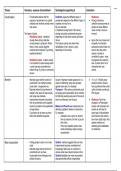
Theory Summary - purpose of punishment Sociologists supporting it Evaluation
Functionalism - Functionalists believe that the Durkheim argues that different types of Weakness:
purpose of punishment is to uphold punishments depend on the different ‘types’ of ● Wrong to assume a
solidarity and reinforce societal norms societies one may live in. collective consciousness as
and values. My own example: people can have different
In traditional society before 19th century views of what is moral or
Two types of justice: stoning and public punishment was given immoral.
- Retributive justice - traditional depending on that certain society and times
society where strong collective Versus ● Ignore the role of power and
consciousness is produced. Where The modern society now where fines, inequality. Functionalist
there is crime, society together rehabilitation, time in prison is given perspective doesn't take into
punishes the wrongdoer. E.g stoning, depending on this society account how the justice
capital punishment system in society is
controlled by upper - class
- Restitutive justice - modern society. bourgeoisie who make the
It is important to repair damage when laws. It allows them not to
a crime has been committed and criminalise their own
restore things. E.g fines or community actions.
service
Marxism - Marxists argue that the function of As part of repressive state apparatus it is a ● Strength: Working class
punishment is to maintain existing means of defending ruling class property people do tend to receive
social order - bourgeoisie rule. against lower class. For example: more punishment than white
- Marxists believe that punishment is Thompson - 18th century punishments such collar criminals according to
related to the nature of class society as hanging and transportation to the colonies PRC figures
and ruling class interests. for theft and poaching were part of the rule of
- Imprisonment becomes a dominant terror by aristocracy over the poor. ● Weakness: Much has
form of punishment as the capitalist changed in a Postmodern
economy is based on the exploitation Melossi and Pavarini see imprisonment as society- both prisoners and
of wage labour. reflecting capitalism relations of production. workers do not face the
E.g prisons can be seen as prison For example: same type of subordination
labour that benefits bourgeoise - Capitalism puts a price on workers' and prisoners and workers
time do prisoners ‘do time’ to pay for have more rights today. Also
their crime. greater emphasis on
- Prison and capitalist system have wellbeing and rehabilitation
similar disciplinary styles involving not retribution
subordination
Mass incarceration - Putting people in prison on a mass Garland - Garland suggests that over time,
scale imprisonment becomes normalised and
- Marxists argue that some forms of increasingly relied upon as a solution to
punishment such as mass various social issues beyond serious crime.
incarceration have ideological and Garland highlights how mass incarceration
political functions. disproportionately affects marginalised
Functionalism - Functionalists believe that the Durkheim argues that different types of Weakness:
purpose of punishment is to uphold punishments depend on the different ‘types’ of ● Wrong to assume a
solidarity and reinforce societal norms societies one may live in. collective consciousness as
and values. My own example: people can have different
In traditional society before 19th century views of what is moral or
Two types of justice: stoning and public punishment was given immoral.
- Retributive justice - traditional depending on that certain society and times
society where strong collective Versus ● Ignore the role of power and
consciousness is produced. Where The modern society now where fines, inequality. Functionalist
there is crime, society together rehabilitation, time in prison is given perspective doesn't take into
punishes the wrongdoer. E.g stoning, depending on this society account how the justice
capital punishment system in society is
controlled by upper - class
- Restitutive justice - modern society. bourgeoisie who make the
It is important to repair damage when laws. It allows them not to
a crime has been committed and criminalise their own
restore things. E.g fines or community actions.
service
Marxism - Marxists argue that the function of As part of repressive state apparatus it is a ● Strength: Working class
punishment is to maintain existing means of defending ruling class property people do tend to receive
social order - bourgeoisie rule. against lower class. For example: more punishment than white
- Marxists believe that punishment is Thompson - 18th century punishments such collar criminals according to
related to the nature of class society as hanging and transportation to the colonies PRC figures
and ruling class interests. for theft and poaching were part of the rule of
- Imprisonment becomes a dominant terror by aristocracy over the poor. ● Weakness: Much has
form of punishment as the capitalist changed in a Postmodern
economy is based on the exploitation Melossi and Pavarini see imprisonment as society- both prisoners and
of wage labour. reflecting capitalism relations of production. workers do not face the
E.g prisons can be seen as prison For example: same type of subordination
labour that benefits bourgeoise - Capitalism puts a price on workers' and prisoners and workers
time do prisoners ‘do time’ to pay for have more rights today. Also
their crime. greater emphasis on
- Prison and capitalist system have wellbeing and rehabilitation
similar disciplinary styles involving not retribution
subordination
Mass incarceration - Putting people in prison on a mass Garland - Garland suggests that over time,
scale imprisonment becomes normalised and
- Marxists argue that some forms of increasingly relied upon as a solution to
punishment such as mass various social issues beyond serious crime.
incarceration have ideological and Garland highlights how mass incarceration
political functions. disproportionately affects marginalised


