
Introduction to Cell Structure
All living organisms are composed of cells. A cell is a small, membrane-bound compartment
that contains all the chemicals and molecules that help support an organism’s life.
Cells can be thought of as building blocks of organisms. Some organisms are composed of a
single cell. Others, like humans, are composed of millions of cells that work together to
perform complex functions.
There are different types of cells with individuated structures. Single celled organisms (like
bacteria and unicellular fungi) have a different structure than multicellular organisms. These
differences reflect differences in the functions that each of these classes are required to
perform.
Cell differences
There are different classes of cells, therefore there are major differences between
prokaryotic cells and eukaryotic cells, and between animal cells and plant cells.
Because plants convert sunlight into energy rather than obtaining energy by eating food like
humans, plant cells require additional structures like chloroplasts that can perform this
function.
<<<<<<<<<<<<<<<<<<<<<<<<<<<<<<<<<<<<<<<<<<<<<<<<<<<<<<<<<<<<<<<<<<<<<<
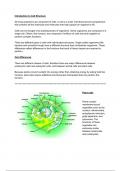
Plant cells
Plants contain
membrane-bound
organelles such as the
nucleus, mitochondria,
endoplasmic reticulum,
golgi apparatus, and
lysosomes. The
functions of these
organelles are
extremely similar
between eukaryotes
and prokaryotes.
, Plant cells can be larger than animal cells. Animal cells can have sizes that vary from 10
micrometres to 30 micrometres. However, plant cells can size from 10 micrometres to 100
micrometres.
Chloroplasts: plants use sunlight as their energy source; the sunlight must be converted
into energy inside the cell in a process called photosynthesis. They are large, double
membrane-bound structures that contain the substance called chlorophyll, which absorbs
sunlight. Additional membranes within the chloroplasts contain structures that actually carry
out the process of photosynthesis
Cell wall: another structural difference in plant cells in the presence of a rigid cell wall
surrounding the cell membrane. The wall can range from 0.1 to 10 micrometres thick and is
composed of fats and sugars like cellulose. The wall provides added stability and protection
to the plant cell.
Vacuoles: vacuoles are large, liquid-filled organelles found only in plant cells. Vacuoles can
occupy up to 90% of the cell’s volume and have a single membrane. They contain a number
of enzymes that perform diverse functions and their interior is used as a storage for nutrients
or provide a place to degrade unwanted substances (with the presence of lysosomes).
<<<<<<<<<<<<<<<<<<<<<<<<<<<<<<<<<<<<<<<<<<<<<<<<<<<<<<<<<<<<<<<<<<<<<<
Prokaryotic cells
Unlike eukaryotic cells, prokaryotic cells lack membrane-bound organelles. Although they
are less structurally complex than eukaryotic cells, they are more chemically complex, due to
the biomolecules floating around each other. These biomolecules must interact only with the
appropriate molecules to perform a biological function.
Prokaryotic cells contain a single compartment enclosed within the cell membrane. In this
space reside DNA, RNA, ribosomes and other molecules. Prokaryotes lack a defined
nucleus (where the DNA and RNA are stored in eukaryotic cells), mitochondria, endoplasmic
reticulum and golgi apparatus. In addition to the lack of organelles, prokaryotic cells also lack
a cytoskeleton. Cytoskeletons give structural support to the interior of the cell, as well as
being involved in intracellular organelle transport. However, as there are no organelles to be
transported in prokaryotes, such function is unnecessary.
Like the eukaryotic cell, the prokaryotic cell is filled with cytosol. The prokaryotic cytosol is
filled with enzymes, which carry out respiratory processes reserved in eukaryotes for the
mitochondria.
<<<<<<<<<<<<<<<<<<<<<<<<<<<<<<<<<<<<<<<<<<<<<<<<<<<<<<<<<<<<<<<<<<<<<<
All living organisms are composed of cells. A cell is a small, membrane-bound compartment
that contains all the chemicals and molecules that help support an organism’s life.
Cells can be thought of as building blocks of organisms. Some organisms are composed of a
single cell. Others, like humans, are composed of millions of cells that work together to
perform complex functions.
There are different types of cells with individuated structures. Single celled organisms (like
bacteria and unicellular fungi) have a different structure than multicellular organisms. These
differences reflect differences in the functions that each of these classes are required to
perform.
Cell differences
There are different classes of cells, therefore there are major differences between
prokaryotic cells and eukaryotic cells, and between animal cells and plant cells.
Because plants convert sunlight into energy rather than obtaining energy by eating food like
humans, plant cells require additional structures like chloroplasts that can perform this
function.
<<<<<<<<<<<<<<<<<<<<<<<<<<<<<<<<<<<<<<<<<<<<<<<<<<<<<<<<<<<<<<<<<<<<<<
Plant cells
Plants contain
membrane-bound
organelles such as the
nucleus, mitochondria,
endoplasmic reticulum,
golgi apparatus, and
lysosomes. The
functions of these
organelles are
extremely similar
between eukaryotes
and prokaryotes.
, Plant cells can be larger than animal cells. Animal cells can have sizes that vary from 10
micrometres to 30 micrometres. However, plant cells can size from 10 micrometres to 100
micrometres.
Chloroplasts: plants use sunlight as their energy source; the sunlight must be converted
into energy inside the cell in a process called photosynthesis. They are large, double
membrane-bound structures that contain the substance called chlorophyll, which absorbs
sunlight. Additional membranes within the chloroplasts contain structures that actually carry
out the process of photosynthesis
Cell wall: another structural difference in plant cells in the presence of a rigid cell wall
surrounding the cell membrane. The wall can range from 0.1 to 10 micrometres thick and is
composed of fats and sugars like cellulose. The wall provides added stability and protection
to the plant cell.
Vacuoles: vacuoles are large, liquid-filled organelles found only in plant cells. Vacuoles can
occupy up to 90% of the cell’s volume and have a single membrane. They contain a number
of enzymes that perform diverse functions and their interior is used as a storage for nutrients
or provide a place to degrade unwanted substances (with the presence of lysosomes).
<<<<<<<<<<<<<<<<<<<<<<<<<<<<<<<<<<<<<<<<<<<<<<<<<<<<<<<<<<<<<<<<<<<<<<
Prokaryotic cells
Unlike eukaryotic cells, prokaryotic cells lack membrane-bound organelles. Although they
are less structurally complex than eukaryotic cells, they are more chemically complex, due to
the biomolecules floating around each other. These biomolecules must interact only with the
appropriate molecules to perform a biological function.
Prokaryotic cells contain a single compartment enclosed within the cell membrane. In this
space reside DNA, RNA, ribosomes and other molecules. Prokaryotes lack a defined
nucleus (where the DNA and RNA are stored in eukaryotic cells), mitochondria, endoplasmic
reticulum and golgi apparatus. In addition to the lack of organelles, prokaryotic cells also lack
a cytoskeleton. Cytoskeletons give structural support to the interior of the cell, as well as
being involved in intracellular organelle transport. However, as there are no organelles to be
transported in prokaryotes, such function is unnecessary.
Like the eukaryotic cell, the prokaryotic cell is filled with cytosol. The prokaryotic cytosol is
filled with enzymes, which carry out respiratory processes reserved in eukaryotes for the
mitochondria.
<<<<<<<<<<<<<<<<<<<<<<<<<<<<<<<<<<<<<<<<<<<<<<<<<<<<<<<<<<<<<<<<<<<<<<


