

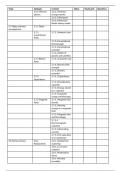
Topic Subtopic Content Notes Flashcards Questions
3.6.2 Thermal 3.6.2.1 Thermal
physics energy transfer
3.6.2.2 Ideal gases
3.6.2.3 Molecular
kinetic theory model
3.7 Fields and their 3.7.1 Fields
consequences
3.7.2 3.7.2.1 Newton's law
Gravitational
fields
3.7.2.2 Gravitational
field strength
3.7.2.3 Gravitational
potential
3.7.2.4 Orbits of
planets and satellites
3.7.3 Electric 3.7.3.1 Coulomb's law
fields
3.7.3.2 Electric field
strength
3.7.3.3 Electric
potential
3.7.4 3.7.4.1 Capacitance
Capacitance
3.7.4.2 Parallel plate
capacitor
3.7.4.3 Energy stored
by a capacitor
3.7.4.4 Capacitor
charge and discharge
3.7.5 Magnetic 3.7.5.1 Magnetic flux
fields density
3.7.5.2 Moving
charges in a magnetic
field
3.7.5.3 Magnetic flux
and flux linkage
3.7.5.4
Electromagnetic
induction
3.7.5.5 Alternating
currents
3.7.5.6 The operation
of a transformer
3.8 Nuclear physics 3.8.1 3.8.1.1 Rutherford
Radioactivity scattering
3.8.1.2 α, β and γ
radiation
3.8.1.3 Radioactive
decay
3.8.1.4 Nuclear
instability
3.6.2 Thermal 3.6.2.1 Thermal
physics energy transfer
3.6.2.2 Ideal gases
3.6.2.3 Molecular
kinetic theory model
3.7 Fields and their 3.7.1 Fields
consequences
3.7.2 3.7.2.1 Newton's law
Gravitational
fields
3.7.2.2 Gravitational
field strength
3.7.2.3 Gravitational
potential
3.7.2.4 Orbits of
planets and satellites
3.7.3 Electric 3.7.3.1 Coulomb's law
fields
3.7.3.2 Electric field
strength
3.7.3.3 Electric
potential
3.7.4 3.7.4.1 Capacitance
Capacitance
3.7.4.2 Parallel plate
capacitor
3.7.4.3 Energy stored
by a capacitor
3.7.4.4 Capacitor
charge and discharge
3.7.5 Magnetic 3.7.5.1 Magnetic flux
fields density
3.7.5.2 Moving
charges in a magnetic
field
3.7.5.3 Magnetic flux
and flux linkage
3.7.5.4
Electromagnetic
induction
3.7.5.5 Alternating
currents
3.7.5.6 The operation
of a transformer
3.8 Nuclear physics 3.8.1 3.8.1.1 Rutherford
Radioactivity scattering
3.8.1.2 α, β and γ
radiation
3.8.1.3 Radioactive
decay
3.8.1.4 Nuclear
instability


