
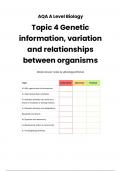
AQA A Level Biology
Topic 4 Genetic
information, variation
and relationships
between organisms
Model answer notes by @biologywitholivia
Topic Understand Memorise Practise
4.1 DNA, genes and chromosomes
4.2 DNA and protein synthesis
4.3 Genetic diversity can arise as a
result of mutation or during meiosis
4.4 Genetic diversity and adaptation
Required practical 6
4.5 Species and taxonomy
4.6 Biodiversity within a community
4.7 Investigating diversity
,AQA A Level Biology Topic 4 Genetic information, variation & relationships between organisms stan.store/biologywitholivia
4.1 DNA, genes and chromosomes
Compare and contrast DNA in eukaryotic cells with DNA in prokaryotic cells
Similarities:
● Nucleotide structure is identical - deoxyribose attached to phosphate and a base
● Adjacent nucleotides joined by phosphodiester bonds, complementary bases joined by hydrogen bonds
● DNA in mitochondria / chloroplasts have similar structure to DNA in prokaryotes
○ Short, circular, not associated with proteins
Differences:
● Eukaryotic DNA is longer
● Eukaryotic DNA is linear, prokaryotic DNA is circular
● Eukaryotic DNA is associated with histone proteins, prokaryotic DNA is not
● Eukaryotic DNA contain introns, prokaryotic DNA does not
What is a chromosome?
● Long, linear DNA + its associated histone proteins
● In the nucleus of eukaryotic cells
What is a gene?
A sequence of DNA (nucleotide) bases that codes for:
● The amino acid sequence of a polypeptide
● Or a functional RNA (eg. ribosomal RNA or tRNA)
What is a locus?
Fixed position a gene occupies on a particular DNA molecule.
Describe the nature of the genetic code
Triplet code A sequence of 3 DNA bases, called a triplet, codes for a specific amino acid
Universal The same base triplets code for the same amino acids in all organisms
Non-overlapping Each base is part of only one triplet so each triplet is read as a discrete unit
Degenerate An amino acid can be coded for by more than one base triplet
2
, AQA A Level Biology Topic 4 Genetic information, variation & relationships between organisms stan.store/biologywitholivia
What are ‘non-coding base sequences’ and where are they found?
Non-coding base sequence - DNA that does not code for amino acid sequences / polypeptides:
1. Between genes - eg. non-coding multiple repeats
2. Within genes - introns
In eukaryotes, much of the nuclear DNA does not code for polypeptides.
What are introns and exons?
Exon Base sequence of a gene coding for amino acid sequences (in a polypeptide)
Intron Base sequence of a gene that doesn’t code for amino acids, in eukaryotic cells
Exam insight: common mistakes ❌
Mistake Explanation
“Bacteria / prokaryotic cells have Chromosomes are found in eukaryotic cells. Bacteria have small,
chromosomes.” circular DNA not associated with histones.
“Prokaryotic DNA is single stranded, and This describes RNA. Prokaryotic DNA is double stranded and made
contains uracil instead of thymine. of exactly the same nucleotides as eukaryotic DNA (with A, T, C, G).
“Triplets produce amino acids.” Triplets code for amino acids, but don’t directly produce them.
“A gene is a section of DNA that This is too vague. A gene is a sequence of DNA (nucleotide) bases
codes for proteins.” that codes for a polypeptide (or functional RNA).
“An intron is a non-coding region This is correct, but not enough to get a mark. You must state what it
of a gene.” is that introns don’t code for, ie. amino acids.
“An exon codes for a protein.” This is too vague. An exon is a base sequence of a gene coding for
amino acid sequences (in a polypeptide).
3
Topic 4 Genetic
information, variation
and relationships
between organisms
Model answer notes by @biologywitholivia
Topic Understand Memorise Practise
4.1 DNA, genes and chromosomes
4.2 DNA and protein synthesis
4.3 Genetic diversity can arise as a
result of mutation or during meiosis
4.4 Genetic diversity and adaptation
Required practical 6
4.5 Species and taxonomy
4.6 Biodiversity within a community
4.7 Investigating diversity
,AQA A Level Biology Topic 4 Genetic information, variation & relationships between organisms stan.store/biologywitholivia
4.1 DNA, genes and chromosomes
Compare and contrast DNA in eukaryotic cells with DNA in prokaryotic cells
Similarities:
● Nucleotide structure is identical - deoxyribose attached to phosphate and a base
● Adjacent nucleotides joined by phosphodiester bonds, complementary bases joined by hydrogen bonds
● DNA in mitochondria / chloroplasts have similar structure to DNA in prokaryotes
○ Short, circular, not associated with proteins
Differences:
● Eukaryotic DNA is longer
● Eukaryotic DNA is linear, prokaryotic DNA is circular
● Eukaryotic DNA is associated with histone proteins, prokaryotic DNA is not
● Eukaryotic DNA contain introns, prokaryotic DNA does not
What is a chromosome?
● Long, linear DNA + its associated histone proteins
● In the nucleus of eukaryotic cells
What is a gene?
A sequence of DNA (nucleotide) bases that codes for:
● The amino acid sequence of a polypeptide
● Or a functional RNA (eg. ribosomal RNA or tRNA)
What is a locus?
Fixed position a gene occupies on a particular DNA molecule.
Describe the nature of the genetic code
Triplet code A sequence of 3 DNA bases, called a triplet, codes for a specific amino acid
Universal The same base triplets code for the same amino acids in all organisms
Non-overlapping Each base is part of only one triplet so each triplet is read as a discrete unit
Degenerate An amino acid can be coded for by more than one base triplet
2
, AQA A Level Biology Topic 4 Genetic information, variation & relationships between organisms stan.store/biologywitholivia
What are ‘non-coding base sequences’ and where are they found?
Non-coding base sequence - DNA that does not code for amino acid sequences / polypeptides:
1. Between genes - eg. non-coding multiple repeats
2. Within genes - introns
In eukaryotes, much of the nuclear DNA does not code for polypeptides.
What are introns and exons?
Exon Base sequence of a gene coding for amino acid sequences (in a polypeptide)
Intron Base sequence of a gene that doesn’t code for amino acids, in eukaryotic cells
Exam insight: common mistakes ❌
Mistake Explanation
“Bacteria / prokaryotic cells have Chromosomes are found in eukaryotic cells. Bacteria have small,
chromosomes.” circular DNA not associated with histones.
“Prokaryotic DNA is single stranded, and This describes RNA. Prokaryotic DNA is double stranded and made
contains uracil instead of thymine. of exactly the same nucleotides as eukaryotic DNA (with A, T, C, G).
“Triplets produce amino acids.” Triplets code for amino acids, but don’t directly produce them.
“A gene is a section of DNA that This is too vague. A gene is a sequence of DNA (nucleotide) bases
codes for proteins.” that codes for a polypeptide (or functional RNA).
“An intron is a non-coding region This is correct, but not enough to get a mark. You must state what it
of a gene.” is that introns don’t code for, ie. amino acids.
“An exon codes for a protein.” This is too vague. An exon is a base sequence of a gene coding for
amino acid sequences (in a polypeptide).
3


