Biological rhythms: circadian rhythms
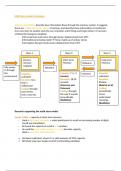
Biological rhythms are periodic activity governed by:
- Internal biological clocks (endogenous pacemakers)
- External changes in the environment (exogenous zeitgebers)
Ultradian rhythm – occurs many times during the day. (Stages of sleep)
Infradian rhythm – takes longer than a day to complete. (Menstrual cycle)
Circadian rhythm – lasts about 24 hours. (Sleep wake cycle)
Sleep wake cycle
Exogenous zeitgebers – fact we feel drowsy when it’s night-time and alert during the day
shows effect of daylight.
Endogenous pacemakers – suprachiasmatic nucleus (SCN) in the hypothalamus that lies
above the optic chiasm and provides info from the eye about light.
Siffre’s cave study:
- He lived underground (in dark cave) for 2 months and then later 6 months to test the
internal body clock
- Deprived of exposure to natural light and sound
- His circadian rhythm settled down to 25 hours.
- Suggesting endogenous pacemakers entrain the circadian rhythm to just short of
natural.
Folkard et al (1985):
- Showed endogenous pacemakers are stronger than exogenous zeitgebers.
- Convinced a group of 12 to live in a cave, they went to sleep at 11:45pm and got up at
7:45am
- Researchers slowly sped up the clock to be just 22 hours.
- Only 1 participant was able to easily adjust.
- Suggests the existence of a strong free running circadian rhythm not controlled by
exogenous zeitgebers (external factors).
Evaluation
Practical application
- Application to shift work.
- Bolvin et al found shift workers have a dip in concentration around 6am (a circadian
trough) causing accidents to be more likely.
- Knutsson et al found it 3x more likely for shift workers to develop heart disease.
- Research into the sleep wake cycle may have economic implications in terms of how to
best manage shift work.
Real world application to medical treatment
Biological rhythms are periodic activity governed by:
- Internal biological clocks (endogenous pacemakers)
- External changes in the environment (exogenous zeitgebers)
Ultradian rhythm – occurs many times during the day. (Stages of sleep)
Infradian rhythm – takes longer than a day to complete. (Menstrual cycle)
Circadian rhythm – lasts about 24 hours. (Sleep wake cycle)
Sleep wake cycle
Exogenous zeitgebers – fact we feel drowsy when it’s night-time and alert during the day
shows effect of daylight.
Endogenous pacemakers – suprachiasmatic nucleus (SCN) in the hypothalamus that lies
above the optic chiasm and provides info from the eye about light.
Siffre’s cave study:
- He lived underground (in dark cave) for 2 months and then later 6 months to test the
internal body clock
- Deprived of exposure to natural light and sound
- His circadian rhythm settled down to 25 hours.
- Suggesting endogenous pacemakers entrain the circadian rhythm to just short of
natural.
Folkard et al (1985):
- Showed endogenous pacemakers are stronger than exogenous zeitgebers.
- Convinced a group of 12 to live in a cave, they went to sleep at 11:45pm and got up at
7:45am
- Researchers slowly sped up the clock to be just 22 hours.
- Only 1 participant was able to easily adjust.
- Suggests the existence of a strong free running circadian rhythm not controlled by
exogenous zeitgebers (external factors).
Evaluation
Practical application
- Application to shift work.
- Bolvin et al found shift workers have a dip in concentration around 6am (a circadian
trough) causing accidents to be more likely.
- Knutsson et al found it 3x more likely for shift workers to develop heart disease.
- Research into the sleep wake cycle may have economic implications in terms of how to
best manage shift work.
Real world application to medical treatment