Multi store model of memory
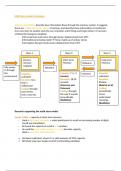
Atkinson and Shiffrin describe how information flows through the memory system. It suggests
there are 3 different unitary stores of memory and describes how information is transferred
from one store to another and why we remember some things and forget others. It has been
criticised for being too simplistic.
- Info is lost from each store through decay/ displacement from STM
- Information processing model linear made up of unitary stores
- Interruption disrupts recall causes displacement from STM
Store 1 Store 2 Store 3
Sensory Short term Long term
memory Memory Rehearse Memory
(register)
Info comes Attention
in through
the Capacity: Capacity: 7 +/- 2 Retrieve Capacity:
environment unlimited (Jacobs) unlimited
Duration: less Duration: 18-30 Duration:
than a seconds lifetime
millisecond (Peterson and (Bahrick et al)
Coding: through Peterson) Coding:
your senses Coding: through semantically
(ears, eyes etc) the way it sounds (must
(acoustically) understand
(Baddeley) meaning)
(Baddeley)
Research supporting the multi store model:
Jacobs (1956) – capacity of short-term memory
- Used a digit span technique > asked participants to recall an increasing number of digits
(recall was immediate)
- He found the capacity of recall is 5-9 numbers
- He used the term magic number 7 +/-2 to describe capacity
- Used a controlled lab experiment.
Has been replicated, shows it’s a valid measure of STM capacity.
Old study may have lacked control (confounding variables)
Atkinson and Shiffrin describe how information flows through the memory system. It suggests
there are 3 different unitary stores of memory and describes how information is transferred
from one store to another and why we remember some things and forget others. It has been
criticised for being too simplistic.
- Info is lost from each store through decay/ displacement from STM
- Information processing model linear made up of unitary stores
- Interruption disrupts recall causes displacement from STM
Store 1 Store 2 Store 3
Sensory Short term Long term
memory Memory Rehearse Memory
(register)
Info comes Attention
in through
the Capacity: Capacity: 7 +/- 2 Retrieve Capacity:
environment unlimited (Jacobs) unlimited
Duration: less Duration: 18-30 Duration:
than a seconds lifetime
millisecond (Peterson and (Bahrick et al)
Coding: through Peterson) Coding:
your senses Coding: through semantically
(ears, eyes etc) the way it sounds (must
(acoustically) understand
(Baddeley) meaning)
(Baddeley)
Research supporting the multi store model:
Jacobs (1956) – capacity of short-term memory
- Used a digit span technique > asked participants to recall an increasing number of digits
(recall was immediate)
- He found the capacity of recall is 5-9 numbers
- He used the term magic number 7 +/-2 to describe capacity
- Used a controlled lab experiment.
Has been replicated, shows it’s a valid measure of STM capacity.
Old study may have lacked control (confounding variables)