
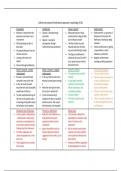
Outline and evaluate the behaviourist approach in psychology (6+10).
Assumptions Conditioning Pavlov’s research Reinforcement
• Behaviour is learned from the • Classical = learning through • Measured amount of saliva • Reinforcement = an outcome of
experiences you have in your association produced when a dog ate (tube behaviour that increases the
environment • Operant = learning by put inside dog’s mouth) likelihood of a behaviour being
• All human beings are born a consequences through • The flow of saliva occurred repeated
blank slate reinforcement and punishment naturally whenever the food • Positive reinforcement = getting
• We acquire behaviour from the was put inside the dog’s mouth a reward when a certain
stimulus around us • The dog was conditioned to behaviour is performed
• Learning is the same in all salivate to the sound of a bell if • Negative reinforcement =
species it was present every time that avoiding something unpleasant
• We learn through conditioning they ate the food
Skinner’s research – positive Skinner’s research – negative Scientific credibility Token economy systems
reinforcement reinforcement • This approach uses scientific • These are used in prisons
• Rat was in a box and the box • A rat is put into the box and an methods • Tokens are given to prisoners as
contained a lever on the side electrical current passes through • It used highly controlled a reward, and they can be
• As the rat moved, it would it conditions to eliminate the redeemed for privileges =
knock the lever and a food pellet • When the rat knocks the lever, effects of extraneous and positive reinforcement
would drop into the box the current is switched off confounding variables • Tokens can also be taken away =
• The rats quickly learned to go to • So, the rats learned to go • Increases validity negative reinforcement
the lever so the positive action straight to the lever to avoid the • This makes it objective and • Token = secondary reinforcer as
of receiving a food pellet caused electrical current. This caused empirical it can be exchanged for primary
the behaviour to be repeated their behaviour to be repeated reinforcements
Mechanistic view of behaviour Free will vs. determinism Ethical issues
• It views people as being passive • Approach sees all behaviour as • The procedures allowed the
– with behaviour simply being being determined by past psychologists to maintain a high
caused by us responding to the experiences that have been level of control over the
environment instead of actively conditioned experiment
thinking about their behaviour • Ignores idea that free will can • But the animals involved were
• SLT better explanation as it influence behaviour (Skinner exposed to stressful conditions
shows that people have a more suggested that free will is just an which could have affected how
active role illusion) they reacted.
• Theory applies more to animals • Humans are different cognitively
than humans & physiologically from animals
, Outline and evaluate the Social Learning Theory (SLT) approach in psychology (6+10).
Assumptions Bandura’s bobo doll study - method Bandura’s bobo doll study – random Bandura’s bobo doll study – results
• Humans learn from experiences • Study was done to investigate if allocation • Condition 1 more aggressive
• Behaviour is learned through aggression could be acquired • Condition 1 – 24 kids saw adult than condition 2/3. Their
observation and imitation through observation and behave aggressively toward the aggressiveness escalated to
• Observational learning takes imitation doll more than what they had
place as an individual identifies • 72 kids were tested in a lab • Condition 2 – another 24 kids observed
with a role model experiment. Their aggression watched adult ignore the doll • Boys imitated more physically
• Humans learn directly through was pre-tested and they were • Condition 3 – final 24 kids were aggressive acts than girls, girls
classical and operant then split into 3 groups through the control group so didn’t have more verbally aggressive
conditioning or indirectly random allocation based on this a role model • Kids learn SL behaviour through
through vicarious reinforcement observational learning
Definitions Observational Modelling Cognitive processes
• Vicarious reinforcement = learn learning/mediating factors • Is when we associate ourselves • It takes thought processes into
through observing someone else • Attention – how much with a role model and we want account and acknowledges the
being reinforced for a behaviour somebody pays attention to to be like them role they play in whether a
and imitating it someone else’s behaviour • We are more likely to become a behaviour is limited or not
• Mediational processes = focuses • Retention – memorising the model if we have similar • Provides more comprehensive
on how mental processes are behaviour characteristics to the role explanation so it’s better than
involved in learning and what • Motor reproduction – ability to model, if the role model has a behaviourist approach
we need for a behaviour to be carry out the behaviour high status or if their attractive
learned • Motivation – reason for doing
the behaviour
Flawed methodology Alternative explanation Deterministic Ethics
• Bandura’s study was in a lab • Doesn’t talk about the impact of • Findings show that children • It’s unethical to use children in
• Lab studies are in artificial biological factors on social learn aggression through studies
environments so it could have learning imitating someone else, but it • No fully informed consent from
increased the chances of • Boys could have been more doesn’t consider any other the child
demand characteristics aggressive than the girls because reasons why those children • Could have taught the children
• The purpose of the doll is to of their levels of testosterone could be displaying aggressive to behave aggressively (in
strike it, the children could have behaviour condition 1)
behaved how they thought was • Doesn’t acknowledge free will
expected of them
Assumptions Conditioning Pavlov’s research Reinforcement
• Behaviour is learned from the • Classical = learning through • Measured amount of saliva • Reinforcement = an outcome of
experiences you have in your association produced when a dog ate (tube behaviour that increases the
environment • Operant = learning by put inside dog’s mouth) likelihood of a behaviour being
• All human beings are born a consequences through • The flow of saliva occurred repeated
blank slate reinforcement and punishment naturally whenever the food • Positive reinforcement = getting
• We acquire behaviour from the was put inside the dog’s mouth a reward when a certain
stimulus around us • The dog was conditioned to behaviour is performed
• Learning is the same in all salivate to the sound of a bell if • Negative reinforcement =
species it was present every time that avoiding something unpleasant
• We learn through conditioning they ate the food
Skinner’s research – positive Skinner’s research – negative Scientific credibility Token economy systems
reinforcement reinforcement • This approach uses scientific • These are used in prisons
• Rat was in a box and the box • A rat is put into the box and an methods • Tokens are given to prisoners as
contained a lever on the side electrical current passes through • It used highly controlled a reward, and they can be
• As the rat moved, it would it conditions to eliminate the redeemed for privileges =
knock the lever and a food pellet • When the rat knocks the lever, effects of extraneous and positive reinforcement
would drop into the box the current is switched off confounding variables • Tokens can also be taken away =
• The rats quickly learned to go to • So, the rats learned to go • Increases validity negative reinforcement
the lever so the positive action straight to the lever to avoid the • This makes it objective and • Token = secondary reinforcer as
of receiving a food pellet caused electrical current. This caused empirical it can be exchanged for primary
the behaviour to be repeated their behaviour to be repeated reinforcements
Mechanistic view of behaviour Free will vs. determinism Ethical issues
• It views people as being passive • Approach sees all behaviour as • The procedures allowed the
– with behaviour simply being being determined by past psychologists to maintain a high
caused by us responding to the experiences that have been level of control over the
environment instead of actively conditioned experiment
thinking about their behaviour • Ignores idea that free will can • But the animals involved were
• SLT better explanation as it influence behaviour (Skinner exposed to stressful conditions
shows that people have a more suggested that free will is just an which could have affected how
active role illusion) they reacted.
• Theory applies more to animals • Humans are different cognitively
than humans & physiologically from animals
, Outline and evaluate the Social Learning Theory (SLT) approach in psychology (6+10).
Assumptions Bandura’s bobo doll study - method Bandura’s bobo doll study – random Bandura’s bobo doll study – results
• Humans learn from experiences • Study was done to investigate if allocation • Condition 1 more aggressive
• Behaviour is learned through aggression could be acquired • Condition 1 – 24 kids saw adult than condition 2/3. Their
observation and imitation through observation and behave aggressively toward the aggressiveness escalated to
• Observational learning takes imitation doll more than what they had
place as an individual identifies • 72 kids were tested in a lab • Condition 2 – another 24 kids observed
with a role model experiment. Their aggression watched adult ignore the doll • Boys imitated more physically
• Humans learn directly through was pre-tested and they were • Condition 3 – final 24 kids were aggressive acts than girls, girls
classical and operant then split into 3 groups through the control group so didn’t have more verbally aggressive
conditioning or indirectly random allocation based on this a role model • Kids learn SL behaviour through
through vicarious reinforcement observational learning
Definitions Observational Modelling Cognitive processes
• Vicarious reinforcement = learn learning/mediating factors • Is when we associate ourselves • It takes thought processes into
through observing someone else • Attention – how much with a role model and we want account and acknowledges the
being reinforced for a behaviour somebody pays attention to to be like them role they play in whether a
and imitating it someone else’s behaviour • We are more likely to become a behaviour is limited or not
• Mediational processes = focuses • Retention – memorising the model if we have similar • Provides more comprehensive
on how mental processes are behaviour characteristics to the role explanation so it’s better than
involved in learning and what • Motor reproduction – ability to model, if the role model has a behaviourist approach
we need for a behaviour to be carry out the behaviour high status or if their attractive
learned • Motivation – reason for doing
the behaviour
Flawed methodology Alternative explanation Deterministic Ethics
• Bandura’s study was in a lab • Doesn’t talk about the impact of • Findings show that children • It’s unethical to use children in
• Lab studies are in artificial biological factors on social learn aggression through studies
environments so it could have learning imitating someone else, but it • No fully informed consent from
increased the chances of • Boys could have been more doesn’t consider any other the child
demand characteristics aggressive than the girls because reasons why those children • Could have taught the children
• The purpose of the doll is to of their levels of testosterone could be displaying aggressive to behave aggressively (in
strike it, the children could have behaviour condition 1)
behaved how they thought was • Doesn’t acknowledge free will
expected of them


