Nucleic Acids
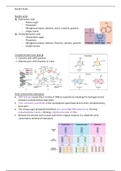
Nucleic acids
Ribonucleic acid:
- Ribose sugar
- Phosphate
- Nitrogenous bases: adenine, uracil, cytosine. guanine
- Single strand
Deoxyribonucleic acid:
- Deoxyribose sugar
- Phosphate
- Nitrogenous bases: adenine, thymine, cytosine, guanine
- Double strand
Complementary base pairing
® Cytosine pairs with guanine
® Adenine pairs with thymine or uracil
Semi-conservative replication
• DNA helicase causes the 2 strands of DNA to separate by breaking the hydrogen bonds
between complementary base pairs
• Free, activated nucleotides in the nucleoplasm specifically bind to their complementary
base pairs
• The strong sugar-phosphate backbone is re-joined by DNA polymerase, forming
phosphodiester bonds – forming 2 identical strands of DNA
• Because the strands each contain half of the original material it is called the semi-
conservative method of replication
Nucleic acids
Ribonucleic acid:
- Ribose sugar
- Phosphate
- Nitrogenous bases: adenine, uracil, cytosine. guanine
- Single strand
Deoxyribonucleic acid:
- Deoxyribose sugar
- Phosphate
- Nitrogenous bases: adenine, thymine, cytosine, guanine
- Double strand
Complementary base pairing
® Cytosine pairs with guanine
® Adenine pairs with thymine or uracil
Semi-conservative replication
• DNA helicase causes the 2 strands of DNA to separate by breaking the hydrogen bonds
between complementary base pairs
• Free, activated nucleotides in the nucleoplasm specifically bind to their complementary
base pairs
• The strong sugar-phosphate backbone is re-joined by DNA polymerase, forming
phosphodiester bonds – forming 2 identical strands of DNA
• Because the strands each contain half of the original material it is called the semi-
conservative method of replication