Biological Molecules
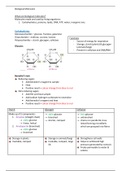
What are biological molecules?
Molecules made and used by living organisms:
1. Carbohydrates, proteins, lipids, DNA, ATP, water, inorganic ions.
Carbohydrates
Monosaccharides – glucose, fructose, galactose
Disaccharides – maltose, sucrose, lactose Functions
Polysaccharides – starch, glycogen, cellulose - Source of energy for respiration
- Storage: starch (plants) & glycogen
Glucose: (animals/fungi)
- Present in cellulose and DNA/RNA
Benedict’s test:
Reducing sugars
• Add benedict’s reagent to sample
• Heat
• Positive result = colour change from blue to red
Non-reducing sugars
• Add HCl and heat sample
• Add sodium hydrogen carbonate to neutralise
• Add benedict’s reagent and heat
• Positive result = colour change from blue to red
Starch Glycogen Cellulose
Made up of 2 components: ® alpha glucose ® beta glucose
1. Amylose (straight chain) ® branched ® unbranched
® alpha glucose ® shorter, compact ® chains run parallel & cross-
® linear, helical linked forming microfibrils
2. Amylopectin (branched) which are grouped into fibres
® alpha glucose
® branched
Storage in plants Storage in animals/fungi Strengthens cell walls
Insoluble, compact Insoluble, compact, large Helps to withstand high
SA pressure generated by osmosis
Freely permeable to water &
solutes
What are biological molecules?
Molecules made and used by living organisms:
1. Carbohydrates, proteins, lipids, DNA, ATP, water, inorganic ions.
Carbohydrates
Monosaccharides – glucose, fructose, galactose
Disaccharides – maltose, sucrose, lactose Functions
Polysaccharides – starch, glycogen, cellulose - Source of energy for respiration
- Storage: starch (plants) & glycogen
Glucose: (animals/fungi)
- Present in cellulose and DNA/RNA
Benedict’s test:
Reducing sugars
• Add benedict’s reagent to sample
• Heat
• Positive result = colour change from blue to red
Non-reducing sugars
• Add HCl and heat sample
• Add sodium hydrogen carbonate to neutralise
• Add benedict’s reagent and heat
• Positive result = colour change from blue to red
Starch Glycogen Cellulose
Made up of 2 components: ® alpha glucose ® beta glucose
1. Amylose (straight chain) ® branched ® unbranched
® alpha glucose ® shorter, compact ® chains run parallel & cross-
® linear, helical linked forming microfibrils
2. Amylopectin (branched) which are grouped into fibres
® alpha glucose
® branched
Storage in plants Storage in animals/fungi Strengthens cell walls
Insoluble, compact Insoluble, compact, large Helps to withstand high
SA pressure generated by osmosis
Freely permeable to water &
solutes