

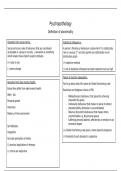
Psychopathology
Definition of abnormality
Deviation from social norms- Statistical infrequency-
Social norms are rules of behaviour that are considered A person’s thinking or behaviour is abnormal if it is statistically
acceptable in a group or society . a deviation is something rare or unusual. 1st and last quartile are statistically rare in
which breaks these implicit/ explicit attitudes distribution graph
(+) easy to use (+) objective method
(-) norms change (-) not all statistical infrequencies need treatment such as high
Failure to function adequately-
Deviation from ideal mental health- Fail to go about daily life, based on Global functioning scale
Extent they differ from ideal mental health Rosenhan and Seligman criteria of FFA
PAM + SIA - Maldaptiveness (behaviour that prevents achieving
Personal growth important life goals)
- Irrationality (behaviour that makes no sense to others)
Autonomy - Unpredictability (behaviour is uncontrollable)
Mastery of the environment - Observer discomfort (behaviour that makes others
uncomfortable e.g. No personal space)
- Suffering/ personal distress- affected by an emotion to an
excessive degree
Self attitudes
(+) Global functioning scale gives a more objective diagnosis
Integration
(-) threshold of each standard is subjective
Accurate perception of reality
(-) practical applications in therapy
(-) criteria are subjective
, Psychopathology
Behavioural, emotional and cognitive characteristics
Phobias Depression OCD
Behavioural - Panic - Change in activity - Compulsions
- Avoidance levels - Avoidance
- Endurance - Disruption to
sleep/ eating
behaviours
- Aggression and
self-harm
Emotional - Anxiety - Lowered mood - Anxiety, worry
- Being - Anger and distress
unreasonable - Lowered self - Guilt and disgust
esteem - Accompanying
depression
Cognitive - Selective - Attending to/ - Obsessive
attention dwelling on thoughts
- Irrational beliefs negative - Insight into
- Cognitive - Absolutist excessive anxiety
distortions thinking - Hyper vigilance
- Poor
concentration
Definition of abnormality
Deviation from social norms- Statistical infrequency-
Social norms are rules of behaviour that are considered A person’s thinking or behaviour is abnormal if it is statistically
acceptable in a group or society . a deviation is something rare or unusual. 1st and last quartile are statistically rare in
which breaks these implicit/ explicit attitudes distribution graph
(+) easy to use (+) objective method
(-) norms change (-) not all statistical infrequencies need treatment such as high
Failure to function adequately-
Deviation from ideal mental health- Fail to go about daily life, based on Global functioning scale
Extent they differ from ideal mental health Rosenhan and Seligman criteria of FFA
PAM + SIA - Maldaptiveness (behaviour that prevents achieving
Personal growth important life goals)
- Irrationality (behaviour that makes no sense to others)
Autonomy - Unpredictability (behaviour is uncontrollable)
Mastery of the environment - Observer discomfort (behaviour that makes others
uncomfortable e.g. No personal space)
- Suffering/ personal distress- affected by an emotion to an
excessive degree
Self attitudes
(+) Global functioning scale gives a more objective diagnosis
Integration
(-) threshold of each standard is subjective
Accurate perception of reality
(-) practical applications in therapy
(-) criteria are subjective
, Psychopathology
Behavioural, emotional and cognitive characteristics
Phobias Depression OCD
Behavioural - Panic - Change in activity - Compulsions
- Avoidance levels - Avoidance
- Endurance - Disruption to
sleep/ eating
behaviours
- Aggression and
self-harm
Emotional - Anxiety - Lowered mood - Anxiety, worry
- Being - Anger and distress
unreasonable - Lowered self - Guilt and disgust
esteem - Accompanying
depression
Cognitive - Selective - Attending to/ - Obsessive
attention dwelling on thoughts
- Irrational beliefs negative - Insight into
- Cognitive - Absolutist excessive anxiety
distortions thinking - Hyper vigilance
- Poor
concentration


