

Summary - Unit 3.3.5 - Alcohols (Chem)
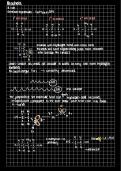
Alcohols are a class of organic compounds characterized by the presence of one or more hydroxyl (-OH) groups attached to a carbon atom. Here are the key points about alcohols relevant to A-level chemistry: Structure and Classification General Formula: The general formula for alcohols is C n H 2 n + 1 O H C n H 2n+1 OH. Functional Group: The defining feature of alcohols is the hydroxyl (-OH) group. Classification: Alcohols are classified based on the number of carbon atoms bonded to the carbon bearing the hydroxyl group: Primary (1°) Alcohols: The carbon with the -OH group is attached to one other carbon (e.g., ethanol). Secondary (2°) Alcohols: The carbon with the -OH group is attached to two other carbons (e.g., propan-2-ol). Tertiary (3°) Alcohols: The carbon with the -OH group is attached to three other carbons (e.g., 2-methylpropan-2-ol). Nomenclature Naming: Alcohols are named by identifying the longest carbon chain containing the -OH group and replacing the "-e" ending of the corresponding alkane with "-ol". The position of the -OH group is indicated by the lowest possible number. Examples: Methanol (CH₃OH) Ethanol (CH₃CH₂OH) Propan-1-ol (CH₃CH₂CH₂OH) Propan-2-ol (CH₃CHOHCH₃) Physical Properties Boiling Points: Alcohols have higher boiling points than alkanes and ethers of similar molecular weight due to hydrogen bonding. Solubility: Lower alcohols are soluble in water because of their ability to form hydrogen bonds with water molecules. Solubility decreases as the carbon chain length increases. Chemical Properties Acidity: Alcohols are weak acids and can lose a proton (H⁺) to form alkoxide ions (RO⁻). Reactivity: Oxidation: Primary alcohols can be oxidized to aldehydes and further to carboxylic acids. Secondary alcohols can be oxidized to ketones. Tertiary alcohols generally resist oxidation. Dehydration: Alcohols can undergo dehydration to form alkenes, typically in the presence of an acid catalyst like sulfuric acid. Substitution: The -OH group can be replaced by halides to form haloalkanes using reagents like phosphorus halides or thionyl chloride. Reactions Combustion: Alcohols combust in air to produce carbon dioxide and water. Esterification: Alcohols react with carboxylic acids in the presence of an acid catalyst to form esters and water. Formation of Ethers: Alcohols can undergo condensation reactions to form ethers. Uses Solvents: Alcohols are commonly used as solvents in laboratory and industrial settings. Fuel: Ethanol is used as a fuel or fuel additive. Synthesis: Alcohols serve as intermediates in the synthesis of other organic compounds. Antiseptics: Some alcohols, like ethanol and isopropanol, are used as antiseptics and disinfectants. In summary, alcohols are versatile organic compounds with significant roles in chemistry and industry. They are characterized by the presence of a hydroxyl group, have distinctive physical and chemical properties, and participate in a variety of chemical reactions.
Document information
- Study Level
-
A/AS Level
- Subject
-
A Level Chemistry
- Uploaded on
- July 1, 2024
- Number of pages
- 8
- Written in
- 2023/2024
- Type
- Summary


