3: Kantian Ethics
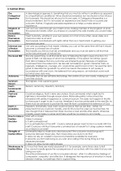
The A deontological approach. Something that you must do without conditions as opposed
Categorical to a hypothetical conditional. Virtue should be rewarded, but we should not be virtuous
Imperative for its rewards. We should be virtuous for its own sake. A Categorical Imperative is a
should statement, but it is not based on experience and doesn't rely on a particular
outcome. Rather, it logically precedes experience or helps us make sense of
experience.
Kingdom of 'Act as if you were through your maxim a law-making member of the kingdom of ends'
Ends The personal morality which you impose on yourself is the safe morality you would make
Formulation law
Ends in 'Treat humanity, whether in your own person or in that of any other, never solely as a
Themselves means but also as an end'
Formulation Treat people as individuals with rights rather than as a mechanism to getting your
favoured outcome
Universal Law 'Act only according to that maxim whereby you can at the same time will that it should
of Nature become a universal law of nature'
Formulation The morality you live by must be universilisable and you must be able to will that that
action becomes part of natural law
The Good Will The only good thing, a will that did its duty of following the right cause of action. It is
good in itself, not because of what it accomplishes. In the search for intrinsic 'good',
Kant did not believe that any outcome was inherently good. Pleasure or happiness
could result from the evilest acts. He also did not believe in 'good' character traits, as
ingenuity, intelligence, courage, etc. could all be used for evil. In fact, he used the term
good to describe the 'goodwill', by which he meant the resolve to act purely in
accordance with one's duty. He believed that using reason, an individual could work
out what one's duty was.
Autonomy The belief that we are self-directed beings, the centre of our own words, making our
own free choices
Summum The highest, most supreme good
Bonum
Kant's Reason, autonomy, freedom, and duty
fundamental
values
Kant and Could be religious, Kant's views are unclear. God commands what is right but its
religion rightness is knowable through reason alone. Rationally perfect virtue should be
rewarded with perfect happiness i.e. summum bonum. This does not happen in this life
but because it ought to be, it can be, therefore it must be achievable in the next life. As
there must be someone to provide this next life Kant considered the existence of God
Kant's 3 Freedom, immortality, God. Kant could not prove that we are free - rather, he
postulates presumed that we could act morally, and for this to be the case we must be free. He
also thought that it followed that there must be a God and life after death, otherwise
morality would make no sense and there would be no reason to act morally.
How to make a Start with a maxim
Kantian Make it universal
decision Is it self-contradictory?
Is it a contradiction of the will? - Could a rational person want to live in a world with this
rule? Could you will that it became a universal law of nature? Is it using a person merely
as a means to an end?
Strengths of Universality helps to make duty clear because if the outcome would be good if
Kantian Ethics everyone followed those rules, then it becomes your duty to do that
It does not rely on a belief in God and is therefore available for everyone
It prevents you from behaving as you wish and calling it the loving thing as it has
absolutist principles
It does not allow human rights abuses
Weaknesses to Is it true that there are moral absolutes? Is it, for example, some times okay to lie?
Kantian Ethics You cannot morally ignore the consequences of our actions with the claim that you are
doing your duty
The ethical dimension of our life is not purely rational - often it is affected by feelings of
compassion, sympathy, and affection. It disregards the importance of emotion in moral
decision making - but perhaps that is a good thing.
The A deontological approach. Something that you must do without conditions as opposed
Categorical to a hypothetical conditional. Virtue should be rewarded, but we should not be virtuous
Imperative for its rewards. We should be virtuous for its own sake. A Categorical Imperative is a
should statement, but it is not based on experience and doesn't rely on a particular
outcome. Rather, it logically precedes experience or helps us make sense of
experience.
Kingdom of 'Act as if you were through your maxim a law-making member of the kingdom of ends'
Ends The personal morality which you impose on yourself is the safe morality you would make
Formulation law
Ends in 'Treat humanity, whether in your own person or in that of any other, never solely as a
Themselves means but also as an end'
Formulation Treat people as individuals with rights rather than as a mechanism to getting your
favoured outcome
Universal Law 'Act only according to that maxim whereby you can at the same time will that it should
of Nature become a universal law of nature'
Formulation The morality you live by must be universilisable and you must be able to will that that
action becomes part of natural law
The Good Will The only good thing, a will that did its duty of following the right cause of action. It is
good in itself, not because of what it accomplishes. In the search for intrinsic 'good',
Kant did not believe that any outcome was inherently good. Pleasure or happiness
could result from the evilest acts. He also did not believe in 'good' character traits, as
ingenuity, intelligence, courage, etc. could all be used for evil. In fact, he used the term
good to describe the 'goodwill', by which he meant the resolve to act purely in
accordance with one's duty. He believed that using reason, an individual could work
out what one's duty was.
Autonomy The belief that we are self-directed beings, the centre of our own words, making our
own free choices
Summum The highest, most supreme good
Bonum
Kant's Reason, autonomy, freedom, and duty
fundamental
values
Kant and Could be religious, Kant's views are unclear. God commands what is right but its
religion rightness is knowable through reason alone. Rationally perfect virtue should be
rewarded with perfect happiness i.e. summum bonum. This does not happen in this life
but because it ought to be, it can be, therefore it must be achievable in the next life. As
there must be someone to provide this next life Kant considered the existence of God
Kant's 3 Freedom, immortality, God. Kant could not prove that we are free - rather, he
postulates presumed that we could act morally, and for this to be the case we must be free. He
also thought that it followed that there must be a God and life after death, otherwise
morality would make no sense and there would be no reason to act morally.
How to make a Start with a maxim
Kantian Make it universal
decision Is it self-contradictory?
Is it a contradiction of the will? - Could a rational person want to live in a world with this
rule? Could you will that it became a universal law of nature? Is it using a person merely
as a means to an end?
Strengths of Universality helps to make duty clear because if the outcome would be good if
Kantian Ethics everyone followed those rules, then it becomes your duty to do that
It does not rely on a belief in God and is therefore available for everyone
It prevents you from behaving as you wish and calling it the loving thing as it has
absolutist principles
It does not allow human rights abuses
Weaknesses to Is it true that there are moral absolutes? Is it, for example, some times okay to lie?
Kantian Ethics You cannot morally ignore the consequences of our actions with the claim that you are
doing your duty
The ethical dimension of our life is not purely rational - often it is affected by feelings of
compassion, sympathy, and affection. It disregards the importance of emotion in moral
decision making - but perhaps that is a good thing.