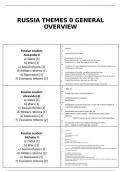
RUSSIA THEMES 0 GENERAL
OVERVIEW
a)
1855–81
Russian Leaders b)
End of Crimean war (1856)
Alexander II c)
a) Dates [1]
Emancipation of the serfs
Placed administration of schools under the Zemstvo.
b) Wars [1]
d)
Doubled the no_ of ppl attending schools by 1865.
c) Social reforms [3] The defeat @ Crimea highlighted the problems in the military, leading to the
military being modernised.
d) Military reforms [1] e)
Emancipation of the serfs – partially to prevent uprisings
e) Repression [4]
Approved plans leading to the Circassian genocide.
Replaced the Third Section of the Imperial Chancellery (a form of the secret
f) Economic reforms [1]
police he inherited) w the ‘softer’ Okhrana in 1880.
Despite liberal polices, repression was still used.
f)
The Reutern reforms (1862-78) encouraged foreign investment.
a)
1881-94
Russian Leaders b)
Avoided any wars (“The Peacemaker”)
Alexander III c)
Undid Alexander II’s local gov.
a) Dates [1] Russification
d)
b) Wars [1] Russification meant the army had a major role in peace-keeping &
monitoring national frontiers.
c) Social reforms [2] e)
d) Military reforms [1]
Russification was used to control the ppl.
1881 Statute of state security – enhanced the powers of the
e) Repression [3] Okhrana.
o Used it to spy on, arrest, imprison, &/or exile opposition.
f) Economic reforms [2] f)
Construction of the Trans-Siberian line began in 1891.
1891 – Medele’ev tariff raised gov revenues.
a)
1894-1917
Russian Leaders
b)
Start of WWI
Russo-Japanese War (lost)
Nicholas II
c)
Feb 1917 rev
Education
a) Dates [1]
Stolypin – land reforms
Nicholas II was still committed to an autocracy.
b) Wars [3]
d)
From 1905-17, the army was mainly used to dismantle strikes, protests, & riots.
o But troops had a tendency to desert & join the protesters.
c) Social reforms [3] Nicholas went to the front lines & declared himself the commander during WWI, meaning anything that
went wrong was on him.
e)
d) Military reforms [3]
Put political opponents in prison
Bloody Sunday massacres (1905)
e) Repression [5]
Stolypin used the carrot & stick method.
Censorship was initially relaxed & then strengthened again.
Okhrana had a small role in 1890s as it was relatively stable, but their activity increased as opposition
f) Economic reforms [2] f)
became more organised.
Emergence of kulaks & commercial farming.
1893-1903 – Witte reforms (the ‘Great Spurt’).
, a)
Russian Leaders
b)
Feb-Oct 1917
Provisional Government
WWI
Oct 1917 rev
c)
a) Dates [1] Avoided major reform b/c they expected a new gov to take their place soon-
ish.
b) Wars [2] d)
No major reform of the army occurred since the army listened to the
c) Social reforms [1] Petrograd Soviets rather than the PG.
e)
d) Military reforms [1] Reversed many repressive policies (e.g. censorship gone, local militias
disbanded, political prisoners released).
e) Repression [2] Focused more on wartime security – created the Counter Espionage Bureau.
f)
f) Economic reforms [1] Dec 1917 – state capitalism – central control of economy through the
Supreme Economic Council.
a)
1917-1924
Russian Leaders b)
End of WWI (Treaty of Brest-Litovsk)
Civil war between red & whites (won)
Lenin c)
Redistributed land among the peasants.
a) Dates [1]
d)
War Communism
The size of the Red Army grew to 5 mill during the course of the civil war (vs 500 000 in the
b) Wars [2]
Whites).
War communism
c) Social reforms [2]
e)
There were still problems w desertion & rebellion (e.g. Kronstatdt in Feb 1921).
d) Military reforms [3]
Red Terror (to consolidate the Communist regime).
Banned opposition
Cheka (secret police) set up to work alongside the Red Army to impose policies - disbanded after
e) Repression [5]
the end of the Civil war.
Press freedom was abolished to supress ‘counter-revs’
f) Economic reforms [2]
1921 – the Agitprop was set up to circulate propaganda abt the idealized Russian life.
f)
War Communism was enforced by the Red Army & the Cheka.
The NEP – went against communist ideology.
a)
1922-53
b)
Russian Leaders
WWII (won)
Cold war
c)
Stalin
1930 –primary school made compulsory till 12yo.
1939 – Stalin scrapped school fees.
a) Dates [1]
d)
The Great Purge (1936-8) removed key military figures from the military.
Used the army to impose economic policy.
b) Wars [2] o
o
Red Army was used to requisition grain as part of collectivisation.
Played a large part in implementing the Great Terror.
e)
c) Social reforms [2] NKVD (secret police) set up to deal w opposition.
o Replaced by the NKGB in 1943.
d) Military reforms [4] o
o
Later turn replaced by the MVD & MGB in 1946.
Then merged in 1953 into the MVD.
Purges
e) Repression [9]
Dekulakisation
Propaganda (‘Uncle Joe’)
f) Economic reforms [2]
Further increased censorship, which continued during WWII.
o Much effort was put into doctoring info abt the rest of the world.
f)
Collectivisation & dekulakisation – aimed to improve agriculture.
5yr plan – aimed for economic autarky (self-sufficiency).
a)
1953-64
b)
Russian Leaders
c)
Cold War (tried to deescalate, was initially successful)
Khrushchev
Destalinisation
Housing
a) Dates [1]
Gulags gone
d)
The main role of the army shifted from dealing w internal threats to resolving
b) Wars [1] international conflicts.
o E.g. KGB’s main role was spying on foreign ppl.
c) Social reforms [3]
The détente led to a reduction of the army from 3.6 mill to 2.4 mill.
MVD was reorganised in March 1954 into the MVD & KGB, both put under the direct
d) Military reforms [4] e)
administration of the party.
Repression against countries who wanted independence – e.g. 1956 Hungarian Uprising.
e) Repression [3]
Gulags gone.
Censorship was eased – by late 1950s, 65 000 books were being published /yr.
f) Economic reforms [3] f)
5yr plan – aimed for economic autarky (self-sufficiency).
1954 – Virgin Land Scheme.
Centralised planning of economy
OVERVIEW
a)
1855–81
Russian Leaders b)
End of Crimean war (1856)
Alexander II c)
a) Dates [1]
Emancipation of the serfs
Placed administration of schools under the Zemstvo.
b) Wars [1]
d)
Doubled the no_ of ppl attending schools by 1865.
c) Social reforms [3] The defeat @ Crimea highlighted the problems in the military, leading to the
military being modernised.
d) Military reforms [1] e)
Emancipation of the serfs – partially to prevent uprisings
e) Repression [4]
Approved plans leading to the Circassian genocide.
Replaced the Third Section of the Imperial Chancellery (a form of the secret
f) Economic reforms [1]
police he inherited) w the ‘softer’ Okhrana in 1880.
Despite liberal polices, repression was still used.
f)
The Reutern reforms (1862-78) encouraged foreign investment.
a)
1881-94
Russian Leaders b)
Avoided any wars (“The Peacemaker”)
Alexander III c)
Undid Alexander II’s local gov.
a) Dates [1] Russification
d)
b) Wars [1] Russification meant the army had a major role in peace-keeping &
monitoring national frontiers.
c) Social reforms [2] e)
d) Military reforms [1]
Russification was used to control the ppl.
1881 Statute of state security – enhanced the powers of the
e) Repression [3] Okhrana.
o Used it to spy on, arrest, imprison, &/or exile opposition.
f) Economic reforms [2] f)
Construction of the Trans-Siberian line began in 1891.
1891 – Medele’ev tariff raised gov revenues.
a)
1894-1917
Russian Leaders
b)
Start of WWI
Russo-Japanese War (lost)
Nicholas II
c)
Feb 1917 rev
Education
a) Dates [1]
Stolypin – land reforms
Nicholas II was still committed to an autocracy.
b) Wars [3]
d)
From 1905-17, the army was mainly used to dismantle strikes, protests, & riots.
o But troops had a tendency to desert & join the protesters.
c) Social reforms [3] Nicholas went to the front lines & declared himself the commander during WWI, meaning anything that
went wrong was on him.
e)
d) Military reforms [3]
Put political opponents in prison
Bloody Sunday massacres (1905)
e) Repression [5]
Stolypin used the carrot & stick method.
Censorship was initially relaxed & then strengthened again.
Okhrana had a small role in 1890s as it was relatively stable, but their activity increased as opposition
f) Economic reforms [2] f)
became more organised.
Emergence of kulaks & commercial farming.
1893-1903 – Witte reforms (the ‘Great Spurt’).
, a)
Russian Leaders
b)
Feb-Oct 1917
Provisional Government
WWI
Oct 1917 rev
c)
a) Dates [1] Avoided major reform b/c they expected a new gov to take their place soon-
ish.
b) Wars [2] d)
No major reform of the army occurred since the army listened to the
c) Social reforms [1] Petrograd Soviets rather than the PG.
e)
d) Military reforms [1] Reversed many repressive policies (e.g. censorship gone, local militias
disbanded, political prisoners released).
e) Repression [2] Focused more on wartime security – created the Counter Espionage Bureau.
f)
f) Economic reforms [1] Dec 1917 – state capitalism – central control of economy through the
Supreme Economic Council.
a)
1917-1924
Russian Leaders b)
End of WWI (Treaty of Brest-Litovsk)
Civil war between red & whites (won)
Lenin c)
Redistributed land among the peasants.
a) Dates [1]
d)
War Communism
The size of the Red Army grew to 5 mill during the course of the civil war (vs 500 000 in the
b) Wars [2]
Whites).
War communism
c) Social reforms [2]
e)
There were still problems w desertion & rebellion (e.g. Kronstatdt in Feb 1921).
d) Military reforms [3]
Red Terror (to consolidate the Communist regime).
Banned opposition
Cheka (secret police) set up to work alongside the Red Army to impose policies - disbanded after
e) Repression [5]
the end of the Civil war.
Press freedom was abolished to supress ‘counter-revs’
f) Economic reforms [2]
1921 – the Agitprop was set up to circulate propaganda abt the idealized Russian life.
f)
War Communism was enforced by the Red Army & the Cheka.
The NEP – went against communist ideology.
a)
1922-53
b)
Russian Leaders
WWII (won)
Cold war
c)
Stalin
1930 –primary school made compulsory till 12yo.
1939 – Stalin scrapped school fees.
a) Dates [1]
d)
The Great Purge (1936-8) removed key military figures from the military.
Used the army to impose economic policy.
b) Wars [2] o
o
Red Army was used to requisition grain as part of collectivisation.
Played a large part in implementing the Great Terror.
e)
c) Social reforms [2] NKVD (secret police) set up to deal w opposition.
o Replaced by the NKGB in 1943.
d) Military reforms [4] o
o
Later turn replaced by the MVD & MGB in 1946.
Then merged in 1953 into the MVD.
Purges
e) Repression [9]
Dekulakisation
Propaganda (‘Uncle Joe’)
f) Economic reforms [2]
Further increased censorship, which continued during WWII.
o Much effort was put into doctoring info abt the rest of the world.
f)
Collectivisation & dekulakisation – aimed to improve agriculture.
5yr plan – aimed for economic autarky (self-sufficiency).
a)
1953-64
b)
Russian Leaders
c)
Cold War (tried to deescalate, was initially successful)
Khrushchev
Destalinisation
Housing
a) Dates [1]
Gulags gone
d)
The main role of the army shifted from dealing w internal threats to resolving
b) Wars [1] international conflicts.
o E.g. KGB’s main role was spying on foreign ppl.
c) Social reforms [3]
The détente led to a reduction of the army from 3.6 mill to 2.4 mill.
MVD was reorganised in March 1954 into the MVD & KGB, both put under the direct
d) Military reforms [4] e)
administration of the party.
Repression against countries who wanted independence – e.g. 1956 Hungarian Uprising.
e) Repression [3]
Gulags gone.
Censorship was eased – by late 1950s, 65 000 books were being published /yr.
f) Economic reforms [3] f)
5yr plan – aimed for economic autarky (self-sufficiency).
1954 – Virgin Land Scheme.
Centralised planning of economy