

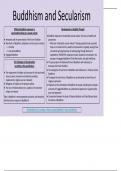
Buddhism and Secularism
Different Buddhist responses to Developments in Buddhist Thought
secularisation/living in a secular society:
● Buddhist responses to materialistic secular values: the value of wealth and
● Amaravati and the preservation of the Forest Tradition possessions
● New forms of Buddhism; adaptations to the secular context. ○ What are ‘materialistic secular values?’ Valuing people by how successful
○ a. Triratna they are in material terms: wealth and possessions. Arguably, valuing these
○ b. Secular Buddhism can lead to ignoring how they are achieved (eg through deceit and
● Engaged Buddhism exploitation). HOWEVER, responses include: Gautama’s renunciation; the
precepts of engaged Buddhism (Thich Nhat Hanh); and right livelihood.
The Challenges of Secularisation ● The preservation of traditional forms of Buddhism with reference to:
according to the specification: Amaravat, the Forest Tradition
● The emergence of new forms of Buddhism with reference to: Triratna, Secular
● The replacement of religion as the source of truth and moral Buddhism
values (science, humanism and atheism providing ● The appeal of some forms of Buddhism as an alternative to other forms of
replacements; religion seen as irrelevant) religious expression.
● Relegation of religion to the personal sphere ● Emphasis on the contribution of Buddhism to society, including the principles
● The rise of militant atheism (inc. Dawkins): the view that and work of Engaged Buddhism as a liberationist approach in supporting the
religion is irrational poor and oppressed.
Why is Buddhism is moving towards secularism, and how/why ● Comparison between the ideas of Stephen Bachelor and David Brazier about
will that have an impact on Buddhism? the nature of Buddhism
Why Buddhism isn't a religion, What is secular Buddhism?, Basics of Buddhism
, Secularism
Secularism in Britain Secularisation Throughout Time
● We know religion is in decline because of the decline in church attendance, but this isn’t a real reflection of why. People ● Secularisation has roots in the Enlightenment, as people began to accept scientific
may not be turning away from religion entirely, but rather leaving religions to pursue their own spiritual path. rationalism and empiricism as providing answers that they used to get from religion.
● Society in Britain has become increasingly secular – Basing arguments on reason alone seemed to remove the need for religion.
○ Fewer people worship or claim to have beliefs, many people claim to be atheist. Britain used to be controlled by the ● Religious changes: reformation, spirituality, secularism
Church in a political and social sense, but increased secularism has shaped society to become very different. ● Philosophical changes: People like Aquinas (influenced by Aristotle): reason can
○ Church in Britain/religious institutions have less say over people’s lives - no longer has responsibility for such things as reveal truth (5 precepts). Over time, we end up with a joint enlightenment and
health care, social care, education or welfare. rationalist movement: Descartes, Kant, and Hume: they argue reason gives us
○ Politics are secular - political and legal decisions are made without religious ideas/moral views. knowledge (not opposed to religion, e.g., how Descartes uses reason to prove god).
○ People are free to believe what they wish. ● The Dark ages stifled rational thought via oppression but in the C13th, religion and
● This implies that either Christianity is losing its authority or that it is so embedded in life today that it is no longer rational thought worked together to allow a development of personal morality.
distinguishable from secular society - see also bullet point about the church being used for practical reasons. ○ Aquinas (C13th): reason can grasp moral truths, but doctrine and scripture are
● Secularism in Buddhism/Buddhist Countries - needed to see the whole truth.
○ In the east, secularism isn’t that big of an issue, apart from mainly in Thailand, e.g., removed monarchy from gov. ● During the Renaissance, people rediscovered classical thought, including Aristotle.
○ In Buddhist cultures, the government has also replaced some of the roles of the Sangha in more modern countries and ● During the (Protestant) Reformation, people were allowed to interpret scripture
communities, e.g., state education replaced in places the education of usually received at a Sangha. according to individual conscience and understanding - people could hold beliefs that
● People go to church for practical reasons, not necessarily religious ones: did not conform to the national religion.
○ Sangha in Buddhism is community focused, gatherings, education for children, etc. ● In the C17th and C18th, the rise of scientific thinking led some to believe that belief in
○ Same for Christianity - church no longer as powerful or influential. In recent times, people are getting poorer and are God was not necessary (rationalist movement).
unable to seek the help they need, so Churches are more involved in religious communities because they’re providing a ● In the C19th, faith was a matter of personal commitment: religion was seen as
practical need, not a social need. Religion providing a social function still plays a massive part in communities. This functional, e.g., keep the W/C from fighting their oppressors (Marx) or satisfy a
explains why, though Britain is becoming more secular, religion/religious communities still play a key role. psychological need (Freud). Religion was seen as personal, but optional.
Rationalism and Secularisation
● Move towards rationalism = move away from religion; reason reveals truth, not religion.
● Hegel blames Kant for deism and secularism (Deism: God is distant from Creation and is impersonal).
○ Kant removed God from morality and the lives of humanity. He shows that reason, what proves right and wrong, is separate from religion. We no longer needed God for moral code.
○ Somewhat like Aquinas and Aristotle - we could use pure practical reason to determine what was God. The religious ethics that came up at this time did not really involve god. (You can bring in deontology, NML
(though it's based on God, modern proportionalists take that element away and others make it more atheistic) and Virtue Ethics here).
● In European society, people are moving away from religion because there are many things happening outside the church, e.g., rights, healthcare, etc.
● In relation to Buddhism -
○ Could be argued the west had no need/appetite for religion as it didn't see religion as a moral guide. So, secularists have no desire to search for truth in religion when reason can do it. This impacts Buddhism:
western views are going towards secularism, scientific thinking, and these ideas (modern culture) are transferred around the world because the west virtually dominates the world (via globalisation mainly).
○ It starts by rejecting Christianity (is historically oppressive), but it merges with a scientific rejection of religion/western religions. It then mixes with modern wars/extremism (so Islam plays a part here: people have
already been put off, and extremists further emphasise evil in religion, which pushes people away further), so when Buddhism offers something new, promoting peace with no ultimate God, people are likely to
reject it because they’re tired of ‘playing games’ - a religion says it’s good, then does something bad, e.g., 300 monks attacking Muslim shrine in 2011.
○ HOWEVER, being different may be appealing in the west, especially its focus on philosophy and thought, e.g., monasteries in places like Manchester are thriving with expats and (mainly) British-born people that
have converted, which then transports globally. In a secular context, Buddhism/Buddhist dharma, where reason/contemplation are key, may appeal to modern mindsets and be an alternative to secularism.
○ All religions are now under fire due to modern western issues with religion in general. Also, views like those of Marx are transported academically around the world, but not as much in popular culture.
, The Challenges of
Secularisation
(in the British Context)
Different Buddhist responses to Developments in Buddhist Thought
secularisation/living in a secular society:
● Buddhist responses to materialistic secular values: the value of wealth and
● Amaravati and the preservation of the Forest Tradition possessions
● New forms of Buddhism; adaptations to the secular context. ○ What are ‘materialistic secular values?’ Valuing people by how successful
○ a. Triratna they are in material terms: wealth and possessions. Arguably, valuing these
○ b. Secular Buddhism can lead to ignoring how they are achieved (eg through deceit and
● Engaged Buddhism exploitation). HOWEVER, responses include: Gautama’s renunciation; the
precepts of engaged Buddhism (Thich Nhat Hanh); and right livelihood.
The Challenges of Secularisation ● The preservation of traditional forms of Buddhism with reference to:
according to the specification: Amaravat, the Forest Tradition
● The emergence of new forms of Buddhism with reference to: Triratna, Secular
● The replacement of religion as the source of truth and moral Buddhism
values (science, humanism and atheism providing ● The appeal of some forms of Buddhism as an alternative to other forms of
replacements; religion seen as irrelevant) religious expression.
● Relegation of religion to the personal sphere ● Emphasis on the contribution of Buddhism to society, including the principles
● The rise of militant atheism (inc. Dawkins): the view that and work of Engaged Buddhism as a liberationist approach in supporting the
religion is irrational poor and oppressed.
Why is Buddhism is moving towards secularism, and how/why ● Comparison between the ideas of Stephen Bachelor and David Brazier about
will that have an impact on Buddhism? the nature of Buddhism
Why Buddhism isn't a religion, What is secular Buddhism?, Basics of Buddhism
, Secularism
Secularism in Britain Secularisation Throughout Time
● We know religion is in decline because of the decline in church attendance, but this isn’t a real reflection of why. People ● Secularisation has roots in the Enlightenment, as people began to accept scientific
may not be turning away from religion entirely, but rather leaving religions to pursue their own spiritual path. rationalism and empiricism as providing answers that they used to get from religion.
● Society in Britain has become increasingly secular – Basing arguments on reason alone seemed to remove the need for religion.
○ Fewer people worship or claim to have beliefs, many people claim to be atheist. Britain used to be controlled by the ● Religious changes: reformation, spirituality, secularism
Church in a political and social sense, but increased secularism has shaped society to become very different. ● Philosophical changes: People like Aquinas (influenced by Aristotle): reason can
○ Church in Britain/religious institutions have less say over people’s lives - no longer has responsibility for such things as reveal truth (5 precepts). Over time, we end up with a joint enlightenment and
health care, social care, education or welfare. rationalist movement: Descartes, Kant, and Hume: they argue reason gives us
○ Politics are secular - political and legal decisions are made without religious ideas/moral views. knowledge (not opposed to religion, e.g., how Descartes uses reason to prove god).
○ People are free to believe what they wish. ● The Dark ages stifled rational thought via oppression but in the C13th, religion and
● This implies that either Christianity is losing its authority or that it is so embedded in life today that it is no longer rational thought worked together to allow a development of personal morality.
distinguishable from secular society - see also bullet point about the church being used for practical reasons. ○ Aquinas (C13th): reason can grasp moral truths, but doctrine and scripture are
● Secularism in Buddhism/Buddhist Countries - needed to see the whole truth.
○ In the east, secularism isn’t that big of an issue, apart from mainly in Thailand, e.g., removed monarchy from gov. ● During the Renaissance, people rediscovered classical thought, including Aristotle.
○ In Buddhist cultures, the government has also replaced some of the roles of the Sangha in more modern countries and ● During the (Protestant) Reformation, people were allowed to interpret scripture
communities, e.g., state education replaced in places the education of usually received at a Sangha. according to individual conscience and understanding - people could hold beliefs that
● People go to church for practical reasons, not necessarily religious ones: did not conform to the national religion.
○ Sangha in Buddhism is community focused, gatherings, education for children, etc. ● In the C17th and C18th, the rise of scientific thinking led some to believe that belief in
○ Same for Christianity - church no longer as powerful or influential. In recent times, people are getting poorer and are God was not necessary (rationalist movement).
unable to seek the help they need, so Churches are more involved in religious communities because they’re providing a ● In the C19th, faith was a matter of personal commitment: religion was seen as
practical need, not a social need. Religion providing a social function still plays a massive part in communities. This functional, e.g., keep the W/C from fighting their oppressors (Marx) or satisfy a
explains why, though Britain is becoming more secular, religion/religious communities still play a key role. psychological need (Freud). Religion was seen as personal, but optional.
Rationalism and Secularisation
● Move towards rationalism = move away from religion; reason reveals truth, not religion.
● Hegel blames Kant for deism and secularism (Deism: God is distant from Creation and is impersonal).
○ Kant removed God from morality and the lives of humanity. He shows that reason, what proves right and wrong, is separate from religion. We no longer needed God for moral code.
○ Somewhat like Aquinas and Aristotle - we could use pure practical reason to determine what was God. The religious ethics that came up at this time did not really involve god. (You can bring in deontology, NML
(though it's based on God, modern proportionalists take that element away and others make it more atheistic) and Virtue Ethics here).
● In European society, people are moving away from religion because there are many things happening outside the church, e.g., rights, healthcare, etc.
● In relation to Buddhism -
○ Could be argued the west had no need/appetite for religion as it didn't see religion as a moral guide. So, secularists have no desire to search for truth in religion when reason can do it. This impacts Buddhism:
western views are going towards secularism, scientific thinking, and these ideas (modern culture) are transferred around the world because the west virtually dominates the world (via globalisation mainly).
○ It starts by rejecting Christianity (is historically oppressive), but it merges with a scientific rejection of religion/western religions. It then mixes with modern wars/extremism (so Islam plays a part here: people have
already been put off, and extremists further emphasise evil in religion, which pushes people away further), so when Buddhism offers something new, promoting peace with no ultimate God, people are likely to
reject it because they’re tired of ‘playing games’ - a religion says it’s good, then does something bad, e.g., 300 monks attacking Muslim shrine in 2011.
○ HOWEVER, being different may be appealing in the west, especially its focus on philosophy and thought, e.g., monasteries in places like Manchester are thriving with expats and (mainly) British-born people that
have converted, which then transports globally. In a secular context, Buddhism/Buddhist dharma, where reason/contemplation are key, may appeal to modern mindsets and be an alternative to secularism.
○ All religions are now under fire due to modern western issues with religion in general. Also, views like those of Marx are transported academically around the world, but not as much in popular culture.
, The Challenges of
Secularisation
(in the British Context)


