
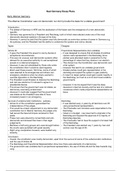
Nazi Germany Essay Plans
Early Weimar Germany
‘The Weimar Constitution was not democratic nor did it provide the basis for a stable government’
Introduction
• The defeat of Germany in WWI and the abdication of the Kaiser saw the emergence of a new democratic
republic.
• Germany was governed by a President and Reichstag, both of which were elected under one of the most
democratic electoral systems in Europe at the time.
• However, it cannot be said that the system was fully democratic as some key centres of power in Germany e.g.
the judiciary, and the President had the ability to undermine the system and rule by decree.
Agree Disagree
Article 48 Proportional Representation (but unstable)
• It gave the President the power to rule by decree in • It was designed to ensure that all shades of political
exceptional circumstances. opinion were represented in the Reichstag, since
• This was not unusual, and democratic systems often parties were allocated seats in proportion to the
allowed for an executive authority to use exceptional percentage of votes that they receive in an election.
powers in a national emergency. • This shows how the Constitution was democratic and
• However, it was not anticipated by those who wrote a fair system.
the constitution that it would be used regularly. • However this lead to an unstable government.
• Ebert used these powers 136 times, some of which • Smaller parties could gain representation in the
were deemed to be emergencies and others non- reichstag and exploit the system to gain publicity.
emergency situations when he simply wanted to • It meant no larger parties could gain overall majority in
override opposition in the Reichstag. the Reichstag, so it led to a lot of short lived coalition
• The President could threaten to dissolve the Reichstag governments.
and call new elections if it refused to agree to a
presidential decree. • However, it can be argued that it was the deep
• This shows that the government was not stable, as devisions in German society and the lack of a national
democracy was being undermined. consensus which made proportional representation an
• However it could also suggest that the government issue.
was stable as the President was able to have
increased powers in an emergency.
Survival of undemocratic institutions - judiciary Reichstag
• Article 54 of the constitution guaranteed the • It was elected every 4 years by all Germans over 20
independence of the judges. using proportional representation.
• This would be a basic requirement in any democratic • The Chancellor and ministers were responsible to the
constitution but in Weimar Germany the judges who Reichstag.
had served the Second Empire remained in their • Voted on a budget - new laws had to originate in the
posts. Reichstag and required the approval of a majority of
• These men were staunchly monarchists and anti- Reichstag deputies.
democratic and showed their bias in their legal • The Chancellor had to have the support of at least half
judgements. of the Reichstag.
• Members of left wing groups who were brought before • The President was elected very 7 years by men and
the courts were punished with great severity. women over the age of 20.
• Right wing conspirators however, were treated very
leniently.
Conclusion
• Overall, the constitution was mostly democratic, apart from the survival of some of the undemocratic institutions
and the use of Article 48.
• The Reichstag and Proportional Representation show how there were elements of a democracy.
• The government was unstable due to proportional representation, the use of Article 48 and the bias towards ring
wing.
Early Weimar Germany
‘The Weimar Constitution was not democratic nor did it provide the basis for a stable government’
Introduction
• The defeat of Germany in WWI and the abdication of the Kaiser saw the emergence of a new democratic
republic.
• Germany was governed by a President and Reichstag, both of which were elected under one of the most
democratic electoral systems in Europe at the time.
• However, it cannot be said that the system was fully democratic as some key centres of power in Germany e.g.
the judiciary, and the President had the ability to undermine the system and rule by decree.
Agree Disagree
Article 48 Proportional Representation (but unstable)
• It gave the President the power to rule by decree in • It was designed to ensure that all shades of political
exceptional circumstances. opinion were represented in the Reichstag, since
• This was not unusual, and democratic systems often parties were allocated seats in proportion to the
allowed for an executive authority to use exceptional percentage of votes that they receive in an election.
powers in a national emergency. • This shows how the Constitution was democratic and
• However, it was not anticipated by those who wrote a fair system.
the constitution that it would be used regularly. • However this lead to an unstable government.
• Ebert used these powers 136 times, some of which • Smaller parties could gain representation in the
were deemed to be emergencies and others non- reichstag and exploit the system to gain publicity.
emergency situations when he simply wanted to • It meant no larger parties could gain overall majority in
override opposition in the Reichstag. the Reichstag, so it led to a lot of short lived coalition
• The President could threaten to dissolve the Reichstag governments.
and call new elections if it refused to agree to a
presidential decree. • However, it can be argued that it was the deep
• This shows that the government was not stable, as devisions in German society and the lack of a national
democracy was being undermined. consensus which made proportional representation an
• However it could also suggest that the government issue.
was stable as the President was able to have
increased powers in an emergency.
Survival of undemocratic institutions - judiciary Reichstag
• Article 54 of the constitution guaranteed the • It was elected every 4 years by all Germans over 20
independence of the judges. using proportional representation.
• This would be a basic requirement in any democratic • The Chancellor and ministers were responsible to the
constitution but in Weimar Germany the judges who Reichstag.
had served the Second Empire remained in their • Voted on a budget - new laws had to originate in the
posts. Reichstag and required the approval of a majority of
• These men were staunchly monarchists and anti- Reichstag deputies.
democratic and showed their bias in their legal • The Chancellor had to have the support of at least half
judgements. of the Reichstag.
• Members of left wing groups who were brought before • The President was elected very 7 years by men and
the courts were punished with great severity. women over the age of 20.
• Right wing conspirators however, were treated very
leniently.
Conclusion
• Overall, the constitution was mostly democratic, apart from the survival of some of the undemocratic institutions
and the use of Article 48.
• The Reichstag and Proportional Representation show how there were elements of a democracy.
• The government was unstable due to proportional representation, the use of Article 48 and the bias towards ring
wing.



