

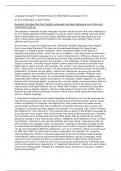
Language Change A* Exemplar Essay for AQA English Language A level
8th June 2018 Paper 2- AQA 7702/2
Evaluate the idea that the English Language has been decaying over time and
continues to do so.
The question of whether English language has been decaying over time and continues to
do so is highly debated among linguists, as well as within society. Whilst some are of the
opinion that English was once at a great, beautiful peak and has been declining ever
since, others would argue that changes to the language have actually made it more
efficient and functional.
On one hand, it could be argued that the standards of English language have slipped
from a once ideal standard. This idea can be expressed through the linguist Jean
Aitchison’s ‘crumbling castle’ metaphor, which compares English of the past to a
beautiful and pristine castle , which has since crumbled, a view also known as declinism,
suggesting that English language is on a never ending decline in efficiency, beauty and
standards. This view could be supported by the fact that several grammatical rules of the
past are now commonly ignored. For example, in his 1780 book ‘A Short Introduction to
English Grammar’, the early linguist Robert Lowthe stated that sentences should never
begin with an object pronoun (for example, the ‘correct’ noun phrase would be ‘my dog
and I’, rather than ‘me and my dog’). He also stated that sentences should not end with a
preposition (‘To where are you going’, rather than ‘Where are you going to) and that
double negation (for example I haven’t got none), should be avoided. However, since
1780, these so called ‘incorrect’ or non-standard features have become widely used,
especially within certain regions and dialects. For example, double negation is a common
feature of the Somerset dialect, as well as the currently rapidly increasing dialect MLE (or
Multicultural London English). Whilst it could be argued that this has always been the
case as even old English dialects such as ‘West Saxon English’ contained non-standard
features such as double negation, with the rapid spread of dialect such as MLE, these
features are becoming increasingly common, which many would argue demonstrates a
decay in English language.
It could also be argued that the English language is decaying over time as language has
now become exclusionary, with the rise of new means of communication such as social
media and texting. For example, the linguist Gary Ives researched text speak among
young people and found that they sometimes incorporate features such as slang, new
coinages or acronyms into their speech (for example ‘I’m not going, CBA’, which includes
the initialism for ‘Can’t Be Ars*d’. This could be seen as decay in the English Language as
it has become more cryptic, with certain terms only being understood by teens. Similarly,
the increased use of professional lexis and office jargon may be argued to be causing
decay by making it more exclusionary. Idioms, metaphors and euphemisms such as ‘blue
sky thinking’, meaning to only see the positives and ‘touch base’, meaning to catch up
with someone are arguably cryptic and pointless, making the intended message harder
to understand and therefore going against the very function of speech. Similar features
can be seen throughout different professions, such as in medicine, where acronyms such
as ‘MRI’ and ‘DNA’ are often used, or even in education, for example ‘LO’, meaning
Learning Objective. Whilst it could be argued that these new coinages make language
more efficient, others would argue that this demonstrates a decay in language, which
used to be much simpler and easy to understand. Some of these terms could also be
argued to be sinister in nature as they aim to mask poor performance or unfriendly acts,
such as the euphemisms ‘downsizing’ or ‘headcount adjustment’, which are used instead
of the term ‘firing people’. Possibly this indicates decay as the true meaning is masked
behind euphemisms.
8th June 2018 Paper 2- AQA 7702/2
Evaluate the idea that the English Language has been decaying over time and
continues to do so.
The question of whether English language has been decaying over time and continues to
do so is highly debated among linguists, as well as within society. Whilst some are of the
opinion that English was once at a great, beautiful peak and has been declining ever
since, others would argue that changes to the language have actually made it more
efficient and functional.
On one hand, it could be argued that the standards of English language have slipped
from a once ideal standard. This idea can be expressed through the linguist Jean
Aitchison’s ‘crumbling castle’ metaphor, which compares English of the past to a
beautiful and pristine castle , which has since crumbled, a view also known as declinism,
suggesting that English language is on a never ending decline in efficiency, beauty and
standards. This view could be supported by the fact that several grammatical rules of the
past are now commonly ignored. For example, in his 1780 book ‘A Short Introduction to
English Grammar’, the early linguist Robert Lowthe stated that sentences should never
begin with an object pronoun (for example, the ‘correct’ noun phrase would be ‘my dog
and I’, rather than ‘me and my dog’). He also stated that sentences should not end with a
preposition (‘To where are you going’, rather than ‘Where are you going to) and that
double negation (for example I haven’t got none), should be avoided. However, since
1780, these so called ‘incorrect’ or non-standard features have become widely used,
especially within certain regions and dialects. For example, double negation is a common
feature of the Somerset dialect, as well as the currently rapidly increasing dialect MLE (or
Multicultural London English). Whilst it could be argued that this has always been the
case as even old English dialects such as ‘West Saxon English’ contained non-standard
features such as double negation, with the rapid spread of dialect such as MLE, these
features are becoming increasingly common, which many would argue demonstrates a
decay in English language.
It could also be argued that the English language is decaying over time as language has
now become exclusionary, with the rise of new means of communication such as social
media and texting. For example, the linguist Gary Ives researched text speak among
young people and found that they sometimes incorporate features such as slang, new
coinages or acronyms into their speech (for example ‘I’m not going, CBA’, which includes
the initialism for ‘Can’t Be Ars*d’. This could be seen as decay in the English Language as
it has become more cryptic, with certain terms only being understood by teens. Similarly,
the increased use of professional lexis and office jargon may be argued to be causing
decay by making it more exclusionary. Idioms, metaphors and euphemisms such as ‘blue
sky thinking’, meaning to only see the positives and ‘touch base’, meaning to catch up
with someone are arguably cryptic and pointless, making the intended message harder
to understand and therefore going against the very function of speech. Similar features
can be seen throughout different professions, such as in medicine, where acronyms such
as ‘MRI’ and ‘DNA’ are often used, or even in education, for example ‘LO’, meaning
Learning Objective. Whilst it could be argued that these new coinages make language
more efficient, others would argue that this demonstrates a decay in language, which
used to be much simpler and easy to understand. Some of these terms could also be
argued to be sinister in nature as they aim to mask poor performance or unfriendly acts,
such as the euphemisms ‘downsizing’ or ‘headcount adjustment’, which are used instead
of the term ‘firing people’. Possibly this indicates decay as the true meaning is masked
behind euphemisms.


