

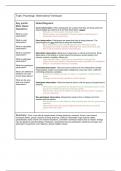
Topic: Psychology- Observational Techniques
Key points/ Notes/Diagrams:
Main Ideas/
Covert observation- When participants are unaware that they are being observed
Questions: (psychologists go undercover to do their observation- closed).
- Behaviour is more natural. Increased validity.
What is covert - Ethical issues- only acceptable to observe people in public places if
observation? behaviours aren’t private ones.
What is overt Overt observation- Participants are aware that they’re being observed. The
observation? psychologists are open that they’re doing the observation.
- More ethical than covert. Participants are given informed consent.
What is naturalistic - Participants are likely to behave differently from usual if they know that
observation? they’re being watched- demand characteristics.
What is controlled Naturalistic observation- Behaviour is observed in a natural environment. Study
observation? takes place in the setting or context where the behaviour would usually occur
(prisons, schools, hospitals, offices etc.)
What is participant - High external validity- results can be generalised to everyday life.
observation? - Lacks control over research situations and makes replication of investigation
difficult. Uncontrolled extraneous variables.
What non-participant
observation? Controlled observation- There are some controls over the independent variable.
Psychologists usually record dependent variables by a two-way mirror. Useful for
What’s the difference controlling extraneous variables.
between overt and - Extraneous variables are less of a factor, so replication of observation is
covert observations? easier.
- Findings cannot be easily applied to real life settings.
What are the pros
and cons of each Participant observation- When the observer joins in with the group of people they’re
observation? studying.
- Researchers can experience the situation from the participants point of view,
giving more realistic results and increasing validity.
- Researchers may come to identify too strongly with those they’re studying
and lose objectivity.
Non-participant observation- Researchers observe from a distance but don’t
interfere with the studies.
- Researcher can be more objective when standing back from the group being
observed
- Researchers may miss special insights into behaviour that can only be
gained “from the inside”
Summary: Overt- more ethical, people aware of being observed, unnatural. Covert- more natural,
increased validity, people unaware of being observed, unethical. Naturalistic- high external validity,
generalisable, lacks control over research situations. Controlled- extraneous factors less of a factor, findings
cant be applied to real life settings. Participant- researchers become participants, identify too strongly. Non-
participant- researchers more objective, special insights missed.
Key points/ Notes/Diagrams:
Main Ideas/
Covert observation- When participants are unaware that they are being observed
Questions: (psychologists go undercover to do their observation- closed).
- Behaviour is more natural. Increased validity.
What is covert - Ethical issues- only acceptable to observe people in public places if
observation? behaviours aren’t private ones.
What is overt Overt observation- Participants are aware that they’re being observed. The
observation? psychologists are open that they’re doing the observation.
- More ethical than covert. Participants are given informed consent.
What is naturalistic - Participants are likely to behave differently from usual if they know that
observation? they’re being watched- demand characteristics.
What is controlled Naturalistic observation- Behaviour is observed in a natural environment. Study
observation? takes place in the setting or context where the behaviour would usually occur
(prisons, schools, hospitals, offices etc.)
What is participant - High external validity- results can be generalised to everyday life.
observation? - Lacks control over research situations and makes replication of investigation
difficult. Uncontrolled extraneous variables.
What non-participant
observation? Controlled observation- There are some controls over the independent variable.
Psychologists usually record dependent variables by a two-way mirror. Useful for
What’s the difference controlling extraneous variables.
between overt and - Extraneous variables are less of a factor, so replication of observation is
covert observations? easier.
- Findings cannot be easily applied to real life settings.
What are the pros
and cons of each Participant observation- When the observer joins in with the group of people they’re
observation? studying.
- Researchers can experience the situation from the participants point of view,
giving more realistic results and increasing validity.
- Researchers may come to identify too strongly with those they’re studying
and lose objectivity.
Non-participant observation- Researchers observe from a distance but don’t
interfere with the studies.
- Researcher can be more objective when standing back from the group being
observed
- Researchers may miss special insights into behaviour that can only be
gained “from the inside”
Summary: Overt- more ethical, people aware of being observed, unnatural. Covert- more natural,
increased validity, people unaware of being observed, unethical. Naturalistic- high external validity,
generalisable, lacks control over research situations. Controlled- extraneous factors less of a factor, findings
cant be applied to real life settings. Participant- researchers become participants, identify too strongly. Non-
participant- researchers more objective, special insights missed.


