

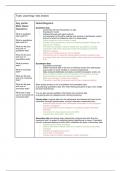
Topic: psychology- data analysis
Key points/ Notes/Diagrams:
Main Ideas/
Qualitative Data
Questions: - Concerned with the interpretation of data.
- Expressed in words
What is qualitative - Gathered through self report methods
data used for? (e.g description of thoughts, feelings and opinions of participants; written
account of what the researcher saw in an observation)
What is quantitative - Offers researcher more richness of detail
data used for? - Broader- gives participants a chance to develop thoughts, feelings and
opinions of a subject.
What are the pros - Therefore has a greater external validity than quantitative; provides
and cons of researchers with more meaningful insight into participant worldview.
qualitative data? - Difficult to analyse
- Patterns and comparisons are hard to identify.
What Are the pros - Conclusions rely on subjective interpretations therefore subject to bias
and cons of (e.g researchers may have preconceptions about what they’re expecting to
quantitative data? find).
What is primary Quantitative Data
data? - Expressed numerically
- Gather numerical data in the form of individual scores from participants.
What is secondary (e.g number of words recalled in a memory experiment).
data? - Data analysed statistically and easily converted into graphs, charts, etc.
- Data is simple to analyse so the comparisons of the groups are easy.
What are the pros - Numerical data is more open and less subject to bias.
and cons of primary - Data more narrower in scope and meaning
data? - Therefore it could fail to represent real life (low in external validity).
What are the pros Many studies produce a mix of qualitative and quantitative data.
and cons of (e.g collecting quantitative data, then interviewing participants to gain more insight
secondary data? into their experiences).
What type of data You can also convert qualitative information into numerical data.
can be converted into (e.g placing data into categories and counting frequency).
numerical data?
Primary data is original data from the participants and obtained first hand by the
researcher (through questionnaires, surveys, interviews, experiments etc).
- Authentic data obtained from participants themselves for the purpose of
specific investigation
(e.g questionnaires can be designed to specifically target information
required)
- To produce this data requires time and effort.
(e,g planning, preparation, resources)
Secondary data has already been collected by someone else other than the
researcher and it is subject to statistical testing (significance is known). Population
records, employee absence records within companies are types of secondary data.
- Inexpensive and easily accessed.
- Desired information already exists so no need to conduct primary data
collection.
- Variation in quality and accuracy
- Out of date or incomplete
- Content might not match researcher’s needs/ objectives.
Key points/ Notes/Diagrams:
Main Ideas/
Qualitative Data
Questions: - Concerned with the interpretation of data.
- Expressed in words
What is qualitative - Gathered through self report methods
data used for? (e.g description of thoughts, feelings and opinions of participants; written
account of what the researcher saw in an observation)
What is quantitative - Offers researcher more richness of detail
data used for? - Broader- gives participants a chance to develop thoughts, feelings and
opinions of a subject.
What are the pros - Therefore has a greater external validity than quantitative; provides
and cons of researchers with more meaningful insight into participant worldview.
qualitative data? - Difficult to analyse
- Patterns and comparisons are hard to identify.
What Are the pros - Conclusions rely on subjective interpretations therefore subject to bias
and cons of (e.g researchers may have preconceptions about what they’re expecting to
quantitative data? find).
What is primary Quantitative Data
data? - Expressed numerically
- Gather numerical data in the form of individual scores from participants.
What is secondary (e.g number of words recalled in a memory experiment).
data? - Data analysed statistically and easily converted into graphs, charts, etc.
- Data is simple to analyse so the comparisons of the groups are easy.
What are the pros - Numerical data is more open and less subject to bias.
and cons of primary - Data more narrower in scope and meaning
data? - Therefore it could fail to represent real life (low in external validity).
What are the pros Many studies produce a mix of qualitative and quantitative data.
and cons of (e.g collecting quantitative data, then interviewing participants to gain more insight
secondary data? into their experiences).
What type of data You can also convert qualitative information into numerical data.
can be converted into (e.g placing data into categories and counting frequency).
numerical data?
Primary data is original data from the participants and obtained first hand by the
researcher (through questionnaires, surveys, interviews, experiments etc).
- Authentic data obtained from participants themselves for the purpose of
specific investigation
(e.g questionnaires can be designed to specifically target information
required)
- To produce this data requires time and effort.
(e,g planning, preparation, resources)
Secondary data has already been collected by someone else other than the
researcher and it is subject to statistical testing (significance is known). Population
records, employee absence records within companies are types of secondary data.
- Inexpensive and easily accessed.
- Desired information already exists so no need to conduct primary data
collection.
- Variation in quality and accuracy
- Out of date or incomplete
- Content might not match researcher’s needs/ objectives.


