
Evaluate whether the UK government should attempt to eliminate poverty, and child poverty in particular, or
leave the issue to market forces. (25
marks)
There are two types of poverty: absolute and relative. Absolute poverty is where you lack the resources to satisfy
your basic human needs i.e. food, water, shelter, etc. and is measured by $1.50 a day or less. Whereas, relative
poverty is when you’re poor in relation to the average income in the country, measured by i.e. the EU poverty line,
when you earn under 60% than median income. Absolute poverty in the UK doesn’t exist, besides the homeless,
whereas Extract C states: worldwide, nearly 3 billion live on less than $2.50. Poverty is something that the UK
government strive to eliminate, especially “child poverty by 2020”, as stated by Prime Minister Blair in 1999.
Whereas, worldwide there is a more urgent need to address absolute poverty as many live without basic needs
every single day. The government can have many policies to try and address this issue or they can leave it to the free
market to solve.
There is a clear market failure that exists if the government doesn’t intervene. This is because the poor will get
poorer, e.g. without the welfare benefit system, people are more likely to be ill, un/undereducated, etc. and thus
have less earning potential. This continues throughout generations as people are stuck in a poverty cycle/trap and it
worsens without intervention. This is the same with rich, as they get richer with investment income rises and asset
value appreciating overtime, worsening inequality in society. However, in terms of poverty it fundamentally gets
worse, if left to market forces.
Therefore, the government evidently need to intervene to try and solve this market failure. One major policy is the
Welfare Benefit System (WBS), used especially in UK, which is funded though progressive tax as a transfer payment.
WBS in the UK is an umbrella term for Universal Credit, which is a term that has all the benefit allowances’ under.
For instance, someone unable to find work, but actively seeking would get Job Seekers Allowance; or someone with
a small income and can’t support their children, would qualify for Family Credit, etc. This helps to reduce relative
poverty in the UK as people are supported even when they don’t have any other income coming in other than
benefits. Although, many argue that WBS is something that cause benefit fraud and dependence among people, and
thus hasn’t got much of an impact on trying to get people out of poverty and start working, etc. but the opposite
effective, as some will be too reliant. Furthermore, this links to policy myopia (government failure) as WBS isn’t
providing skills, it’s more a short-term market fix, and doesn’t actually provide people with the means to get a job, so
it can’t reduce eliminate poverty. Moreover, the argument highlighted above supports the statement, in Extract B, as
to why child poverty exists as, the long-term effects are going to persist into adulthood, as the cycle of staying in
relative poverty and on benefits, in the UK continues again and again, as no skills are gained, therefore doesn’t solve
poverty issue, especially child poverty. Another issue with the WBS is, in order to obtain them you need a fixed
address, which means the homeless aren’t able to gain WBS, therefore this is not able to get rid of absolute poverty.
The government can use supply side measures such as training and education, which will especially help to eliminate
child poverty. The government can make education compulsory till 18, have scholarships/ bursaries, apprenticeships,
training schemes funded by gov. investment, etc. which tries to develop people’s skills and also reduces the number
in low paid work. In Extract B, the statement of “poor life chances…persist into adulthood” is in support of this
government intervention policy, as people need the skills, training, opportunity to be able to change poverty
situation they’re in. On the other hand, this policy can be very costly to the government and can have opportunity
costs with other sectors like the NHS, infrastructure, etc. Also, the education/apprenticeship/ etc. they apply to may
not always give a person ‘life/work skills’ for the long run i.e. communication, teamwork, leadership, etc. Some
people don’t choose to stay in education because they simply don’t want to, therefore no level of gov. intervention
with this policy will help the person’s poverty situation.
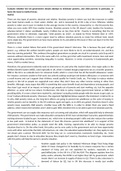
Another supply side policy is the National Minimum Wage/ Real living Wage
(what it’s been changed to) to basically try to ensure everyone has a certain
standard of living and are not exploited by workers, especially in low
paid/skilled jobs. In the UK it is £7.85 the RLW. The diagram explains how this
policy works, whereby the NMW is set higher than W1 by government, which
means there’s an increase in supply of labour to Q3. There is also a decrease in
demand of labour by Q2, but in UK this decrease is mostly just smaller
leave the issue to market forces. (25
marks)
There are two types of poverty: absolute and relative. Absolute poverty is where you lack the resources to satisfy
your basic human needs i.e. food, water, shelter, etc. and is measured by $1.50 a day or less. Whereas, relative
poverty is when you’re poor in relation to the average income in the country, measured by i.e. the EU poverty line,
when you earn under 60% than median income. Absolute poverty in the UK doesn’t exist, besides the homeless,
whereas Extract C states: worldwide, nearly 3 billion live on less than $2.50. Poverty is something that the UK
government strive to eliminate, especially “child poverty by 2020”, as stated by Prime Minister Blair in 1999.
Whereas, worldwide there is a more urgent need to address absolute poverty as many live without basic needs
every single day. The government can have many policies to try and address this issue or they can leave it to the free
market to solve.
There is a clear market failure that exists if the government doesn’t intervene. This is because the poor will get
poorer, e.g. without the welfare benefit system, people are more likely to be ill, un/undereducated, etc. and thus
have less earning potential. This continues throughout generations as people are stuck in a poverty cycle/trap and it
worsens without intervention. This is the same with rich, as they get richer with investment income rises and asset
value appreciating overtime, worsening inequality in society. However, in terms of poverty it fundamentally gets
worse, if left to market forces.
Therefore, the government evidently need to intervene to try and solve this market failure. One major policy is the
Welfare Benefit System (WBS), used especially in UK, which is funded though progressive tax as a transfer payment.
WBS in the UK is an umbrella term for Universal Credit, which is a term that has all the benefit allowances’ under.
For instance, someone unable to find work, but actively seeking would get Job Seekers Allowance; or someone with
a small income and can’t support their children, would qualify for Family Credit, etc. This helps to reduce relative
poverty in the UK as people are supported even when they don’t have any other income coming in other than
benefits. Although, many argue that WBS is something that cause benefit fraud and dependence among people, and
thus hasn’t got much of an impact on trying to get people out of poverty and start working, etc. but the opposite
effective, as some will be too reliant. Furthermore, this links to policy myopia (government failure) as WBS isn’t
providing skills, it’s more a short-term market fix, and doesn’t actually provide people with the means to get a job, so
it can’t reduce eliminate poverty. Moreover, the argument highlighted above supports the statement, in Extract B, as
to why child poverty exists as, the long-term effects are going to persist into adulthood, as the cycle of staying in
relative poverty and on benefits, in the UK continues again and again, as no skills are gained, therefore doesn’t solve
poverty issue, especially child poverty. Another issue with the WBS is, in order to obtain them you need a fixed
address, which means the homeless aren’t able to gain WBS, therefore this is not able to get rid of absolute poverty.
The government can use supply side measures such as training and education, which will especially help to eliminate
child poverty. The government can make education compulsory till 18, have scholarships/ bursaries, apprenticeships,
training schemes funded by gov. investment, etc. which tries to develop people’s skills and also reduces the number
in low paid work. In Extract B, the statement of “poor life chances…persist into adulthood” is in support of this
government intervention policy, as people need the skills, training, opportunity to be able to change poverty
situation they’re in. On the other hand, this policy can be very costly to the government and can have opportunity
costs with other sectors like the NHS, infrastructure, etc. Also, the education/apprenticeship/ etc. they apply to may
not always give a person ‘life/work skills’ for the long run i.e. communication, teamwork, leadership, etc. Some
people don’t choose to stay in education because they simply don’t want to, therefore no level of gov. intervention
with this policy will help the person’s poverty situation.
Another supply side policy is the National Minimum Wage/ Real living Wage
(what it’s been changed to) to basically try to ensure everyone has a certain
standard of living and are not exploited by workers, especially in low
paid/skilled jobs. In the UK it is £7.85 the RLW. The diagram explains how this
policy works, whereby the NMW is set higher than W1 by government, which
means there’s an increase in supply of labour to Q3. There is also a decrease in
demand of labour by Q2, but in UK this decrease is mostly just smaller



