

3.3 Halogenoalkanes
Classifying halogenoalkanes
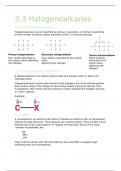
Halogenoalkanes can be classified as primary, secondary, or tertiary depending
on the number of carbon atoms attached to the C-X functional group.
One carbon attached to Two carbons attached to the carbon Three carbons
the carbon atom adjoining atom attached to the
the halogen adjoining the halogen carbon atom
adjoining the
halogen
3.3.3.1 Nucleophilic substitution
A halogenoalkane is an alkane with at least one halogen atom in place of a
hydrogen atom.
Halogenoalkanes contain polar bonds as the halogens are more electronegative
than carbon atoms. The charge on the carbon makes it prone to attacks from
nucleophiles, this means electron density is drawn towards the halogen forming
∂+ and ∂- regions.
Example:
Nucleophiles
A nucleophile is an electron pair donor it donates an electron pair to somewhere
without enough electrons. These species are ‘positive liking’. They contain a lone
electron pair that is attracted to ∂+ regions of molecules. Some of the most
common nucleophiles are:
CN:-
:NH3
-
:OH
They must be shown with the lone electron pair and often a negative sign
indicating they are nucleophiles.
, Nucleophilic Substitution
Substitution: swapping a halogen atom for another atom or groups of atoms
A nucleophile can react with a polar molecule by kicking out the functional group
and taking its place – nucleophilic substitution.
This is the reaction mechanism that shows how nucleophiles attack
halogenoalkanes. It can be used to produce alcohols or amines from
halogenoalkanes.
Mechanism - Alcohol
The ∂+ carbon attacks a lone pair of electrons from the OH- ion. The C-Br bond
breaks and the Chlorine leaves, taking both electrons to become Br -. A new bond
forms between the carbon and the OH- ion, making an alcohol.
Mechanism - Amines
Mechanism - Nitriles
Nitrile groups have to be at the end of a chain. Start numbering the chain from
the C in the CN.
The greater the Mr of the halogen in the polar bond, the lower the bond enthalpy
meaning it can be broken more easily. Therefore the rate of reaction for these
halogenoalkanes is faster. Nucleophilic substitution reactions can only occur for
1o (primary) and 2o (secondary) halogenoalkanes.
Explain why the carbon–halogen bond enthalpy influences the rate of reaction.
The strength of the carbon-halogen bond determines the ease with which
the bond can be broken and influences the rate of reaction in organic
chemistry. A weaker bond leads to a faster reaction, while a stronger bond
leads to a slower reaction.
Classifying halogenoalkanes
Halogenoalkanes can be classified as primary, secondary, or tertiary depending
on the number of carbon atoms attached to the C-X functional group.
One carbon attached to Two carbons attached to the carbon Three carbons
the carbon atom adjoining atom attached to the
the halogen adjoining the halogen carbon atom
adjoining the
halogen
3.3.3.1 Nucleophilic substitution
A halogenoalkane is an alkane with at least one halogen atom in place of a
hydrogen atom.
Halogenoalkanes contain polar bonds as the halogens are more electronegative
than carbon atoms. The charge on the carbon makes it prone to attacks from
nucleophiles, this means electron density is drawn towards the halogen forming
∂+ and ∂- regions.
Example:
Nucleophiles
A nucleophile is an electron pair donor it donates an electron pair to somewhere
without enough electrons. These species are ‘positive liking’. They contain a lone
electron pair that is attracted to ∂+ regions of molecules. Some of the most
common nucleophiles are:
CN:-
:NH3
-
:OH
They must be shown with the lone electron pair and often a negative sign
indicating they are nucleophiles.
, Nucleophilic Substitution
Substitution: swapping a halogen atom for another atom or groups of atoms
A nucleophile can react with a polar molecule by kicking out the functional group
and taking its place – nucleophilic substitution.
This is the reaction mechanism that shows how nucleophiles attack
halogenoalkanes. It can be used to produce alcohols or amines from
halogenoalkanes.
Mechanism - Alcohol
The ∂+ carbon attacks a lone pair of electrons from the OH- ion. The C-Br bond
breaks and the Chlorine leaves, taking both electrons to become Br -. A new bond
forms between the carbon and the OH- ion, making an alcohol.
Mechanism - Amines
Mechanism - Nitriles
Nitrile groups have to be at the end of a chain. Start numbering the chain from
the C in the CN.
The greater the Mr of the halogen in the polar bond, the lower the bond enthalpy
meaning it can be broken more easily. Therefore the rate of reaction for these
halogenoalkanes is faster. Nucleophilic substitution reactions can only occur for
1o (primary) and 2o (secondary) halogenoalkanes.
Explain why the carbon–halogen bond enthalpy influences the rate of reaction.
The strength of the carbon-halogen bond determines the ease with which
the bond can be broken and influences the rate of reaction in organic
chemistry. A weaker bond leads to a faster reaction, while a stronger bond
leads to a slower reaction.


