

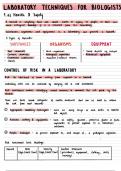
LABORATORY TECHNIQUES FOR BIOLOGISTS
1 a Health 13 Safety
A hazard is anything that can cause harm or injury to people or that can
cause ecological damage if it is released from the laboratory
Substances organisms and equipment in a laboratory can present a hazard
3 Types of Hazards
SUBSTANCES ORGANISMS EQUIPMENT
Toxic chemicals Micro organisms sharp objects e.g scalpel
Corrosive chemicals Pathogenic organisms Mechanical equipment
Flammable substances Harmless virulent strains
Heat
CONTROL OF RISK IN A LABORATORY
Risk the likelihood of harm arising from exposure to a hazard
Controlling risks can be achieved
by carrying out a risk assessment
Risk assessment involves identifying control measures to minimise the risk posed by the
hazard
the risk from most hazards
1 Appropriate handling techniques such as using tongs or oven mitts to handel
not objects
ii iii iii
2 Protective clothing B equipment such as safety glasses protective gloves or fume
cupboards to prevent exposure to a hazardous
substance
Risk Assessment Table Headings
Hazard Risk Severity Control Measures
High med low High med low procedures equipment clothing skills
training
, 1b liquids 13 Solutions
All the components of a solution are evenly distributed throughout the solution
solute the substance that is dissolved
solvent the substance in which the solute dissolves
suspension particles are dispersed but not dissolved in a substance
D I L UT I O N SE R I E S
Dilutions are used in
many experimental procedures
They can be used to
control potential confounding variables in an experimental system
generate a suitable range in an independent variable
modify the dependent variable
so that a measurable value can be obtained
1 a Health 13 Safety
A hazard is anything that can cause harm or injury to people or that can
cause ecological damage if it is released from the laboratory
Substances organisms and equipment in a laboratory can present a hazard
3 Types of Hazards
SUBSTANCES ORGANISMS EQUIPMENT
Toxic chemicals Micro organisms sharp objects e.g scalpel
Corrosive chemicals Pathogenic organisms Mechanical equipment
Flammable substances Harmless virulent strains
Heat
CONTROL OF RISK IN A LABORATORY
Risk the likelihood of harm arising from exposure to a hazard
Controlling risks can be achieved
by carrying out a risk assessment
Risk assessment involves identifying control measures to minimise the risk posed by the
hazard
the risk from most hazards
1 Appropriate handling techniques such as using tongs or oven mitts to handel
not objects
ii iii iii
2 Protective clothing B equipment such as safety glasses protective gloves or fume
cupboards to prevent exposure to a hazardous
substance
Risk Assessment Table Headings
Hazard Risk Severity Control Measures
High med low High med low procedures equipment clothing skills
training
, 1b liquids 13 Solutions
All the components of a solution are evenly distributed throughout the solution
solute the substance that is dissolved
solvent the substance in which the solute dissolves
suspension particles are dispersed but not dissolved in a substance
D I L UT I O N SE R I E S
Dilutions are used in
many experimental procedures
They can be used to
control potential confounding variables in an experimental system
generate a suitable range in an independent variable
modify the dependent variable
so that a measurable value can be obtained


