
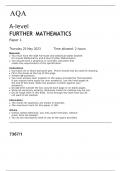
AQA
A-level
FURTHER MATHEMATICS
Paper 1
Thursday 25 May 2023 Time allowed: 2 hours
Materials
You must have the AQA Formulae and statistical tables booklet
for A-level Mathematics and A-level Further Mathematics.
You should have a graphical or scientific calculator that
meets the requirements of the specification.
Instructions
Use black ink or black ball-point pen. Pencil should only be used for drawing.
Fill in the boxes at the top of this page.
Answer all questions.
You must answer each question in the space provided for that question.
If you require extra space for your answer(s), use the lined pages at
the end of this book. Write the question number against your
answer(s).
Do not write outside the box around each page or on blank pages.
Show all necessary working; otherwise marks for method may be lost.
Do all rough work in this book. Cross through any work that you do
not want to be marked.
Information
The marks for questions are shown in brackets.
The maximum mark for this paper is 100.
Advice
Unless stated otherwise, you may quote formulae, without
proof, from the booklet.
You do not necessarily need to use all the space provided.
7367/1
, 2
Do not write
outside the
box
Answer all questions in the spaces
provided.
1 Find the number of solutions of the equation tanh x ¼
cosh x Circle your answer. [1
mark]
0 1 2 3
2 The diagram below shows a locus on an Argand diagram.
Im
O 2 Re
–3
Which of the equations below represents the locus shown above?
Circle your answer.
[1 mark]
jz — 2 þ 3 i j¼ 2 jz þ 2 — 3 i j¼ 2 jz — 2 þ 3 i j¼ 4 jz þ 2 — 3 i j¼ 4
(02)
Jun23/7367/
1
, 3
Do not write
1 2 outside the
3 The matrix A ¼ box
0 1 represents a
transformation.
Which one of the points below is an invariant point under this transformation?
Circle your answer.
[1 mark]
(1, 1) (0, 2) (3, 0) (2, 1)
4 The solution of a second order differential equation
is f (t) The differential equation models heavy
damping.
Which one of the statements below could be true?
Tick (3) one box.
[1 mark]
f (t) ¼ 2e—t cos (3t) þ 5e—t sin (3t)
f (t) ¼ 3e—t þ 4te—t
f (t) ¼ 7e—t þ 2e—2t
f (t) ¼ 8e—t cos (3t — 0:1)
Turn over for the next question
(03)
Jun23/7367/
1
, 4
Do not write
Turn over
s
(03)
Jun23/7367/
1
A-level
FURTHER MATHEMATICS
Paper 1
Thursday 25 May 2023 Time allowed: 2 hours
Materials
You must have the AQA Formulae and statistical tables booklet
for A-level Mathematics and A-level Further Mathematics.
You should have a graphical or scientific calculator that
meets the requirements of the specification.
Instructions
Use black ink or black ball-point pen. Pencil should only be used for drawing.
Fill in the boxes at the top of this page.
Answer all questions.
You must answer each question in the space provided for that question.
If you require extra space for your answer(s), use the lined pages at
the end of this book. Write the question number against your
answer(s).
Do not write outside the box around each page or on blank pages.
Show all necessary working; otherwise marks for method may be lost.
Do all rough work in this book. Cross through any work that you do
not want to be marked.
Information
The marks for questions are shown in brackets.
The maximum mark for this paper is 100.
Advice
Unless stated otherwise, you may quote formulae, without
proof, from the booklet.
You do not necessarily need to use all the space provided.
7367/1
, 2
Do not write
outside the
box
Answer all questions in the spaces
provided.
1 Find the number of solutions of the equation tanh x ¼
cosh x Circle your answer. [1
mark]
0 1 2 3
2 The diagram below shows a locus on an Argand diagram.
Im
O 2 Re
–3
Which of the equations below represents the locus shown above?
Circle your answer.
[1 mark]
jz — 2 þ 3 i j¼ 2 jz þ 2 — 3 i j¼ 2 jz — 2 þ 3 i j¼ 4 jz þ 2 — 3 i j¼ 4
(02)
Jun23/7367/
1
, 3
Do not write
1 2 outside the
3 The matrix A ¼ box
0 1 represents a
transformation.
Which one of the points below is an invariant point under this transformation?
Circle your answer.
[1 mark]
(1, 1) (0, 2) (3, 0) (2, 1)
4 The solution of a second order differential equation
is f (t) The differential equation models heavy
damping.
Which one of the statements below could be true?
Tick (3) one box.
[1 mark]
f (t) ¼ 2e—t cos (3t) þ 5e—t sin (3t)
f (t) ¼ 3e—t þ 4te—t
f (t) ¼ 7e—t þ 2e—2t
f (t) ¼ 8e—t cos (3t — 0:1)
Turn over for the next question
(03)
Jun23/7367/
1
, 4
Do not write
Turn over
s
(03)
Jun23/7367/
1


