

STOICHIOMETRIC CALCULATIONS
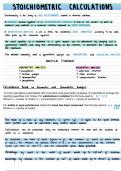
Stoichiometry is the study of MOLE RELATIONSHIPS involved in chemical reactions
A BALANCED chemical equation is a STOICHIOMETRIC EQUATION It tells us the number of moles of
reactants and products in a chemical reaction obtained in IDEAL CONDITIONS
A QUANTITATIVE REACTION is one in which the substances REACT COMPLETELY according to the mole
ratios given by the balanced equation
The exact quantity of a substance in a given sample can be determined by carrying out a
quantitative reaction and using the stoichiometry of the reaction to determine the amount of
the substance
Two methods commonly used in quantitative analysis are GRAVIMETRIC and VOLUMETRICANALYSIS
ANALYTICAL TECHNIQUES
GRAVIMETRIC ANALYSIS VOLUMETRIC ANALYSIS
precipitation 4 acid base titrations
thermal analysis redox titrations
decomposition complexometric titrations
dehydration
Calculations Based on Volumetric and Gravimetric Analysis
In most calculations associated with volumetric and gravimetric analyses, it is sensible to change the
reacting quantities into moles. For substances in solution the formula used is: n cu
Where n = number of moles, C = concentration (mol l i ) and V = volume of solution (l).
For solids or pure substances where the mass has been measured, the formula used is: n mass
Where n = number of moles. GFM
the mass of a mole of any substance in grams g is equal to the gram formula
mass GEM and can be
calculated relative atomic masses
using
Calculations can be performed using the relationship between the mass and the number of
moles of a substance
For solutions the mass of solute grams or g the number of moles of solute moles
or not the volume of solution litres or 1 or the concentration of the solution
mots per litre or moll can be calculated from data provided
Percentage
by mass is the mass of solute made up to 100cm of solution
Percentage by volume is the number of cm of solute made up to 100cm
of solution
Stoichiometry is the study of MOLE RELATIONSHIPS involved in chemical reactions
A BALANCED chemical equation is a STOICHIOMETRIC EQUATION It tells us the number of moles of
reactants and products in a chemical reaction obtained in IDEAL CONDITIONS
A QUANTITATIVE REACTION is one in which the substances REACT COMPLETELY according to the mole
ratios given by the balanced equation
The exact quantity of a substance in a given sample can be determined by carrying out a
quantitative reaction and using the stoichiometry of the reaction to determine the amount of
the substance
Two methods commonly used in quantitative analysis are GRAVIMETRIC and VOLUMETRICANALYSIS
ANALYTICAL TECHNIQUES
GRAVIMETRIC ANALYSIS VOLUMETRIC ANALYSIS
precipitation 4 acid base titrations
thermal analysis redox titrations
decomposition complexometric titrations
dehydration
Calculations Based on Volumetric and Gravimetric Analysis
In most calculations associated with volumetric and gravimetric analyses, it is sensible to change the
reacting quantities into moles. For substances in solution the formula used is: n cu
Where n = number of moles, C = concentration (mol l i ) and V = volume of solution (l).
For solids or pure substances where the mass has been measured, the formula used is: n mass
Where n = number of moles. GFM
the mass of a mole of any substance in grams g is equal to the gram formula
mass GEM and can be
calculated relative atomic masses
using
Calculations can be performed using the relationship between the mass and the number of
moles of a substance
For solutions the mass of solute grams or g the number of moles of solute moles
or not the volume of solution litres or 1 or the concentration of the solution
mots per litre or moll can be calculated from data provided
Percentage
by mass is the mass of solute made up to 100cm of solution
Percentage by volume is the number of cm of solute made up to 100cm
of solution


