

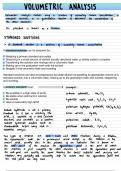
VOLUMETRIC ANALYSIS
Volumetric analysis involves using a solution
of accurately known concentration a
standard solution in a quantitative reaction to determine the concentration of
the other reactant
The procedure is known as a titration
STANDARD SOLUTIONS
A standard solution is a solution
of accurately known concentration
A standard solution can be prepared by:
• Weighing a primary standard accurately
• Dissolving in a small amount of solvent (usually deionised water or dirtied water) in a beaker
• Transferring the solution and rinsings into a volumetric ask
• Making up to the graduation mark with the solvent
• Stopper in the volumetric ask and inverting
Standard solutions can also be prepared by accurate dilution be pipetting an appropriate volume of a
standard solution into a volumetric ask, making up to the graduation mark with solvent, stoppering
and inverting.
A primary standard must: I examples
• Be available in a high state of purity sodium carbonate iiazCO
• Be stable when solid and in solution
• Be soluble
• Have a reasonably high GFM
hydrated oxalic acid HzC04 2420
potassium hydrogen phthalate KH 81404
iii iii
standard as a relatively low
it has silver nitrate Agno
AFM is unstable as a solid absorbs
moisture and unstable as a solution potassium iodate KIO
standardised before being used in
volumetric analysis
mmmm
Two types of titration are acid base and redox titrations During a titration
the experimenter looks for a permanent colour change in the solution in the
conical flask usually due to the presence an indicator This is known as
of
the end point of the reaction The equivalence point is the point at which
the reaction is just complete The ideal situation is when the equivalence pointand
the endpoint are exactly the same Choosing the correct indicator and carrying out
titrations very carefully and accurately help to ensure that the equivalence point and
the end point are very close
Volumetric analysis involves using a solution
of accurately known concentration a
standard solution in a quantitative reaction to determine the concentration of
the other reactant
The procedure is known as a titration
STANDARD SOLUTIONS
A standard solution is a solution
of accurately known concentration
A standard solution can be prepared by:
• Weighing a primary standard accurately
• Dissolving in a small amount of solvent (usually deionised water or dirtied water) in a beaker
• Transferring the solution and rinsings into a volumetric ask
• Making up to the graduation mark with the solvent
• Stopper in the volumetric ask and inverting
Standard solutions can also be prepared by accurate dilution be pipetting an appropriate volume of a
standard solution into a volumetric ask, making up to the graduation mark with solvent, stoppering
and inverting.
A primary standard must: I examples
• Be available in a high state of purity sodium carbonate iiazCO
• Be stable when solid and in solution
• Be soluble
• Have a reasonably high GFM
hydrated oxalic acid HzC04 2420
potassium hydrogen phthalate KH 81404
iii iii
standard as a relatively low
it has silver nitrate Agno
AFM is unstable as a solid absorbs
moisture and unstable as a solution potassium iodate KIO
standardised before being used in
volumetric analysis
mmmm
Two types of titration are acid base and redox titrations During a titration
the experimenter looks for a permanent colour change in the solution in the
conical flask usually due to the presence an indicator This is known as
of
the end point of the reaction The equivalence point is the point at which
the reaction is just complete The ideal situation is when the equivalence pointand
the endpoint are exactly the same Choosing the correct indicator and carrying out
titrations very carefully and accurately help to ensure that the equivalence point and
the end point are very close


