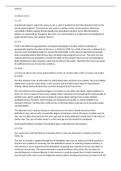
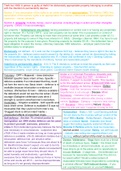
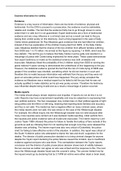
SHN2004 (Acute Care) – Managing Risk
Managing Clinical Risk/Risk Assessment Tools
Objectives
Understand what clinical risk assessment is and why/when is it carried out
Define key terms related to risk assessment
Discuss the steps if risk assessment
Understand the concept of clinical risk management
Identify types of patient safety incidents and consider some examples
Discuss the risk assessment tools used in practice
Explore governing bodies/legislations covering risk management in clinical areas
Clinical Risk Assessment
The overall process of identifying risk and evaluating whether acceptable or not,
taking into account best practice and the appetite of the organisation. Risk appetite
is the amount of risk that an organisation is prepared to accept, tolerate or be
exposed to at any point in time
o This can vary depending on the organisation
Why are risk assessments carried out in nursing?
To safeguard patients, staff, other individuals
To inform nursing care
To enable strategies to minimise risk
To fulfil clinical governance requirements
o Clinical governance is the system through which NHS organisations are
accountable for continuously improving the quality of their services and
safeguarding high standard of care, by creating an environment in which
clinical excellence can flourish (Public Health England, 2021)
o Clinical governance
Risk management
Education/training
Evidence based care
Clinical audit
Staff management
When is a Risk Assessment carried out?
When a risk may be obvious
To assess whether there is a risk
To ensure a potential action is ‘safe’
Key Terms
Hazards
1
, SHN2004 (Acute Care) – Managing Risk
o Are situations with the potential to cause harm
Risk
o Is the probability that a specific adverse event will occur in a specific period
or as a result of a specific situation
Clinical Risk
o The chance of an adverse outcome resulting from clinical intervention,
treatment or patient care
o Clinical risk incidents include:
Accidental
An unfortunate incident that happens unexpectedly and
unintentional, typically resulting in damage or injury
Non-clinical incident (e.g. security, environmental)
Serious Untoward Incidents
Actual serious injury or unexpected death resulting from an
incident involving an individual to whom the organisation has
a duty of care
Never Events
Immediately reportable to be National Patient Safety Agency
(NPSA)
Examples include:
o Surgery to wrong site
o Retained instrument during operation
o Radiotherapy administered to wrong site
o Undetected misplaced nasogastric tube
See National Patient Safety Agency, 2007
Steps of Risk Assessment
Identify the hazards
o E.g. tables, lone working
Decide who might be harmed and how
Evaluate the risks and decide on precautions
Record your findings and implement them
Review your assessment and update if necessary
Risk Factor/Risk Rating
Attributes a score to each identified risk
Allows greatest risk to be identified
Enables prioritisation of remedial action
Risk factor = consequence (severity) x likelihood
2
Managing Clinical Risk/Risk Assessment Tools
Objectives
Understand what clinical risk assessment is and why/when is it carried out
Define key terms related to risk assessment
Discuss the steps if risk assessment
Understand the concept of clinical risk management
Identify types of patient safety incidents and consider some examples
Discuss the risk assessment tools used in practice
Explore governing bodies/legislations covering risk management in clinical areas
Clinical Risk Assessment
The overall process of identifying risk and evaluating whether acceptable or not,
taking into account best practice and the appetite of the organisation. Risk appetite
is the amount of risk that an organisation is prepared to accept, tolerate or be
exposed to at any point in time
o This can vary depending on the organisation
Why are risk assessments carried out in nursing?
To safeguard patients, staff, other individuals
To inform nursing care
To enable strategies to minimise risk
To fulfil clinical governance requirements
o Clinical governance is the system through which NHS organisations are
accountable for continuously improving the quality of their services and
safeguarding high standard of care, by creating an environment in which
clinical excellence can flourish (Public Health England, 2021)
o Clinical governance
Risk management
Education/training
Evidence based care
Clinical audit
Staff management
When is a Risk Assessment carried out?
When a risk may be obvious
To assess whether there is a risk
To ensure a potential action is ‘safe’
Key Terms
Hazards
1
, SHN2004 (Acute Care) – Managing Risk
o Are situations with the potential to cause harm
Risk
o Is the probability that a specific adverse event will occur in a specific period
or as a result of a specific situation
Clinical Risk
o The chance of an adverse outcome resulting from clinical intervention,
treatment or patient care
o Clinical risk incidents include:
Accidental
An unfortunate incident that happens unexpectedly and
unintentional, typically resulting in damage or injury
Non-clinical incident (e.g. security, environmental)
Serious Untoward Incidents
Actual serious injury or unexpected death resulting from an
incident involving an individual to whom the organisation has
a duty of care
Never Events
Immediately reportable to be National Patient Safety Agency
(NPSA)
Examples include:
o Surgery to wrong site
o Retained instrument during operation
o Radiotherapy administered to wrong site
o Undetected misplaced nasogastric tube
See National Patient Safety Agency, 2007
Steps of Risk Assessment
Identify the hazards
o E.g. tables, lone working
Decide who might be harmed and how
Evaluate the risks and decide on precautions
Record your findings and implement them
Review your assessment and update if necessary
Risk Factor/Risk Rating
Attributes a score to each identified risk
Allows greatest risk to be identified
Enables prioritisation of remedial action
Risk factor = consequence (severity) x likelihood
2