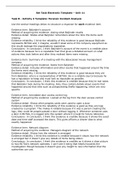
Sign Test:
Used when there is –
A test of difference
A related design (repeated measures or matched pairs)
Nominal data
Step one –
Subtract each value in the control condition from the experimental condition
and record the sign (+ or -)
Step two –
Count the number of times the less frequent sign appears. This gives S
Step three –
Count the total number of plusses and minuses and this gives N (don’t include
zeros)
Step four –
Use a table of critical values for the sign test.
1. Read down from N to find the correct score
2. Read across from this point to 0.05 for a one tailed test to find the critical
value
3. S must be equal or less than the critical value to be significant
Step five–
State the conclusion. If the result is not significant, we accept the null
hypothesis
Used when there is –
A test of difference
A related design (repeated measures or matched pairs)
Nominal data
Step one –
Subtract each value in the control condition from the experimental condition
and record the sign (+ or -)
Step two –
Count the number of times the less frequent sign appears. This gives S
Step three –
Count the total number of plusses and minuses and this gives N (don’t include
zeros)
Step four –
Use a table of critical values for the sign test.
1. Read down from N to find the correct score
2. Read across from this point to 0.05 for a one tailed test to find the critical
value
3. S must be equal or less than the critical value to be significant
Step five–
State the conclusion. If the result is not significant, we accept the null
hypothesis