
Primary socialisation vs
Secondary socialisation Essay
Plan -
Evaluate the view that secondary socialisation is the most important form of socialisation
FOR: AGAINST:
- In contemporary society the Media - Media is not as available in less
has gained a huge foothold in the industrialised societies and
life of many people (especially teens therefore this only applies really to
and young adults) globally more western societies
- In less industrialised societies - Decrease in religion in the west
Religion is the foundation of their known as secularisation meaning
culture and therefore is the main that it no longer has as much power
form of socialisation – Bible belt and influence as previously in pre-
industrial western societies
- Education is where individuals
spend most of their childhood and - Hidden curriculum does not work
adolescence - hidden and academic for all children some children can
curriculum to socialise children – resist the hidden curriculum and so
through subjects like history social remain relatively unaffected by it
solidarity developed – education
promotes universal values and - Eventually despite the peer group
meritocracy teens and young adults will most
likely revert back to teachings and
- Peer group become most influential beliefs of their family and the family
in adolescent years and have more becomes once again their main
influence over behaviour than even source of knowledge and
family understanding about the world and
influence
- Most of the stages within a child’s
life are spent with family and so the
child spends more quality time with
the family at their most
impressionable ages of imitation
and role play – Parental love and
approval very powerful motivation
to adopt culture from parents
Neil Postman (1985), Jean Twenge (2014) Daniele Harvieu-Leger (2000)
Dominic Sandbrook (2012) – evaluation of Paul Willis (1977) and Paul Corrigan (1979) -
criticism of secularisation ethnographic study
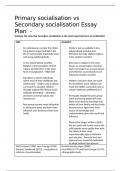
Secondary socialisation Essay
Plan -
Evaluate the view that secondary socialisation is the most important form of socialisation
FOR: AGAINST:
- In contemporary society the Media - Media is not as available in less
has gained a huge foothold in the industrialised societies and
life of many people (especially teens therefore this only applies really to
and young adults) globally more western societies
- In less industrialised societies - Decrease in religion in the west
Religion is the foundation of their known as secularisation meaning
culture and therefore is the main that it no longer has as much power
form of socialisation – Bible belt and influence as previously in pre-
industrial western societies
- Education is where individuals
spend most of their childhood and - Hidden curriculum does not work
adolescence - hidden and academic for all children some children can
curriculum to socialise children – resist the hidden curriculum and so
through subjects like history social remain relatively unaffected by it
solidarity developed – education
promotes universal values and - Eventually despite the peer group
meritocracy teens and young adults will most
likely revert back to teachings and
- Peer group become most influential beliefs of their family and the family
in adolescent years and have more becomes once again their main
influence over behaviour than even source of knowledge and
family understanding about the world and
influence
- Most of the stages within a child’s
life are spent with family and so the
child spends more quality time with
the family at their most
impressionable ages of imitation
and role play – Parental love and
approval very powerful motivation
to adopt culture from parents
Neil Postman (1985), Jean Twenge (2014) Daniele Harvieu-Leger (2000)
Dominic Sandbrook (2012) – evaluation of Paul Willis (1977) and Paul Corrigan (1979) -
criticism of secularisation ethnographic study


