

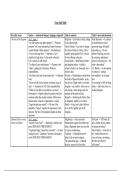
Essay Stuff Table
Key idea/ scene Quotes → Analysis of imagery, language, stagecraft Links to contexts Critics’ views and discussion
Division of the kingdom Act 1, scene 1 Kingship → Lear believes being a King Frank Kermode → A contrast
“we shall express our darker purpose” → Personal is an ordained right. is created between Lear’s
pronoun “we”, royal terminology. Sense of mystery Chain of being → Lear tries to change perceived image of himself
created through “darker purpose” - foreshadowing. the chain of being by retiring. This is and reality, e.g. “the two
“Give me the map there” → Imperative “give” arguably going against God - a reason bodies of the king; one lives
signifies his high status. At this point in the play for his suffering in the play. by ceremony, administers
Lear’s orders are still obeyed. Scared bonds → Bond between father justice in a furred gown… the
“To shake all cares and business” → Dynamic verb and daughter broken - Cordelia’s other is born naked”.
“shake”, getting rid of his duties. Wants no refusal to flatter Lear. Ironically, she is A C Bradley → In his opinion
responsibilities. the best child. we observe a “marked
“that future strife may be prevented now” → Dramatic Division → Elizabethans worried about one-sidedness” in the tragic
irony. the death of Queen Elizabeth I, as she hero.
“divest us both of rule, interest of territory, cares of has no heirs. Might result in a divided 1st recording in 1606 for King
state” → Asyndetic list. All of his responsibilities. kingdom - war, conflict - after years of James → Show the chaos of a
“Which of you shall we say doth love us most?” → only having 1 ruler (longest rule of a divided kingdom.
Interrogative. A highly subjective question based on monarch at this point in time).
emotions rather than factual evidence. Oblivious to Hamartia → Believing the flattery from
human nature. Unaware of appearance vs reality. his daughters, unable to see reality.
“largest bounty may extend” → The use of the Hubris → King Lear’s pride. Believes
superlative “largest” signifies the importance of this he is still the rightful ruler of the
decision. The fate of the kingdom depends on these kingdom.
questions.
Edmund’s plot to usurp Act 1, scene 2 Illegitimacy → The reason that Jan Knott → “All bonds, all
brother and father “bastardy? base, base?” → Repetition, reinforces the Edmund plots against his brother and laws, whether divine, natural
point. REPEATED THROUGHOUT. father. Illegitimate heirs were not able or human are broken”
“Legitimate Edgar, I must have your land” → A taunt/ to receive an inheritance. John F Danby → Viewed it as
stating his aims. “Legitimate” becomes a derogatory Treachery → Edmund betrays his the “conflict between two
word. REPEATED THROUGHOUT father. Lack of moral compass. views of nature, one benign…
The generational gap → Edmund the other governed by
believes in survival of the fittest self-interest”
, “Edmund the base shall top the legitimate” → (proto-Darwinism). Gloucester believes Jonathan Dollimore →
Juxtaposition between “base” and “legitimate”. The in the chain of being. Edmund is “not the antithesis
vocatives’ meanings are reversed. Societal roles → Edmund is a bastard. of social process but its
“Now, gods, stand up for the bastards!” → Lacks the rights of a legitimate son. focus… the focus of political
Exclamatory tone. Sacred bonds → Bond between father social and ideological
“hastily puts the letter into his pocket” → Stage and son broken. First by Edmund’s contradictions”.
directions. Suspicious behaviour. The letter is a key letter - breaks the bond between Edgar Sibling rivalry → Lear's
prop/ narrative device used to frame Edgar. and Gloucester temporarily. Then, by daughters and Gloucester’s
Act 3, scene 3 Edmund himself as he leaves his father sons represent both aspects,
“the younger rises when the old doth fall” → to be tortured by Regan and Cornwall - loving and cruel.
Edmund’s long term plan. The dispassionate dynamic breaks the bond between Gloucester
verb “fall” signifies how Edmund doesn’t care what and Edmund permanently.
happens to Gloucester.
Gloucester’s Act 1, scene 2 Fatalism → Gloucester believes that Jonathan Dollimore →
superstitious nature “These late eclipses in the sun and moon portend no one can not change their fate. Ideas of Edmund is “not the antithesis
good to us” → Semantic field of superstition, predestination. Very superstitious. of social process but its
“eclipses”. Free will → Edmund believes in free focus… the focus of political
“Love cools, friendship falls off, brothers divide” → will. Will take the throne by force. Not social and ideological
Foreshadows the events of the play. willing to take life passively. contradictions”.
“and true-hearted Kent banished; his offence honesty!
‘Tis strange.” → Dramatic irony. Unable to see that he
is making the same mistake.
“we make guilty of our disasters the sun, moon and the
stars” → Edmund criticising Gloucester. Believes
superstition is a projection used to evade
responsibility. Syndetic listing. Repetition of “sun”
and “moon”, like Gloucester’s previous comment.
Goneril and Regan’s Act 1, scene 4 Chain of being → The King’s life is Jan Knott → “All bonds, all
conspiracy against Lear “the hedge-sparrow fed the cuckoo so long, that it had above that or ordinary people. Goneril laws, whether divine, natural
it head bit off by it’s young” → A metaphor for the and Regan get rid of the idea that being or human are broken”
downfall of King Lear. Fool acts as the role of the King is a divinely ordained right. John F Danby → Viewed it as
Greek chorus. Almost prophetic. Sacred bonds → Fathers and daughters the “conflict between two
“shut up your doors” → Imperative. No compassion - Regan and Goneril should care for views of nature, one benign…
for Lear. their father. Men and women - Lear is the other governed by
Act 3, scene 7 self-interest”
Key idea/ scene Quotes → Analysis of imagery, language, stagecraft Links to contexts Critics’ views and discussion
Division of the kingdom Act 1, scene 1 Kingship → Lear believes being a King Frank Kermode → A contrast
“we shall express our darker purpose” → Personal is an ordained right. is created between Lear’s
pronoun “we”, royal terminology. Sense of mystery Chain of being → Lear tries to change perceived image of himself
created through “darker purpose” - foreshadowing. the chain of being by retiring. This is and reality, e.g. “the two
“Give me the map there” → Imperative “give” arguably going against God - a reason bodies of the king; one lives
signifies his high status. At this point in the play for his suffering in the play. by ceremony, administers
Lear’s orders are still obeyed. Scared bonds → Bond between father justice in a furred gown… the
“To shake all cares and business” → Dynamic verb and daughter broken - Cordelia’s other is born naked”.
“shake”, getting rid of his duties. Wants no refusal to flatter Lear. Ironically, she is A C Bradley → In his opinion
responsibilities. the best child. we observe a “marked
“that future strife may be prevented now” → Dramatic Division → Elizabethans worried about one-sidedness” in the tragic
irony. the death of Queen Elizabeth I, as she hero.
“divest us both of rule, interest of territory, cares of has no heirs. Might result in a divided 1st recording in 1606 for King
state” → Asyndetic list. All of his responsibilities. kingdom - war, conflict - after years of James → Show the chaos of a
“Which of you shall we say doth love us most?” → only having 1 ruler (longest rule of a divided kingdom.
Interrogative. A highly subjective question based on monarch at this point in time).
emotions rather than factual evidence. Oblivious to Hamartia → Believing the flattery from
human nature. Unaware of appearance vs reality. his daughters, unable to see reality.
“largest bounty may extend” → The use of the Hubris → King Lear’s pride. Believes
superlative “largest” signifies the importance of this he is still the rightful ruler of the
decision. The fate of the kingdom depends on these kingdom.
questions.
Edmund’s plot to usurp Act 1, scene 2 Illegitimacy → The reason that Jan Knott → “All bonds, all
brother and father “bastardy? base, base?” → Repetition, reinforces the Edmund plots against his brother and laws, whether divine, natural
point. REPEATED THROUGHOUT. father. Illegitimate heirs were not able or human are broken”
“Legitimate Edgar, I must have your land” → A taunt/ to receive an inheritance. John F Danby → Viewed it as
stating his aims. “Legitimate” becomes a derogatory Treachery → Edmund betrays his the “conflict between two
word. REPEATED THROUGHOUT father. Lack of moral compass. views of nature, one benign…
The generational gap → Edmund the other governed by
believes in survival of the fittest self-interest”
, “Edmund the base shall top the legitimate” → (proto-Darwinism). Gloucester believes Jonathan Dollimore →
Juxtaposition between “base” and “legitimate”. The in the chain of being. Edmund is “not the antithesis
vocatives’ meanings are reversed. Societal roles → Edmund is a bastard. of social process but its
“Now, gods, stand up for the bastards!” → Lacks the rights of a legitimate son. focus… the focus of political
Exclamatory tone. Sacred bonds → Bond between father social and ideological
“hastily puts the letter into his pocket” → Stage and son broken. First by Edmund’s contradictions”.
directions. Suspicious behaviour. The letter is a key letter - breaks the bond between Edgar Sibling rivalry → Lear's
prop/ narrative device used to frame Edgar. and Gloucester temporarily. Then, by daughters and Gloucester’s
Act 3, scene 3 Edmund himself as he leaves his father sons represent both aspects,
“the younger rises when the old doth fall” → to be tortured by Regan and Cornwall - loving and cruel.
Edmund’s long term plan. The dispassionate dynamic breaks the bond between Gloucester
verb “fall” signifies how Edmund doesn’t care what and Edmund permanently.
happens to Gloucester.
Gloucester’s Act 1, scene 2 Fatalism → Gloucester believes that Jonathan Dollimore →
superstitious nature “These late eclipses in the sun and moon portend no one can not change their fate. Ideas of Edmund is “not the antithesis
good to us” → Semantic field of superstition, predestination. Very superstitious. of social process but its
“eclipses”. Free will → Edmund believes in free focus… the focus of political
“Love cools, friendship falls off, brothers divide” → will. Will take the throne by force. Not social and ideological
Foreshadows the events of the play. willing to take life passively. contradictions”.
“and true-hearted Kent banished; his offence honesty!
‘Tis strange.” → Dramatic irony. Unable to see that he
is making the same mistake.
“we make guilty of our disasters the sun, moon and the
stars” → Edmund criticising Gloucester. Believes
superstition is a projection used to evade
responsibility. Syndetic listing. Repetition of “sun”
and “moon”, like Gloucester’s previous comment.
Goneril and Regan’s Act 1, scene 4 Chain of being → The King’s life is Jan Knott → “All bonds, all
conspiracy against Lear “the hedge-sparrow fed the cuckoo so long, that it had above that or ordinary people. Goneril laws, whether divine, natural
it head bit off by it’s young” → A metaphor for the and Regan get rid of the idea that being or human are broken”
downfall of King Lear. Fool acts as the role of the King is a divinely ordained right. John F Danby → Viewed it as
Greek chorus. Almost prophetic. Sacred bonds → Fathers and daughters the “conflict between two
“shut up your doors” → Imperative. No compassion - Regan and Goneril should care for views of nature, one benign…
for Lear. their father. Men and women - Lear is the other governed by
Act 3, scene 7 self-interest”


