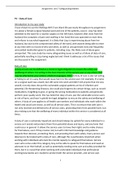
PVL3701 ASSIGNMENT 01 2024 MEMORANDUM
REFERENCE, ACADEMIC HONESTLY DECLARATION INCLUDED
MODULE CODE: PVL3704
ASSIGNMENT: 01
SEMESTER: 01
DUE DATE: 12 MARCH 2024
QUESTION 1
Discuss the general requirement that the defendant’s enrichment must have been
at the expense of the plaintiff. Refer in your answer to case law.
In order for a plaintiff to successfully claim unjust enrichment against a defendant, it is
generally required that the defendant's enrichment must have been at the expense of
the plaintiff. This means that the plaintiff must have suffered some form of detriment or
loss in order for the defendant to have been unjustly enriched.
In the case of United States v. Ciasulli, 396 F. Supp. 615 (D.N.J. 1975). In this case, the
defendant, Ciasulli, had obtained a government loan to build a hotel, but instead used
the funds for personal expenses. The government successfully claimed unjust
enrichment against Ciasulli, arguing that he had been enriched at the expense of the
government through his misuse of the loan funds. The court ruled in favor of the
government, ordering Ciasulli to repay the funds he had misused. This case illustrates
the principle that unjust enrichment requires a showing that the defendant's enrichment
was at the expense of the plaintiff.
In the case of Lipkin Gorman v Karpnale Ltd [1991]. In this case, the defendant had
misappropriated funds from its client's account and used the money to gamble at a
casino. The client sought to recover the misappropriated funds on the basis of unjust
enrichment. The House of Lords held that the defendant had been unjustly enriched at
the expense of the plaintiff, as the funds had been taken without consent and to the
detriment of the client.
Another important case that illustrates the requirement that the defendant's enrichment
must have been at the expense of the plaintiff is the case of Woolwich Equitable
Building Society v IRC [1993]. In this case, the defendant had mistakenly received
payments from the plaintiff, which were not due to them. The plaintiff sought to recover
the mistaken payments on the grounds of unjust enrichment. The House of Lords held
REFERENCE, ACADEMIC HONESTLY DECLARATION INCLUDED
MODULE CODE: PVL3704
ASSIGNMENT: 01
SEMESTER: 01
DUE DATE: 12 MARCH 2024
QUESTION 1
Discuss the general requirement that the defendant’s enrichment must have been
at the expense of the plaintiff. Refer in your answer to case law.
In order for a plaintiff to successfully claim unjust enrichment against a defendant, it is
generally required that the defendant's enrichment must have been at the expense of
the plaintiff. This means that the plaintiff must have suffered some form of detriment or
loss in order for the defendant to have been unjustly enriched.
In the case of United States v. Ciasulli, 396 F. Supp. 615 (D.N.J. 1975). In this case, the
defendant, Ciasulli, had obtained a government loan to build a hotel, but instead used
the funds for personal expenses. The government successfully claimed unjust
enrichment against Ciasulli, arguing that he had been enriched at the expense of the
government through his misuse of the loan funds. The court ruled in favor of the
government, ordering Ciasulli to repay the funds he had misused. This case illustrates
the principle that unjust enrichment requires a showing that the defendant's enrichment
was at the expense of the plaintiff.
In the case of Lipkin Gorman v Karpnale Ltd [1991]. In this case, the defendant had
misappropriated funds from its client's account and used the money to gamble at a
casino. The client sought to recover the misappropriated funds on the basis of unjust
enrichment. The House of Lords held that the defendant had been unjustly enriched at
the expense of the plaintiff, as the funds had been taken without consent and to the
detriment of the client.
Another important case that illustrates the requirement that the defendant's enrichment
must have been at the expense of the plaintiff is the case of Woolwich Equitable
Building Society v IRC [1993]. In this case, the defendant had mistakenly received
payments from the plaintiff, which were not due to them. The plaintiff sought to recover
the mistaken payments on the grounds of unjust enrichment. The House of Lords held