Global Systems & Global Governance
Dimensions of globalisation
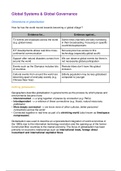
How far has the world moved towards becoming a ʻglobal villageʼ?
Evidence for... Evidence against...
TV events are broadcast across the world Some news channels are fairly narrowing
(e.g. global news) in their broadcasting. Focusing on specific
countries/superpowers
ICT developments allows real-time cross- Not everyone has access to this
continental communication technology (especially global south)
Support after natural disasters comes from We can observe global events but there is
around the world not necessarily global participation
Events such as the Olympics includes lots Remote tribes donʼt have this global
of countries inclusion
Cultural events from around the world are Elderly population may be less globalised
becoming apart of everyday society (e.g. compared to younger
Chinese New Year)
Defining globalisation:
Geographers describe globalisation in general terms as the process by which places and
environments become more:
• Interconnected --> a tying together of places by connection (e.g TNCs)
• Interdependent --> a reliance of these connections (e.g. floods, natural resources,
politicians)
• More deeply connected --> we know more of other cultures, better personnel
connections across the world
• Connected together in real time as part of a shrinking world (also known as time/space
compression)
Globalisation was used to describe an unprecedented integration of world economies in
the 1990s due to the information technology revolution and the opening up of the former
Communist Bloc countries to the market economy. The focus of globalisation has been
primarily on economic relationships such as international trade, foreign direct
investment and international capitalist flows.
,Is globalisation a good thing?
Positives Negatives
Improve conditions in developing More conflict because of terrorists
countries e.g. healthcare, education
Greater knowledge sharing Exploitation of developing nations e.g.
polluting, cheap labour
Greater understanding of cultures Countries are reliant on each other more
for resources e.g. oil, food
Easier to travel Cultural diffusion
Stay more connected to people across Large-scale migration
the world
Cheaper goods, greater variety of
products
Less global conflict e.g. EU
Outsourcing, cheaper labour, better
supply lines
, Globalisation flows and processes
Flows of capital
- World GDP, 2009 = $58
billion
What does it mean?
(define)
Capital includes all money
that move between
countries which is used for
investment, trade or
production
Whatʼs the pattern?
(describe)
No longer a case of seeing
core and periphery regions
of the world. Because
middle-income countries
such as BRICs and MINTs
have a rapidly developed there is now more of a containment of development
Why has this happened? (explain)
- Deregulation of world financial markets meant that there were fewer restrictions of
trade so they can trade beyond natural boundaries.
- Repatriation of profits - TNCs profit goes straight back to headquarters (economic
leakage) which are normally based in richer countries
- Aid - important source of financial support for poor countries e.g. UN, official
development assistants, NGOs
- Migration - majority of out-migration of labour takes place from poorer to richer countries
--> means less developed nations lose their most skilled works and their taxes and
spendings
- Remittance payments - these are transfers of money made by foreign workers to family
in their home country
Flows of labour (graphic from 2005-2010)
- Economic migration
- Numbers indicate the total migration in and out of
a region in millions
- Africa - internal migration moving from the
poorest to the more developed
- Northern Africa to southern Europe because of
Med. sea
- West Asia has in-migration because of oil
opportunities
- Large Mexico to USA migration
Dimensions of globalisation
How far has the world moved towards becoming a ʻglobal villageʼ?
Evidence for... Evidence against...
TV events are broadcast across the world Some news channels are fairly narrowing
(e.g. global news) in their broadcasting. Focusing on specific
countries/superpowers
ICT developments allows real-time cross- Not everyone has access to this
continental communication technology (especially global south)
Support after natural disasters comes from We can observe global events but there is
around the world not necessarily global participation
Events such as the Olympics includes lots Remote tribes donʼt have this global
of countries inclusion
Cultural events from around the world are Elderly population may be less globalised
becoming apart of everyday society (e.g. compared to younger
Chinese New Year)
Defining globalisation:
Geographers describe globalisation in general terms as the process by which places and
environments become more:
• Interconnected --> a tying together of places by connection (e.g TNCs)
• Interdependent --> a reliance of these connections (e.g. floods, natural resources,
politicians)
• More deeply connected --> we know more of other cultures, better personnel
connections across the world
• Connected together in real time as part of a shrinking world (also known as time/space
compression)
Globalisation was used to describe an unprecedented integration of world economies in
the 1990s due to the information technology revolution and the opening up of the former
Communist Bloc countries to the market economy. The focus of globalisation has been
primarily on economic relationships such as international trade, foreign direct
investment and international capitalist flows.
,Is globalisation a good thing?
Positives Negatives
Improve conditions in developing More conflict because of terrorists
countries e.g. healthcare, education
Greater knowledge sharing Exploitation of developing nations e.g.
polluting, cheap labour
Greater understanding of cultures Countries are reliant on each other more
for resources e.g. oil, food
Easier to travel Cultural diffusion
Stay more connected to people across Large-scale migration
the world
Cheaper goods, greater variety of
products
Less global conflict e.g. EU
Outsourcing, cheaper labour, better
supply lines
, Globalisation flows and processes
Flows of capital
- World GDP, 2009 = $58
billion
What does it mean?
(define)
Capital includes all money
that move between
countries which is used for
investment, trade or
production
Whatʼs the pattern?
(describe)
No longer a case of seeing
core and periphery regions
of the world. Because
middle-income countries
such as BRICs and MINTs
have a rapidly developed there is now more of a containment of development
Why has this happened? (explain)
- Deregulation of world financial markets meant that there were fewer restrictions of
trade so they can trade beyond natural boundaries.
- Repatriation of profits - TNCs profit goes straight back to headquarters (economic
leakage) which are normally based in richer countries
- Aid - important source of financial support for poor countries e.g. UN, official
development assistants, NGOs
- Migration - majority of out-migration of labour takes place from poorer to richer countries
--> means less developed nations lose their most skilled works and their taxes and
spendings
- Remittance payments - these are transfers of money made by foreign workers to family
in their home country
Flows of labour (graphic from 2005-2010)
- Economic migration
- Numbers indicate the total migration in and out of
a region in millions
- Africa - internal migration moving from the
poorest to the more developed
- Northern Africa to southern Europe because of
Med. sea
- West Asia has in-migration because of oil
opportunities
- Large Mexico to USA migration