

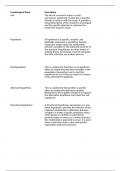
Psychological Word Description
Aim The aim of a research study is a clear
and concise statement of what the researcher
intends to achieve with the study. It provides a
broad description of the research's overall goal
and the specific objective or outcome the
researcher hopes to reach.
Hypothesis A hypothesis is a specific, testable, and
falsifiable statement or prediction that the
researcher makes about the relationship
between variables or the expected outcome of
the research. Hypotheses are often based on
existing theory or previous research and guide
the data collection and analysis process.
Null hypothesis This is a statement that there is no significant
effect or relationship between variables in the
population. Researchers aim to test this
hypothesis to see if they can reject it in favour
of the alternative hypothesis.
Alternate hypothesis This is a statement that predicts a specific
effect or relationship between variables.
Researchers aim to gather evidence to support
the alternative hypothesis and reject the null
hypothesis
Directional hypothesis A directional hypothesis, also known as a one-
tailed hypothesis, specifies the direction of the
expected relationship or difference between
variables. It makes a specific prediction about
which group or condition is expected to
perform better or worse, or in which direction
the relationship is expected to occur. It is used
when researchers have a clear and specific
expectation about the outcome.
,Non-directional hypothesis A non-directional hypothesis, also known as a
two-tailed hypothesis, does not specify the
direction of the expected relationship or
difference between variables. It simply predicts
that there will be a difference or a relationship,
without indicating whether it will be a positive
or negative effect. It is used when researchers
believe that there could be an effect, but they
do not have a specific expectation about the
direction.
Independent variable The variable that the researcher manipulates or
varies in an experiment to investigate its effect
on the dependent variable. It is the "cause" or
the factor that the researcher wants to test to
determine if it has an impact on the dependent
variable.
Dependent variable The variable that is measured or observed in
response to changes in the independent
variable. It is the "effect" or the outcome that
the researcher is interested in and hopes to
understand better as a result of manipulating
the independent variable.
Control variable Control variables are the factors or variables
that the researcher keeps constant or controls
throughout the experiment to ensure that the
changes observed in the dependent variable
are due to the manipulation of the
independent variable and not influenced by
other factors. They help eliminate potential
confounding variables that could affect the
results.
Confounding variable Confounding variables are variables other than
the independent variable that can affect the
dependent variable and lead to a
misinterpretation of the study's results. They
are sources of error or bias in an experiment.
Researchers aim to control or eliminate
confounding variables to ensure that the
effects observed are genuinely due to the
independent variable.
,Extraneous variable Variables that are not of primary interest in a
study but could potentially affect the results.
They are factors that are not being studied but
may have an impact on the dependent variable.
Researchers attempt to control or account for
extraneous variables to prevent them from
confounding the results.
Participant variable Participant variables are characteristics or traits
of the individuals participating in a study. These
variables can include age, gender, personality
traits, prior experiences, and more. Participant
variables can introduce variability into the
study's results if they are not controlled for.
Researchers may address participant variables
through random assignment, matching, or
statistical analysis.
Screw you effect Refers to a situation in which research
participants intentionally provide inaccurate or
uncooperative responses during a study. This
behaviour can occur when participants feel
dissatisfied with the study, its procedures, or
the researchers. They may choose to disrupt
the study by providing untruthful or unhelpful
responses, which can lead to inaccurate data
and negatively affect the research's validity.
Demand characteristics Cues or subtle hints in an experiment that
unintentionally convey information to
participants about the researcher's
expectations or the purpose of the study. When
participants pick up on these cues, they may
alter their behaviour or responses to align with
what they believe the researcher wants or
expects. This can introduce bias into the study
and lead to invalid or misleading results.
, Hawthorne effect Refers to the phenomenon in which individuals
modify their behaviour when they are aware
that they are being observed or are
participating in an experiment. This effect can
lead to changes in behaviour, performance, or
responses that do not accurately represent the
individual's typical or natural behaviour. The
Hawthorne effect is particularly relevant when
studying human behaviour and can impact the
internal and external validity of research.
Social desirability bias A type of response bias that occurs when
research participants provide responses that
they believe are socially acceptable or
desirable, rather than offering their true or
honest opinions or behaviours. Participants
may shape their responses to make themselves
look good or to conform to societal norms. This
can lead to the distortion of research findings,
as participants may not accurately represent
their thoughts, feelings, or behaviours.
Investigator effect Refers to the unintentional influence that
researchers or experimenters can have on the
behaviour and responses of study participants.
This influence occurs when the experimenter's
expectations, beliefs, or behaviours impact the
way participants behave or the data collected.
For example, an experimenter's facial
expressions, tone of voice, or nonverbal cues
may inadvertently influence participants'
responses.
Aim The aim of a research study is a clear
and concise statement of what the researcher
intends to achieve with the study. It provides a
broad description of the research's overall goal
and the specific objective or outcome the
researcher hopes to reach.
Hypothesis A hypothesis is a specific, testable, and
falsifiable statement or prediction that the
researcher makes about the relationship
between variables or the expected outcome of
the research. Hypotheses are often based on
existing theory or previous research and guide
the data collection and analysis process.
Null hypothesis This is a statement that there is no significant
effect or relationship between variables in the
population. Researchers aim to test this
hypothesis to see if they can reject it in favour
of the alternative hypothesis.
Alternate hypothesis This is a statement that predicts a specific
effect or relationship between variables.
Researchers aim to gather evidence to support
the alternative hypothesis and reject the null
hypothesis
Directional hypothesis A directional hypothesis, also known as a one-
tailed hypothesis, specifies the direction of the
expected relationship or difference between
variables. It makes a specific prediction about
which group or condition is expected to
perform better or worse, or in which direction
the relationship is expected to occur. It is used
when researchers have a clear and specific
expectation about the outcome.
,Non-directional hypothesis A non-directional hypothesis, also known as a
two-tailed hypothesis, does not specify the
direction of the expected relationship or
difference between variables. It simply predicts
that there will be a difference or a relationship,
without indicating whether it will be a positive
or negative effect. It is used when researchers
believe that there could be an effect, but they
do not have a specific expectation about the
direction.
Independent variable The variable that the researcher manipulates or
varies in an experiment to investigate its effect
on the dependent variable. It is the "cause" or
the factor that the researcher wants to test to
determine if it has an impact on the dependent
variable.
Dependent variable The variable that is measured or observed in
response to changes in the independent
variable. It is the "effect" or the outcome that
the researcher is interested in and hopes to
understand better as a result of manipulating
the independent variable.
Control variable Control variables are the factors or variables
that the researcher keeps constant or controls
throughout the experiment to ensure that the
changes observed in the dependent variable
are due to the manipulation of the
independent variable and not influenced by
other factors. They help eliminate potential
confounding variables that could affect the
results.
Confounding variable Confounding variables are variables other than
the independent variable that can affect the
dependent variable and lead to a
misinterpretation of the study's results. They
are sources of error or bias in an experiment.
Researchers aim to control or eliminate
confounding variables to ensure that the
effects observed are genuinely due to the
independent variable.
,Extraneous variable Variables that are not of primary interest in a
study but could potentially affect the results.
They are factors that are not being studied but
may have an impact on the dependent variable.
Researchers attempt to control or account for
extraneous variables to prevent them from
confounding the results.
Participant variable Participant variables are characteristics or traits
of the individuals participating in a study. These
variables can include age, gender, personality
traits, prior experiences, and more. Participant
variables can introduce variability into the
study's results if they are not controlled for.
Researchers may address participant variables
through random assignment, matching, or
statistical analysis.
Screw you effect Refers to a situation in which research
participants intentionally provide inaccurate or
uncooperative responses during a study. This
behaviour can occur when participants feel
dissatisfied with the study, its procedures, or
the researchers. They may choose to disrupt
the study by providing untruthful or unhelpful
responses, which can lead to inaccurate data
and negatively affect the research's validity.
Demand characteristics Cues or subtle hints in an experiment that
unintentionally convey information to
participants about the researcher's
expectations or the purpose of the study. When
participants pick up on these cues, they may
alter their behaviour or responses to align with
what they believe the researcher wants or
expects. This can introduce bias into the study
and lead to invalid or misleading results.
, Hawthorne effect Refers to the phenomenon in which individuals
modify their behaviour when they are aware
that they are being observed or are
participating in an experiment. This effect can
lead to changes in behaviour, performance, or
responses that do not accurately represent the
individual's typical or natural behaviour. The
Hawthorne effect is particularly relevant when
studying human behaviour and can impact the
internal and external validity of research.
Social desirability bias A type of response bias that occurs when
research participants provide responses that
they believe are socially acceptable or
desirable, rather than offering their true or
honest opinions or behaviours. Participants
may shape their responses to make themselves
look good or to conform to societal norms. This
can lead to the distortion of research findings,
as participants may not accurately represent
their thoughts, feelings, or behaviours.
Investigator effect Refers to the unintentional influence that
researchers or experimenters can have on the
behaviour and responses of study participants.
This influence occurs when the experimenter's
expectations, beliefs, or behaviours impact the
way participants behave or the data collected.
For example, an experimenter's facial
expressions, tone of voice, or nonverbal cues
may inadvertently influence participants'
responses.


