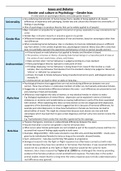
Issues and Debates
Gender and culture in Psychology – Gender bias
(To what extent are psychological theories and studies gender biased?)
• Any underlying characteristic of human beings that is capable of being applied to all, despite
Universality differences of experience and upbringing. Gender bias and cultural bias threaten the universality of
findings in psychology.
• (Aim of psychology is to produce theories that can be widely applied to all people)
• Bias: inclination or prejudice for or against one person or group, especially in a way considered to be
unfair.
• Gender bias: inclination towards or prejudice against one gender
Gender Bias • Differential treatment and/or representation of men and women, based on stereotypes rather than
real differences
• When considering human behaviour, bias is a tendency to treat one individual/ group in a different
way from others. In the context of gender bias, psychological research/ theory may offer a view that
does not justifiably represent the experience and behaviour of men or women (usually women)
• A theory based on male behaviour but applied to females and therefore is biased.
• The practice, conscious or theory, of placing male human beings or a masculine point of view at
the centre of one's world view, culture, and history.
• Male-centred; when ‘normal’ behaviour is judged according to a male standard
Androcentrism • Many psychological theories represent a male point-of-view
• If findings displaying ‘normal ‘behaviour is being drawn from research that involves a;;-male
samples, then any behaviour that deviates from this standard is likely to be judged as ‘abnormal’,
‘inferior’ or ‘deficient’ by comparison
• At best, this leads to female behaviour being misunderstood and at worst, pathologised (seen as
mentally ill)
• Androcentrism can lead to either an alpha or beta bias…
• Psychological theories that suggest there are real and enduring differences between men and
women. These may enhance or undervalue members of either sex, but typically undervalue females.
• Exaggerates or overestimates differences between the sexes – such differences are presented as real
and enduring or fixed and inevitable
• Differences may heighten the value of women, or may devalue females in relation to males
Alpha bias - E.g. Biological explanations of mental illness - depression can be explained in terms of chemical
imbalances in serotonin and noradrenaline as causing malfunctions in parts of the brain associated
with emotion. When explaining why twice as many women as men are diagnosed with depression,
supporters of the biomedical view tend to suggest that this is because of hormonal differences, for
example post-natal depression, to show how fluctuations in female sex hormones can lead to
abnormalities of mood. This might be a biased view because most doctors are men and hold
stereotypes which may lead them to give certain diagnoses and that’s why more women receive the
diagnosis.
- E.g. Psychodynamic theory states that morality is governed by the superego.
• Theories that ignore, minimise or underestimate differences between the sexes
• Assume that what is true for one gender is true for all human kind.
• Often occurs when female participants are not included as part of the research process and then it is
Beta bias assumed that research findings apply equally to both sexes
• Examples: Milgram(1963) – 65% males shocked to max 450 volts and Zimbardo(1969) – shocks were
given by de-individuated females for twice as long as the normally- dressed females.
• Asch: androcentric – beta bias (conformity/ NSI applies to all genders)
• biological research into the fight-or-flight response has often been carried out with male
animals because they have less variation in hormones than females. It was assumed that this
would not be a problem as the fight-or-flight response would be the same for both.
However, later stress research by Taylor et al. (2000) has challenged this view by providing
evidence that females produce a tend-and-befriend response. The beta-bias in the earlier
animal studies meant that for a long time the stress response was not fully understood and a
real difference was ignored.
Gender and culture in Psychology – Gender bias
(To what extent are psychological theories and studies gender biased?)
• Any underlying characteristic of human beings that is capable of being applied to all, despite
Universality differences of experience and upbringing. Gender bias and cultural bias threaten the universality of
findings in psychology.
• (Aim of psychology is to produce theories that can be widely applied to all people)
• Bias: inclination or prejudice for or against one person or group, especially in a way considered to be
unfair.
• Gender bias: inclination towards or prejudice against one gender
Gender Bias • Differential treatment and/or representation of men and women, based on stereotypes rather than
real differences
• When considering human behaviour, bias is a tendency to treat one individual/ group in a different
way from others. In the context of gender bias, psychological research/ theory may offer a view that
does not justifiably represent the experience and behaviour of men or women (usually women)
• A theory based on male behaviour but applied to females and therefore is biased.
• The practice, conscious or theory, of placing male human beings or a masculine point of view at
the centre of one's world view, culture, and history.
• Male-centred; when ‘normal’ behaviour is judged according to a male standard
Androcentrism • Many psychological theories represent a male point-of-view
• If findings displaying ‘normal ‘behaviour is being drawn from research that involves a;;-male
samples, then any behaviour that deviates from this standard is likely to be judged as ‘abnormal’,
‘inferior’ or ‘deficient’ by comparison
• At best, this leads to female behaviour being misunderstood and at worst, pathologised (seen as
mentally ill)
• Androcentrism can lead to either an alpha or beta bias…
• Psychological theories that suggest there are real and enduring differences between men and
women. These may enhance or undervalue members of either sex, but typically undervalue females.
• Exaggerates or overestimates differences between the sexes – such differences are presented as real
and enduring or fixed and inevitable
• Differences may heighten the value of women, or may devalue females in relation to males
Alpha bias - E.g. Biological explanations of mental illness - depression can be explained in terms of chemical
imbalances in serotonin and noradrenaline as causing malfunctions in parts of the brain associated
with emotion. When explaining why twice as many women as men are diagnosed with depression,
supporters of the biomedical view tend to suggest that this is because of hormonal differences, for
example post-natal depression, to show how fluctuations in female sex hormones can lead to
abnormalities of mood. This might be a biased view because most doctors are men and hold
stereotypes which may lead them to give certain diagnoses and that’s why more women receive the
diagnosis.
- E.g. Psychodynamic theory states that morality is governed by the superego.
• Theories that ignore, minimise or underestimate differences between the sexes
• Assume that what is true for one gender is true for all human kind.
• Often occurs when female participants are not included as part of the research process and then it is
Beta bias assumed that research findings apply equally to both sexes
• Examples: Milgram(1963) – 65% males shocked to max 450 volts and Zimbardo(1969) – shocks were
given by de-individuated females for twice as long as the normally- dressed females.
• Asch: androcentric – beta bias (conformity/ NSI applies to all genders)
• biological research into the fight-or-flight response has often been carried out with male
animals because they have less variation in hormones than females. It was assumed that this
would not be a problem as the fight-or-flight response would be the same for both.
However, later stress research by Taylor et al. (2000) has challenged this view by providing
evidence that females produce a tend-and-befriend response. The beta-bias in the earlier
animal studies meant that for a long time the stress response was not fully understood and a
real difference was ignored.