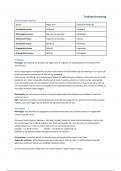
Psychology Plan
Behaviourist Approach Plan Evaluation
Point 1 Reductionist – Ignores the nature side of the argument – Contrary evidence such as
neurotransmitters – Ex Serotonin has effect on depression – However the positive of being
reductionist is that it opens up the pathway for scientific evidence – Objective
Point 2 Scientific Credibility – it’s leading force of turning psychology into a science – Criticism of
using animal experiments – However as a whole the backing of science has led to various real-life
application – Ex Token Economy System & Treatment of Phobias
Point 3 The Focus on Science some would argue ignores human emotion - Mechanistic View Of
Behaviour – Passive and Machine Like with no conscious insight - Environmentally Deterministic –
Neglects free will – Governed by external experiences – Bad implications – Fails to explain the
ability of choice
Cognitive Approach
Point 1 Machine Reductionism – The computer analogy provides a better developed account of
internal processes that shape behaviour – However it ignores human emotion and motivation on
the cognitive system – Oversimplifying – However as a result it allows scientific research to
happen
Point 2 Very Strong Emphasis On Science – Employed highly controlled and rigorous methods –
Many critics argue the lab experiments were highly artificial lacking ecological validity – However
the trust brought in from empirical evidence has led to mass real life application – Cognitive
Behavioural Therapy – Has Played A Role In The Development Of AI and Robots - Is the leading
contemporary explanation of behaviour
Point 3 Soft stance on Determinism – Recognises free will – Argues we operate only within what
we know – Some would argue this divided position – Defenders would argue it acknowledges the
complexity of behaviour – However critics will argue it’s a weak position failing to provide
justification for certain behaviours
Biological Approach Evaluation
Point 1 Scientific Methods Of Investigation – High degree of validity and reliability – Critics will
argue it neglects the experience of people – However the pioneering scientific backing has led to
mass real life application – Development of treatment drugs due to the understanding of
neurotransmitters – Proven effective in the treatment of mental disorders such as schizophrenia –
However patient drugs aren’t always effective and tend to cause side effects which varies – Critics
will point to the lack of the approach failing to separate nature and nurture (Concordance Rates in
the Twin Study)- Exposing it’s reductionist view
Point 2 Reductionist – Being the strongest advocate for the nature perspective - Chooses to ignore
the effects of childhood and environment which though encourages more sound science – Fails to
acknowledge the interference of the environment as strong influence on our behaviour – Evidence
contradicts itself (Twin Studies) providing an incoherent explanation of behaviour – Fails to
oppose and take account of the wide range of evidence that points to the influence of our
environment – Incomplete image of behaviour
Behaviourist Approach Plan Evaluation
Point 1 Reductionist – Ignores the nature side of the argument – Contrary evidence such as
neurotransmitters – Ex Serotonin has effect on depression – However the positive of being
reductionist is that it opens up the pathway for scientific evidence – Objective
Point 2 Scientific Credibility – it’s leading force of turning psychology into a science – Criticism of
using animal experiments – However as a whole the backing of science has led to various real-life
application – Ex Token Economy System & Treatment of Phobias
Point 3 The Focus on Science some would argue ignores human emotion - Mechanistic View Of
Behaviour – Passive and Machine Like with no conscious insight - Environmentally Deterministic –
Neglects free will – Governed by external experiences – Bad implications – Fails to explain the
ability of choice
Cognitive Approach
Point 1 Machine Reductionism – The computer analogy provides a better developed account of
internal processes that shape behaviour – However it ignores human emotion and motivation on
the cognitive system – Oversimplifying – However as a result it allows scientific research to
happen
Point 2 Very Strong Emphasis On Science – Employed highly controlled and rigorous methods –
Many critics argue the lab experiments were highly artificial lacking ecological validity – However
the trust brought in from empirical evidence has led to mass real life application – Cognitive
Behavioural Therapy – Has Played A Role In The Development Of AI and Robots - Is the leading
contemporary explanation of behaviour
Point 3 Soft stance on Determinism – Recognises free will – Argues we operate only within what
we know – Some would argue this divided position – Defenders would argue it acknowledges the
complexity of behaviour – However critics will argue it’s a weak position failing to provide
justification for certain behaviours
Biological Approach Evaluation
Point 1 Scientific Methods Of Investigation – High degree of validity and reliability – Critics will
argue it neglects the experience of people – However the pioneering scientific backing has led to
mass real life application – Development of treatment drugs due to the understanding of
neurotransmitters – Proven effective in the treatment of mental disorders such as schizophrenia –
However patient drugs aren’t always effective and tend to cause side effects which varies – Critics
will point to the lack of the approach failing to separate nature and nurture (Concordance Rates in
the Twin Study)- Exposing it’s reductionist view
Point 2 Reductionist – Being the strongest advocate for the nature perspective - Chooses to ignore
the effects of childhood and environment which though encourages more sound science – Fails to
acknowledge the interference of the environment as strong influence on our behaviour – Evidence
contradicts itself (Twin Studies) providing an incoherent explanation of behaviour – Fails to
oppose and take account of the wide range of evidence that points to the influence of our
environment – Incomplete image of behaviour