100% satisfaction guarantee Immediately available after payment Both online and in PDF No strings attached 4.6 TrustPilot
logo-home
Exam (elaborations)

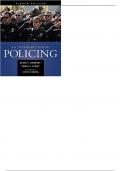
Test Bank For An Introduction to Policing 8th Edition by John S. Dempsey

Rating
-
Sold
-
Pages
263
Grade
A
Uploaded on
28-09-2023
Written in
2022/2023

True / False 1. Most police management experts say the span of control in a police department should be one supervisor to every 11 to 15 officers of a lower rank. ANSWER: False POINTS: 1 ANSWER: POINTS: REFERENCES: LEARNING OBJE CTIVES: KEYWORDS: True 1 False 1 a. True b. False REFERENCES: Organizing the Department: Managerial Concepts LEARNING OBJECTI INPO.DEMP.16.03.01 - Identify the major managerial concepts that must be considered when VES: organizing a police department KEYWORDS: Bloom's: Remembering 2. Most government employees at the federal, state, and local levels are managed by a civil service system. a. True b. False ANSWER: True POINTS: 1 REFERENCES: Alternative Organizational Models and Structures LEARNING OBJECTI INPO.DEMP.16.03.01 - Identify the major managerial concepts that must be considered when VES: KEYWORDS: 3. A reserve officer ANSWER: POINTS: REFERENCES: LEARNING OBJE CTIVES: KEYWORDS: organizing a police department Bloom's: Remembering is not considered to be sworn personnel. a. True b. False Organizing by Personnel INPO.DEMP.16.03.4 - Describe the differences between sworn and non sworn or civilian police department members, and list some way in which civilianization can benefit a police department Bloom's: Remembering 4. In some jurisdictions, reserve officers are paid, and in some they are not. a. True b. False Organizing by Personnel INPO.DEMP.16.03.4 - Describe the differences between sworn and non sworn or civilian police department members, and list some way in which civilianization can benefit a police department Bloom's: Remembering 5. Most police departments, particularly large departments, are governed by civil service regulations. a. True ANSWER: True b. False POINTS: 1 REFERENCES: Alternative Organizational Models and Structures LEARNING OBJECTI INPO.DEMP.16.03.01 - Identify the major managerial concepts that must be considered when VES: organizing a police department KEYWORDS: Bloom's: Remembering 6. The 4–10 schedule makes it easier for managers to schedule employees. a. True ANSWER: POINTS: REFERENCES: LEARNING OBJE CTIVES: KEYWORDS: False 1 b. False Organizing by Area INPO.DEMP.16.03.05 - Discuss the special problems that must dealt with in organizing a police department that operates seven days a week, 24 hours a day Bloom's: Remembering 7. Police unions are predominantly local organizations that bargain and communicate with the local police department and the mayor or chief’s office. ANSWER: POINTS: REFERENCES: LEARNING OBJECTIVES: KEYWORDS: a. True b. False True 1 Organizing by Personnel INPO.DEMP.16.03.02 - Describe some recent examples of shared leadership in policing Bloom's: Remembering 8. All three shifts in the police three-tour system have the same characteristics. a. True ANSWER: POINTS: REFERENCES: LEARNING OBJE CTIVES: KEYWORDS: False 1 b. False Organizing by Time INPO.DEMP.16.03.05 - Discuss the special problems that must dealt with in organizing a police department that operates seven days a week, 24 hours a day Bloom's: Remembering 9. Modern police organizations can be considered bureaucracies. a. True b. False REFERENCES: Organizing the Department: Managerial Concepts LEARNING OBJECTI INPO.DEMP.16.03.01 - Identify the major managerial concepts that must be considered when VES: organizing a police department KEYWORDS: Bloom's: Remembering 10. A civil service system solves all managerial problems with promotion, demotion, and dismissal. ANSWER: True POINTS: 1 ANSWER: False POINTS: 1 a. True b. False REFERENCES: Alternative Organizational Models and Structures LEARNING OBJECTI INPO.DEMP.16.03.01 - Identify the major managerial concepts that must be considered when VES: organizing a police department KEYWORDS: Bloom's: Remembering 11. Marine Corps general Smedley Butler organized a "bandit squad" to raid prostitution houses and suspected crime dens in Philadelphia. ANSWER: POINTS: REFERENCES: LEARNING OBJE CTIVES: KEYWORDS: a. True b. False True 1 Organizing the Department INPO.DEMP.16.03.05 - Discuss the special problems that must dealt with in organizing a police department that operates seven days a week, 24 hours a day Bloom's: Remembering 12. When an officer transfers from one department to another, they can lose some or all of their investment in their pension plans. ANSWER: True POINTS: 1 ANSWER: POINTS: REFERENCES: LEARNING OBJE CTIVES: KEYWORDS: True 1 a. True b. False REFERENCES: Organizing by Personnel LEARNING OBJECTI INPO.DEMP.16.03.01 - Identify the major managerial concepts that must be considered when VES: organizing a police department KEYWORDS: Bloom's: Remembering 13. Police fraternal organizations generally focus on national origin, ethnic, or gender identification. a. True b. False Organizing by Personnel INPO.DEMP.03.04 - Describe the differences between sworn and nonswhorn or civilian police department members, and list some way in which civilianization can benefit a police department Bloom's: Remembering 14. The leadership team is an independent body with authority to make binding decisions on a wide range of policy issues, working conditions, and departmental strategies. a. True b. False ANSWER: True POINTS: 1 REFERENCES: LEARNING OBJECTIVES: KEYWORDS: Alternative Organizational Models and Structures INPO.DEMP.16.03.02 - Describe some recent examples of shared leadership in policing Bloom's: Remembering 15. Officers are looking for leadership characteristics in their managers that will positively influence them in their police career. ANSWER: POINTS: REFERENCES: LEARNING OBJECTIVES: KEYWORDS: Multiple Choice a. True b. False True 1 Alternative Organizational Models and Structures INPO.DEMP.16.03.02 - Describe some recent examples of shared leadership in policing Bloom's: Remembering 16. The management concept that says that each individual in an organization is supervised by one immediate supervisor or boss who in turn reports to a higher supervisor is termed: a. ladder of command. b. effective level of supervision. c. span of control. d. chain of command. ANSWER: d POINTS: 1 REFERENCES: Organizing the Department: Managerial Concepts LEARNING OBJECTI INPO.DEMP.16.03.01 - Identify the major managerial concepts that must be considered when VES: organizing a police department KEYWORDS: Bloom's: Remembering 17. The number of officers or subordinates a supervisor can supervise effectively is called: a. chain of command. b. organizational index. c. span of control. d. effective level of supervision. ANSWER: c POINTS: 1 REFERENCES: Organizing the Department: Managerial Concepts LEARNING OBJECTI INPO.DEMP.16.03.01 - Identify the major managerial concepts that must be considered when VES: organizing a police department KEYWORDS: Bloom's: Remembering 18. The civil service system was created by the: a. Pendleton Act. c. Fourteenth Amendment. b. Civil Rights Act of 1964. d. Civil Service Act of 1911. ANSWER: a POINTS: 1 REFERENCES: Organizing the Department: Managerial Concepts LEARNING OBJECTI INPO.DEMP.16.03.01 - Identify the major managerial concepts that must be considered when VES: organizing a police department KEYWORDS: Bloom's: Remembering 19. The civil service system is a ____________________ system. a. c. REFERENCES: nepotism b. favoritism reward d. merit d 1 Organizing the Department: Managerial Concepts ANSWER: POINTS: LEARNING OBJECTI INPO.DEMP.16.03.01 - Identify the major managerial concepts that must be considered when VES: organizing a police department KEYWORDS: Bloom's: Remembering 20. The police structure in the United States is: a. c. ANSWER: POINTS: REFERENCES: military. quasi-military. b. civilian. d. hemi-military. ANSWER: POINTS: 22. Which of highest? a. b. c. d. ANSWER: POINTS: the following represents the standard order of civil service ranks within a police department from lowest to officer, sergeant, lieutenant, captain, chief corporal, officer, sergeant, lieutenant, captain, chief captain, officer, sergeant, corporal, lieutenant, chief officer, sergeant, corporal, lieutenant, captain, chief a 1 Organizing by Personnel INPO.DEMP.16.03.04 - Describe the differences between sworn and non sworn or civilian police department members, and list some ways in which civilianization can benefit a police department Bloom's: Remembering at a crime scene is in charge until relieved, at which point the ____________________ takes charge REFERENCES: LEARNING OBJE CTIVES: KEYWORDS: 23. The first officer of the scene. c 1 Alternative Organizational Models and Structures LEARNING OBJECTI INPO.DEMP.16.03.01 - Identify the major managerial concepts that must be considered when VES: organizing a police department KEYWORDS: Bloom's: Remembering 21. Police officers are considered ____________________ members of the department. a. c. REFERENCES: LEARNING OBJECTI VES: KEYWORDS: sworn b. nonsworn civilian d. local a 1 Alternative Organizational Models and Structures INPO.DEMP.16.03.01 - Identify the major managerial concepts that must be considered when organizing a police department Bloom's: Remembering a. captain b. lieutenant c. sergeant d. detective/investigator ANSWER: POINTS: REFERENCES: LEARNING OBJE CTIVES: ANSWER: POINTS: REFERENCES: LEARNING OBJE CTIVES: d 1 Organizing by Personnel INPO.DEMP.16.03.04 - Describe the differences between sworn and non sworn or civilian police department members, and list some ways in which civilianization can benefit a police department Bloom's: Remembering 24. The first supervisor in the police chain of command is the: KEYWORDS: a. c. detective. lieutenant. Organizing by Personnel b. captain. d. sergeant. d 1 INPO.DEMP.16.03.04 - Describe the differences between sworn and non sworn or civilian police department members, and list some ways in which civilianization can benefit a police department Bloom's: Remembering 25. Who is generally in charge of a squad? KEYWORDS: a. c. ANSWER: POINTS: REFERENCES: LEARNING OBJE CTIVES: ANSWER: POINTS: REFERENCES: LEARNING OBJE CTIVES: KEYWORDS: a. c. captain inspector Organizing by Personnel b. lieutenant d. detective master patrol officer lieutenant d 1 Organizing by Personnel b. corporal d. sergeant INPO.DEMP.16.03.04 - Describe the differences between sworn and non sworn or civilian police department members, and list some ways in which civilianization can benefit a police department Bloom's: Remembering 26. Who is generally in charge of a platoon? KEYWORDS: b 1 INPO.DEMP.16.03.04 - Describe the differences between sworn and non sworn or civilian police department members, and list some ways in which civilianization can benefit a police department Bloom's: Remembering 27. The collection of all officers working a particular shift is called a: a. cohort. b. precinct. c. platoon. d. staff. ANSWER: c POINTS: 1 REFERENCES: Organizing by Personnel LEARNING OBJE CTIVES: KEYWORDS: INPO.DEMP.16.03.04 - Describe the differences between sworn and non sworn or civilian police department members, and list some ways in which civilianization can benefit a police department Bloom's: Remembering 28. The process of removing sworn officers from nonenforcement jobs and replacing them by nonsworn personnel is called: a. c. ANSWER: POINTS: REFERENCES: LEARNING OBJE CTIVES: KEYWORDS: KEYWORDS: rationalization. upgrading. b 1 Organizing by Personnel b. civilianization. d. lateral transfer. INPO.DEMP.16.03.04 - Describe the differences between sworn and non sworn or civilian police department members, and list some ways in which civilianization can benefit a police department Bloom's: Remembering 29. An entry-level police apprentice without general law enforcement powers suggested by the President’s Commission on Law Enforcement and Administration of Justice is a: a. police agent. c. community service officer. b. police officer. d. reserve officer. ANSWER: POINTS: REFERENCES: LEARNING OBJE CTIVES: a. c. ANSWER: POINTS: REFERENCES: LEARNING OBJECTIVES: KEYWORDS: c 1 Organizing by Personnel INPO.DEMP.16.03.04 - Describe the differences between sworn and non sworn or civilian police department members, and list some ways in which civilianization can benefit a police department Bloom's: Remembering 30. The police strike of 1919 occurred in: New York. Chicago. b. Pittsburgh. d. Boston. d 1 Organizing by Personnel INPO.DEMP.16.03.02 - Describe some recent examples of shared leadership in policing Bloom's: Remembering 31. The smallest geographical area a single patrol unit can patrol effectively is called a: a. precinct. b. sector. c. beat. d. zone. ANSWER: c POINTS: 1 REFERENCES: Organizing by Personnel LEARNING OBJE CTIVES: KEYWORDS: INPO.DEMP.16.03.05 - Discuss the special problems that must dealt with in organizing a police department that operates seven days a week, 24 hours a day Bloom's: Remembering 32. Using a traditional three-tour system with one officer per beat per shift, about how many officers actually must be available to cover each beat? ANSWER: d POINTS: 1 a.2 b.3 c.4 d.5 REFERENCES: LEARNING OBJE CTIVES: KEYWORDS: Organizing by Area INPO.DEMP.16.03.05 - Discuss the special problems that must dealt with in organizing a police department that operates seven days a week, 24 hours a day Bloom's: Remembering 33. A patrol officer should report to his or her immediate ____________________, unless an emergency exists or speed is necessary. a. c. REFERENCES: department b. platoon d. b 1 Organizing the Department: Managerial Concepts sergeant precinct ANSWER: POINTS: LEARNING OBJECTI INPO.DEMP.16.03.01 - Identify the major managerial concepts that must be considered when VES: organizing a police department KEYWORDS: Bloom's: Remembering 34. Police chiefs are possibly the key figure in the police organization because they: a. get paid the most. ANSWER: POINTS: REFERENCES: c 1 Organizing by Personnel b. appear before local government agencies. c. set the vision and tone for the department. d. work shifts when officers are sick. LEARNING OBJECTI INPO.DEMP.16.03.01 - Identify the major managerial concepts that must be considered when VES: organizing a police department KEYWORDS: Bloom's: Remembering 35. The highly organized rank structure for sworn members of a department is known as: a. functional command. b. chain of command. c. unity of ANSWER: POINTS: REFERENCES: LEARNING OBJECTI VES: command. d. supervision ratio. b 1 Organizing by Personnel INPO.DEMP.16.03.01 - Identify the major managerial concepts that must be considered when organizing a police department Bloom's: Remembering 36. What is an example of an administrative unit in a police department? KEYWORDS: a. c. ANSWER: POINTS: REFERENCES: records b. alcohol testing personnel d. community relations c 1 Organizing by Function or Purpose INPO.DEMP.16.03.05 - Discuss the special problems that must dealt with in organizing a police department that operates seven days a week, 24 hours a day Bloom's: Remembering LEARNING OBJE CTIVES: KEYWORDS: 37. An example of an operations unit in a police department would be: a. c. ANSWER: POINTS: REFERENCES: patrol. b. communications. training. d. internal affairs. a 1 Organizing by Time LEARNING OBJECTI INPO.DEMP.16.03.01 - Identify the major managerial concepts that must be considered when VES: organizing a police department KEYWORDS: Bloom's: Remembering 38. Activities that benefit other units within the police department more frequently than do administrative activities are called: a. personnel processes. c. auxiliary services. b. operational procedures. d. resource functions. ANSWER: POINTS: REFERENCES: LEARNING OBJE CTIVES: KEYWORDS: c 1 Organizing by Function or Purpose INPO.DEMP.16.03.05 - Discuss the special problems that must dealt with in organizing a police department that operates seven days a week, 24 hours a day Bloom's: Remembering 39. An example of an auxiliary unit in a police department would be: a. criminal investigations. b. community relations. c. communications. d. training. ANSWER: POINTS: REFERENCES: LEARNING OBJE CTIVES: KEYWORDS: c 1 Organizing by Function or Purpose INPO.DEMP.16.03.05 - Discuss the special problems that must dealt with in organizing a police department that operates seven days a week, 24 hours a day Bloom's: Remembering 40. Activities performed in direct assistance to the public are called: a. administration. b. operations. c. auxiliary services. d. fraternal procedures. ANSWER: POINTS: REFERENCES: LEARNING OBJE CTIVES: KEYWORDS: b 1 Organizing by Function or Purpose INPO.DEMP.16.03.05 - Discuss the special problems that must dealt with in organizing a police department that operates seven days a week, 24 hours a day Bloom's: Remembering 41. ____________________ is defined as an organizational model marked by hierarchy and promotion on professional merit and skill. ANSWER: b a. c. Keynesian paradigm b. Bureaucracy Privatization d. Monetarism POINTS: 1 REFERENCES: Organizing the Department: Managerial Concepts LEARNING OBJECTI INPO.DEMP.16.03.01 - Identify the major managerial concepts that must be considered when VES: organizing a police department KEYWORDS: Bloom's: Remembering 42. Informal job actions by officers in which they refuse to perform certain job functions in an attempt to win labor concessions from their employers are called: a. c. ANSWER: POINTS: REFERENCES: LEARNING OBJECTIVES: KEYWORDS: a. c. ANSWER: POINTS: REFERENCES: LEARNING OBJECTIVES: KEYWORDS: ANSWER: POINTS: REFERENCES: LEARNING OBJECTIVES: KEYWORDS: c 1 Organizing the Department: Managerial Concepts INPO.DEMP.16.03.02 - Describe some recent examples of shared leadership in policing Bloom's: Remembering blue flu. blackout. b. sit-out. d. blue-out. 43. The power of police is limited by state laws and the: a. c. ANSWER: POINTS: REFERENCES: Pendleton Act. Bill of Rights. b. district attorney. d. municipal judge. a 1 Organizing by Personnel INPO.DEMP.16.03.02 - Describe some recent examples of shared leadership in policing Bloom's: Remembering c 1 Organizing the Department: Managerial Concepts LEARNING OBJECTI INPO.DEMP.16.03.01 - Identify the major managerial concepts that must be considered when VES: organizing a police department KEYWORDS: Bloom's: Remembering 44. A majority of female officers prefer a leader who is considered “transformational” and: autocratic. b. situational. democratic. d. laissez faire. c 1 Alternative Organizational Models and Structures INPO.DEMP.16.03.02 - Describe some recent examples of shared leadership in policing Bloom's: Remembering 45. Total quality management, quality circles, job involvement, participative management, and employee empowerment are all known as forms of: a. bottom-up leadership. b. top-down leadership. c. shared leadership. d. theory X leadership. 46. Shared leadership attained renewed interest in the 1980s and 1990s in response to: a. the court case of Tennessee v. Garner. b. New York City’s successful implementation. c. the riots in Los Angeles. d. Japanese industry’s success. ANSWER: POINTS: REFERENCES: LEARNING OBJECTIVES: KEYWORDS: d 1 Organizing the Department: Managerial Concepts INPO.DEMP.16.03.02 - Describe some recent examples of shared leadership in policing Bloom's: Remembering 47. The independent body in Broken Arrow, Oklahoma, that has authority to make binding decisions on a wide range of policy issues, working conditions, and departmental strategies is called a: a. community review board. b. community team. c. leadership team. d. police chief’s administrative team. ANSWER: POINTS: REFERENCES: LEARNING OBJECTIVES: KEYWORDS: c 1 Organizing the Department: Managerial Concepts INPO.DEMP.16.03.02 - Describe some recent examples of shared leadership in policing Bloom's: Remembering 48. The President’s Commission on Law Enforcement and Administration of Justice recommended: a. hiring lateral police officers. b. developing a national police retirement system. c. hiring more women. d. forming permanent police reserve units. ANSWER: POINTS: REFERENCES: LEARNING OBJECTIVES: KEYWORDS: b 1 Organizing the Department: Managerial Concepts INPO.DEMP.16.03.02 - Describe some recent examples of shared leadership in policing Bloom's: Remembering 49. Tradition and civil service rules have established the police officer’s working day as ____________________ hours. a.6 b.8 c. 10 d. 12 ANSWER: b POINTS: 1 REFERENCES: Organizing by Personnel LEARNING OBJECTI INPO.DEMP.16.03.01 - Identify the major managerial concepts that must be considered when VES: organizing a police department KEYWORDS: Bloom's: Remembering 50. Which group is considered the backbone of police services? a. c. ANSWER: POINTS: REFERENCES: detectives b. patrol officers training officers d. community service officers b 1 Organizing by Area LEARNING OBJECTI INPO.DEMP.16.03.01 - Identify the major managerial concepts that must be considered when VES: organizing a police department KEYWORDS: Bloom's: Remembering Completion 51. The concept of dividing the tasks of an organization according to personnel, area, time, and function or process is called __________. ANSWER: POINTS: REFERENCES: LEARNING OBJE CTIVES: KEYWORDS: division of labor 1 Organizing the Department: Managerial Concepts INPO.DEMP.16.03.05 - Discuss the special problems that must dealt with in organizing a police department that operates seven days a week, 24 hours a day Bloom's: Remembering 52. Another name for chain of command is __________. ANSWER: hierarchy of authority POINTS: 1 REFERENCES: Organizing the Department: Managerial Concepts LEARNING OBJECTI INPO.DEMP.16.03.01 - Identify the major managerial concepts that must be considered when VES: organizing a police department KEYWORDS: Bloom's: Remembering 53. The number of officers or subordinates that a supervisor can supervise effectively is called the __________. ANSWER: span of control POINTS: 1 REFERENCES: Organizing the Department: Managerial Concepts LEARNING OBJECTI INPO.DEMP.16.03.01 - Identify the major managerial concepts that must be considered when VES: organizing a police department KEYWORDS: Bloom's: Remembering 54. The concept that each individual in an organization is directly accountable to only one supervisor is called __________. ANSWER: unity of command (chain of command) chain of command (unity of command) unity of command chain of command POINTS: 1 REFERENCES: Organizing the Department: Managerial Concepts LEARNING OBJECTI INPO.DEMP.16.03.01 - Identify the major managerial concepts that must be considered when VES: organizing a police department KEYWORDS: Bloom's: Remembering 55. Chain of command may be violated in two situations. They are __________ and __________. ANSWER: POINTS: REFERENCES: emergency, speed speed, emergency 1 Organizing the Department: Managerial Concepts LEARNING OBJECTI INPO.DEMP.16.03.01 - Identify the major managerial concepts that must be considered when VES: organizing a police department KEYWORDS: Bloom's: Remembering 56. No matter the size of the agency, the chain of command starts with the __________. ANSWER: POINTS: REFERENCES: LEARNING OBJE CTIVES: ANSWER: POINTS: REFERENCES: LEARNING OBJE CTIVES: KEYWORDS: chief of police 1 Organizing the Department: Managerial Concepts INPO.DEMP.16.03.05 - Discuss the special problems that must dealt with in organizing a police department that operates seven days a week, 24 hours a day Bloom's: Remembering 57. The first-line supervisor in the police chain of command is the __________. KEYWORDS: sergeant 1 Organizing by Personnel INPO.DEMP.16.03.04 - Describe the differences between sworn and non sworn or civilian police department members, and list some ways in which civilianization can benefit a police department Bloom's: Remembering 58. The process of removing sworn officers from noncritical or nonenforcement tasks and replacing them with civilians or nonsworn employees is called __________. ANSWER: POINTS: REFERENCES: LEARNING OBJE CTIVES: KEYWORDS: civilianization 1 Organizing the Department: Managerial Concepts INPO.DEMP.16.03.04 - Describe the differences between sworn and non sworn or civilian police department members, and list some ways in which civilianization can benefit a police department Bloom's: Remembering 59. The ability and opportunity to transfer from one police department to another is called __________. ANSWER: lateral transfer (lateral movement) lateral movement (lateral transfer) lateral transfer lateral movement POINTS: 1 REFERENCES: Organizing by Personnel LEARNING OBJECTI INPO.DEMP.16.03.01 - Identify the major managerial concepts that must be considered when VES: organizing a police department KEYWORDS: Bloom's: Remembering 60. The traditional principles of management have been described using the acronym _____________. ANSWER: PODSCORB POINTS: 1 REFERENCES: Organizing the Department: Managerial Concepts LEARNING OBJECTI INPO.DEMP.16.03.01 - Identify the major managerial concepts that must be considered when VES: organizing a police department KEYWORDS: Bloom's: Remembering 61. Officers that move from one department to another are called _________________________. ANSWER: lateral transfers POINTS: 1 REFERENCES: Organizing by Personnel LEARNING OBJECTI INPO.DEMP.16.03.01 - Identify the major managerial concepts that must be considered when VES: organizing a police department KEYWORDS: Bloom's: Remembering Essay 62. Describe the major strengths and weaknesses of the civil service system. ANSWER: Answer varies. POINTS: 1 REFERENCES: Alternative Organizational Models and Structures LEARNING OBJECTI INPO.DEMP.16.03.01 - Identify the major managerial concepts that must be considered when VES: organizing a police department KEYWORDS: Bloom's: Understanding 63. Define civilianization and discuss the reasons for it. ANSWER: Answer varies. POINTS: 1 REFERENCES: Organizing by Personnel LEARNING OBJECTI INPO.DEMP.16.03.01 - Identify the major managerial concepts that must be considered when VES: organizing a police department KEYWORDS: Bloom's: Understanding 64. Delineate the ranks in the police hierarchy from bottom to top, and explain the responsibilities of each rank. ANSWER: Answer varies. POINTS: 1 REFERENCES: Organizing by Personnel LEARNING OBJECTI INPO.DEMP.16.03.01 - Identify the major managerial concepts that must be considered when VES: organizing a police department KEYWORDS: Bloom's: Understanding 65. Discuss the basic paradox ANSWER: POINTS: REFERENCES: LEARNING OBJECTIVES: KEYWORDS: of police discretion and control-oriented management. Answer varies. 1 Alternative Organizational Models and Structures INPO.DEMP.16.03.02 - Describe some recent examples of shared leadership in policing Bloom's: Understanding 66. Detail the benefits of a police union. ANSWER: POINTS: REFERENCES: LEARNING OBJECTIVES: KEYWORDS: Answer varies. 1 Organizing by Personnel INPO.DEMP.16.03.02 - Describe some recent examples of shared leadership in policing Bloom's: Analyzing 67. What are the major managerial concepts that must be considered when organizing a police department by area? ANSWER: POINTS: REFERENCES: LEARNING OBJE CTIVES: KEYWORDS: Answer varies. 1 Organizing by Personnel INPO.DEMP.16.03.05 - Discuss the special problems that must dealt with in organizing a police department that operates seven days a week, 24 hours a day Bloom's: Evaluating 68. Identify the staffing issues that must be considered in organizing a police department that operates 7 days a week, 24 hours a day. ANSWER: POINTS: REFERENCES: LEARNING OBJE CTIVES: KEYWORDS: Answer varies. 1 Organizing by Area INPO.DEMP.16.03.05 - Discuss the special problems that must dealt with in organizing a police department that operates seven days a week, 24 hours a day Bloom's: Understanding 69. Discuss what ethical leadership is and how it is demonstrated. ANSWER: Answer varies. POINTS: 1 REFERENCES: Organizing the Department: Managerial Concepts LEARNING OBJECTI INPO.DEMP.16.03.01 - Identify the major managerial concepts that must be considered when VES: organizing a police department KEYWORDS: Bloom's: Understanding 70. Identify the backbone of the police department, and tell why this group’s members are the most important people in police service. ANSWER: POINTS: REFERENCES: LEARNING OBJECTIVES: KEYWORDS: Answer varies. 1 Organizing by Personnel INPO.DEMP.16.03.02 - Describe some recent examples of shared leadership in policing Bloom's: Understanding 71. Explain the concept of shared leadership. Use the Broken Arrow, Oklahoma, Police Department as an example. ANSWER: Answer varies. POINTS: 1 REFERENCES: Organizing the Department: Managerial Concepts LEARNING OBJECTI INPO.DEMP.16.03.01 - Identify the major managerial concepts that must be considered when VES: organizing a police department KEYWORDS: Bloom's: Understanding 72.ListanddiscussTaylor'sFourScientificManagementPrinciplesandiftheseprinciplesarestillvalidtoday. Preparea 3-5-page paper defending your position. ANSWER: POINTS: REFERENCES: Answer varies. 1 Organizing the Department: Managerial Concepts LEARNING OBJECTI INPO.DEMP.16.03.01 - Identify the major managerial concepts that must be considered when VES: organizing a police department KEYWORDS: Bloom's: Understanding 73.Discussthebenefitsanddrawbacksofhiringalateraltransferintoanagency. IfyouweretheChief/Sheriffofyour agency, would you want to hire lateral transfers and why or why not? ANSWER: Answer varies. POINTS: 1 REFERENCES: Organizing by Personnel LEARNING OBJECTI INPO.DEMP.16.03.01 - Identify the major managerial concepts that must be considered when VES: organizing a police department KEYWORDS: Bloom's: Understanding 74. Leadership is an essential element in any organization. Are managers and supervisors leaders? Are the words manage and supervise analogous to the word lead? Think of some of the supervisors or bosses you have worked for. Did they merely tell you what to do and how to do it, and then discipline you if you did it poorly? Or did they motivate you to see the value of the work you were performing and how you fit into the broader mission of the organization, and inspire you to perform your job to the very best of your ability? ANSWER: POINTS: REFERENCES: LEARNING OBJECTIVES: KEYWORDS: Answer varies. 1 Organizing by Personnel INPO.DEMP.16.03.02 - Describe some recent examples of shared leadership in policing Bloom's: Analyzing 75. The number of officers or subordinates that a supervisor can supervise effectively is called the span of control. Most police management experts say the chain of command should be 1 supervisor to every 6 to 10 officers of lower rank. What are some factors that may limit the number of employees a supervisor can manage? ANSWER: POINTS: REFERENCES: LEARNING OBJECTI VES: KEYWORDS: Answer varies. 1 Organizing by Personnel INPO.DEMP.03.01 - Identify the major managerial concepts that must be considered when organizing a police department Bloom's: Understanding True / False 1. Movies and television shows about the police emphasize the police crime-fighting role. a. True b. False ANSWER: POINTS: REFERENCES: True 1 The Police Role LEARNING OBJECINPO.DEMP.16.05.02 - List the different definitions of police operational styles and how they TIVES: address the major goals and objectives of policing. KEYWORDS: Bloom's: Remembering 2. The police themselves emphasize their role as crime fighters and play down their job as peacekeepers and social service providers. ANSWER: POINTS: REFERENCES: a. True b. False True 1 The Police Role LEARNING OBJECINPO.DEMP.16.05.02 - List the different definitions of police operational styles and how they TIVES: address the major goals and objectives of policing. KEYWORDS: Bloom's: Remembering 3. Elaine Cumming and her colleagues reported that the ordinary work routines of police officers include mostly law enforcement activities and very few other activities. ANSWER: POINTS: REFERENCES: a. True b. False False 1 The Police Role LEARNING OBJECINPO.DEMP.16.05.02 - List the different definitions of police operational styles and how they TIVES: address the major goals and objectives of policing. KEYWORDS: Bloom's: Remembering 4. The police role is extremely well defined and contains little ambiguity. a. True ANSWER: POINTS: REFERENCES: LEARNING OBJEC TIVES: KEYWORDS: False 1 b. False The Police Role INPO.DEMP.16.05.01 - Discuss the ambiguity of the police role, including the distinctions between crime fighting and order maintenance. Bloom's: Remembering 5. The “defense of life” standard allowed police officers to use deadly force against people who were using deadly force against an officer or another person. a. True ANSWER: POINTS: REFERENCES: LEARNING OBJECTI VES: KEYWORDS: True 1 Police Shootings and the Use of Deadly Force INPO.DEMP.16.06.04 - Identify the ways police departments can address the high levels of stress exhibited by their officers. Bloom's: Remembering 6. The primary goal or objective of the police a. ANSWER: POINTS: REFERENCES: LEARNING OBJEC TIVES: KEYWORDS: False 1 ANSWER: POINTS: REFERENCES: False 1 b. False should be to arrest all offenders. True False Role Discuss the ambiguity of the police role, including the distinctions between maintenance. than other officials in the criminal justice system. True b. Goals and Objectives of Policing b. Ambiguity of the Police INPO.DEMP.16.04.01 - crime fighting and order Bloom's: Understanding 7. Police generally have much less discretion a. False LEARNING OBJECINPO.DEMP.16.05.02 - List the different definitions of police operational styles and how they TIVES: address the major goals and objectives of policing. KEYWORDS: Bloom's: Remembering 8. The police officer is generally the first decision maker in the U.S. criminal justice system and is often the most important. ANSWER: POINTS: REFERENCES: a. True b. False True 1 Goals and Objectives of Policing LEARNING OBJECINPO.DEMP.16.05.02 - List the different definitions of police operational styles and how they TIVES: address the major goals and objectives of policing. KEYWORDS: Bloom's: Remembering 9. Police are free or have the ability to ignore crimes or to exercise discretion regarding them, even when the crime is serious. ANSWER: POINTS: REFERENCES: a. True b. False False 1 Police Discretion LEARNING OBJECTIVES:INPO.DEMP.16.05.03 - Explain why levels of stress are higher in policing than other occupations. KEYWORDS: Bloom's: Remembering 10. An officer’s discretion varies depending on the type of situation he or she encounters. a. True b. False ANSWER: POINTS: REFERENCES: True 1 Police Discretion LEARNING OBJECTIVES:INPO.DEMP.16.05.03 - Explain why levels of stress are higher in policing than other occupations. KEYWORDS: Bloom's: Remembering 11. The entire criminal justice system is based on the concept of discretion. a. True ANSWER: POINTS: REFERENCES: LEARNING OBJE CTIVES: KEYWORDS: b. False True 1 Police Discretion INPO.DEMP.16.05.03 - Explain why levels of stress are higher in policing than other occupations. INPO.DEMP.16.05.05 - Describe and discuss the occupational dangers to the health and safety of police officers. Bloom's: Remembering 12. Most of what happens in the U.S. criminal justice system happens without the use of discretion by the police. a. True ANSWER: POINTS: REFERENCES: b. False Police Operational Styles False 1 LEARNING OBJECTIVES:INPO.DEMP.16.05.03 - Explain why levels of stress are higher in policing than other occupations. KEYWORDS: Bloom's: Remembering 13. The growing popularity of less-than-lethal weapons (LTLW) by police officers in the United States virtually ensures their increased use in the law enforcement community. ANSWER: POINTS: REFERENCES: LEARNING OBJE CTIVES: a. True b. False True 1 Police Shootings and the Use of Deadly Force INPO.DEMP.16.05.03 - Explain why levels of stress are higher in policing than other occupations. INPO.DEMP.16.05.04 - Identify the ways police departments can address the high levels of stress exhibited by their officers. Bloom's: Remembering KEYWORDS: 14. Two studies indicate that people who engage in violent crime or who engage the police in violent confrontations are much more likely to be the victims of police shootings. ANSWER: POINTS: REFERENCES: LEARNING OBJECTI VES: KEYWORDS: a. True b. False Police Shootings and the Use of Deadly Force INPO.DEMP.16.06.04 - Identify the ways police departments can address the high levels of stress exhibited by their officers. Bloom's: Remembering True 1 15. The "broken windows" theory suggests it is appropriate to allow a neighborhood to deteriorate if the neighborhood will not participate in its upkeep. ANSWER: POINTS: REFERENCES: LEARNING OBJEC TIVES: KEYWORDS: False 1 a. True b. False The Police Role INPO.DEMP.16.05.01 - Discuss the ambiguity of the police role, including the distinctions between crime fighting and order maintenance. Bloom's: Remembering 16. Minority groups allege they are the victims of race-based policing due the NYPD stop-and-frisk policies. a. True ANSWER: POINTS: REFERENCES: LEARNING OBJECTIV ES: KEYWORDS: b. False Police Discretion INPO.DEMP.16.05.05 - Describe and discuss the occupational dangers to the health and safety of police officers. Bloom's: Remembering ANSWER: POINTS: REFERENCES: b. False Police Discretion True 1 17. In most cases where stops were made, the behavior of the suspect was what concerned the officer. a. True True 1 LEARNING OBJECTIVES:INPO.DEMP.16.05.03 - Explain why levels of stress are higher in policing than other occupations. KEYWORDS: Bloom's: Remembering 18. Officers have broad discretion on whether to arrest or not to arrest in domestic violence cases. a. True ANSWER: False POINTS: 1 b. False REFERENCES: Police Discretion LEARNING OBJECTIVES:INPO.DEMP.16.05.03 - Explain why levels of stress are higher in policing than other occupations. KEYWORDS: Bloom's: Remembering 19. Gender does not play an important role in use of force incidents by police officers. a. True ANSWER: POINTS: REFERENCES: LEARNING OBJE CTIVES: KEYWORDS: Multiple Choice b. False False 1 Police Discretion INPO.DEMP.16.05.03 - Explain why levels of stress are higher in policing than other occupations. INPO.DEMP.16.05.05 - Describe and discuss the occupational dangers to the health and safety of police officers. Bloom's: Remembering 20. In 1985, the fleeing felon rule was declared unconstitutional by the U.S. Supreme Court in the landmark case of: a. Mapp v. Ohio. b. Lawrence v. Texas. c. Tennessee v. Garner. d. Terry v. Ohio. ANSWER: POINTS: REFERENCES: LEARNING OBJE CTIVES: KEYWORDS: c 1 Police Shootings and the Use of Deadly Force INPO.DEMP.16.05.01 - Discuss the ambiguity of the police role, including the distinctions between crime fighting and order maintenance. INPO.DEMP.16.05.04 - Identify the ways police departments can address the high levels of stress exhibited by their officers. Bloom's: Remembering 21. The police make approximately ____________________ million arrests a year. a. 3.3 b. 10.16 c. 12.2 d. 13.12 ANSWER: POINTS: REFERENCES: LEARNING OBJEC TIVES: KEYWORDS: d 1 The Police Role INPO.DEMP.16.05.01 - Discuss the ambiguity of the police role, including the distinctions between crime fighting and order maintenance. Bloom's: Remembering 22. According to the text, the legality and morality of the “fleeing felon” rule have been challenged because of the U.S. legal concept of: a. c. ANSWER: POINTS: REFERENCES: presumption of innocence. cruel and unusual punishment. b. fundamental fairness. d. application of equality. a 1 Police Shootings and the Use of Deadly Force LEARNING OBJEC INPO.DEMP.16.05.01 - Discuss the ambiguity of the police role, including the distinctions between TIVES: crime fighting and order maintenance. KEYWORDS: Bloom's: Remembering 23. Which of the following is incorrect? a. The police make more arrests for minor violations than serious crime. b. The police make more arrests for drug offenses than they do for driving while intoxicated (DWI/DUI) c. The police make more arrests for aggravated or felony assault than they do for misdemeanor assault. d. Violations of liquor laws, drunkenness, disorderly conduct, vagrancy, and loitering are responsible for approximately 1.72 million arrests a year. ANSWER: POINTS: REFERENCES: LEARNING OBJEC TIVES: c 1 The Police Role INPO.DEMP.16.05.01 - Discuss the ambiguity of the police role, including the distinctions between crime fighting and order maintenance. Bloom's: Remembering 24. Of the following, the police make more arrests for ____________________ crimes than for the other types. KEYWORDS: a. c. REFERENCES: LEARNING OBJEC TIVES: KEYWORDS: violent b. property financial d. quality-of-life b 1 The Police Role INPO.DEMP.16.05.01 - Discuss the ambiguity of the police role, including the distinctions between crime fighting and order maintenance. Bloom's: Remembering ANSWER: POINTS: 25. Most police contacts involve: a. motor vehicle or traffic-related issues. ANSWER: POINTS: REFERENCES: LEARNING OBJEC TIVES: a. b. c. d. ANSWER: POINTS: REFERENCES: b. family violence. c. arrests of offenders. d. testifying in court. a 1 The Police Role INPO.DEMP.16.05.01 - Discuss the ambiguity of the police role, including the distinctions between crime fighting and order maintenance. Bloom's: Remembering 26. The police role is: KEYWORDS: very ambiguous. very clearly defined. mainly related to violent crime. mainly related to arresting offenders. a 1 The Police Role LEARNING OBJEC INPO.DEMP.16.05.01 - Discuss the ambiguity of the police role, including the distinctions between TIVES: crime fighting and order maintenance. KEYWORDS: Bloom's: Remembering 27. Robert Lilly’s research concluded that the majority of police calls are in reference to: a. c. ANSWER: POINTS: REFERENCES: burglaries. b. thefts. information. d. social services. c 1 The Police Role INPO.DEMP.16.05.01 - Discuss the ambiguity of the police role, including the distinctions between crime fighting and order maintenance. Bloom's: Remembering 28. Egon Bittner has a. religious vocation. b. respected profession. c. feared occupation. d. tainted occupation. LEARNING OBJEC TIVES: KEYWORDS: ANSWER: POINTS: REFERENCES: LEARNING OBJE CTIVES: KEYWORDS: d 1 The Police Role INPO.DEMP.16.05.01 - Discuss the ambiguity of the police role, including the distinctions between crime fighting and order maintenance. INPO.DEMP.16.05.04 - Identify the ways police departments can address the high levels of stress exhibited by their officers. Bloom's: Remembering stated that police work has, from its earliest origins, been a: 29. Sheehan and Cordner state that the two primary goals and objectives of police departments are: a. maintaining order, and protecting life and property. b. preventing crime and arresting offenders. c. preventing crime and maintaining order. d. protecting life and property, and preventing crime. ANSWER: POINTS: REFERENCES: LEARNING OBJEC TIVES: KEYWORDS: 30. According to the a. safety and security. b. community involvement. c. omniscience. d. omnipresence. ANSWER: POINTS: REFERENCES: LEARNING OBJEC TIVES: KEYWORDS: d 1 Ambiguity of the Police Role INPO.DEMP.16.05.01 - Discuss the ambiguity of the police role, including the distinctions between crime fighting and order maintenance. Bloom's: Remembering a 1 The Police Role INPO.DEMP.16.05.01 - Discuss the ambiguity of the police role, including the distinctions between crime fighting and order maintenance. Bloom's: Remembering text, the police attempt to prevent crime by trying to create a sense of: 31. Which of the following is not one of Broderick’s police operational styles? a. c. REFERENCES: LEARNING OBJEC TIVES: KEYWORDS: enforcers b. dreamers realists d. optimists b 1 Ambiguity of the Police Role INPO.DEMP.16.05.01 - Discuss the ambiguity of the police role, including the distinctions between crime fighting and order maintenance. Bloom's: Remembering ANSWER: POINTS: 32. Officer Smith believes her role is to maintain order on her beat by arresting criminals. According to Broderick, she would be considered a(n): a. c. REFERENCES: LEARNING OBJEC TIVES: violate the constitutional rights of individuals. According to Broderick, ANSWER: POINTS: c 1 realist. enforcer. Ambiguity of the Police Role b. optimist. d. idealist. INPO.DEMP.16.05.01 - Discuss the ambiguity of the police role, including the distinctions between crime fighting and order maintenance. Bloom's: Remembering 33. Officer Brown believes his role is keeping the peace and preserving the social order, yet he is very careful not to KEYWORDS: a. c. REFERENCES: LEARNING OBJEC TIVES: KEYWORDS: realist. b. enforcer. d. Ambiguity of the Police Role INPO.DEMP.16.05.01 - Discuss the ambiguity of crime fighting and order maintenance. Bloom's: Remembering he would be considered a(n): optimist. idealist. the police role, including the distinctions between objectives of the police department and support of his fellow officers. According to optimist. idealist. ANSWER: POINTS: d 1 34. Officer Green believes that it is impossible to achieve the goals and concentrates his efforts on the concept of police loyalty and the mutual Broderick, he would be considered a(n): a. c. REFERENCES: LEARNING OBJE CTIVES: realist. enforcer. a 1 Ambiguity of the Police Role b. d. ANSWER: POINTS: INPO.DEMP.16.05.01 - Discuss the ambiguity of the police role, including the distinctions between crime fighting and order maintenance. INPO.DEMP.16.05.02 - List the different definitions of police operational styles and how they address the major goals and objectives of policing. Bloom's: Remembering 35. Officer White concentrates her efforts on helping people in trouble, rather than on keeping society safe. According to KEYWORDS: Broderick, she would be considered a(n): a. c. REFERENCES: LEARNING OBJE CTIVES: KEYWORDS: 36. Which of the following is not one of James Q. Wilson’s operating styles? ANSWER: POINTS: a. c. REFERENCES: watchman b. legalistic service d. aggressive d 1 Ambiguity of the Police Role ANSWER: POINTS: realist. enforcer. b 1 Ambiguity of the Police Role b. optimist. d. idealist. INPO.DEMP.16.05.01 - Discuss the ambiguity of the police role, including the distinctions between crime fighting and order maintenance. INPO.DEMP.16.05.02 - List the different definitions of police operational styles and how they address the major goals and objectives of policing. Bloom's: Remembering LEARNING OBJECINPO.DEMP.16.05.02 - List the different definitions of police operational styles and how they TIVES: address the major goals and objectives of policing. KEYWORDS: Bloom's: Remembering 37. The Magic City Police Department maintains order through informal police intervention, including persuasion and threats, or hassling or roughing up disruptive people instead of formal arrests. According to James Q. Wilson, it would be considered to be a ____________________ department. a. c. REFERENCES: watchman moralistic a 1 Ambiguity of the Police Role b. legalistic d. service ANSWER: POINTS: LEARNING OBJECINPO.DEMP.16.05.02 - List the different definitions of police operational styles and how they TIVES: address the major goals and objectives of policing. KEYWORDS: Bloom's: Remembering 38. The Humortown Police Department issues many summonses and makes many misdemeanor arrests. According to James Q. Wilson, it would be considered to be a ____________________ department. a. c. REFERENCES: watchman b. legalistic moralistic d. service b 1 Ambiguity of the Police Role ANSWER: POINTS: LEARNING OBJECINPO.DEMP.16.05.02 - List the different definitions of police operational styles and how they TIVES: address the major goals and objectives of policing. KEYWORDS: Bloom's: Remembering 39. The Smalltown Police Department uses social service agencies to provide counseling for minor offenders. According to James Q. Wilson, it would be considered to be a ____________________ department. a. watchman b. legalistic c. REFERENCES: moralistic d. service d 1 Ambiguity of the Police Role ANSWER: POINTS: LEARNING OBJECINPO.DEMP.16.05.02 - List the different definitions of police operational styles and how they TIVES: address the major goals and objectives of policing. KEYWORDS: Bloom's: Remembering 40. Police officers have ____________________ discretion. a. c. REFERENCES: little limited b 1 Goals and Objectives of Policing b. tremendous d. no ANSWER: POINTS: LEARNING OBJECTIVES:INPO.DEMP.16.05.03 - Explain why levels of stress are higher in policing than other occupations. KEYWORDS: Bloom's: Remembering 41. The first decision maker in the criminal justice system and often the most important is the: a. c. ANSWER: POINTS: REFERENCES: LEARNING OBJE CTIVES: KEYWORDS: judge. b. defense attorney. police officer. d. prosecutor. c 1 Goals and Objectives of Policing INPO.DEMP.16.05.03 - Explain why levels of stress are higher in policing than other occupations. INPO.DEMP.16.05.05 - Describe and discuss the occupational dangers to the health and safety of police officers. Bloom's: Remembering 42. Which of the following is not one of the reasons police exercise discretion? a. If the police enforced all the laws, all the time, they would be in the station house or court much of their time. b. Complete enforcement would alienate the public from the police. c. Most violations of law are minor and do not require full enforcement. d. The police want to show they have a caring attitude toward the community. ANSWER: POINTS: REFERENCES: d 1 Police Operational Styles LEARNING OBJECTIVES:INPO.DEMP.16.05.03 - Explain why levels of stress are higher in policing than other occupations. KEYWORDS: Bloom's: Remembering 43. Which of the following is not one of the major factors Herbert Jacob says causes the police to exercise discretion? a. departmentpolicies b. characteristicsofthecrime c. relationshipbetweencriminalandvictimorbetweenpoliceandcriminalorvictim d. geographicareaofthecrime ANSWER: d POINTS: 1 REFERENCES: Police Discretion LEARNING OBJECTIVES:INPO.DEMP.16.05.03 - Explain why levels of stress are higher in policing than other occupations. KEYWORDS: Bloom's: Remembering 44. Which of the following is not one of the factors that may influence police discretion as indicated by research findings? a. c. ANSWER: POINTS: REFERENCES: LEARNING OBJE CTIVES: KEYWORDS: time of day b. the offense subject’s attitude d. subject’s race a 1 Police Discretion INPO.DEMP.16.05.03 - Explain why levels of stress are higher in policing than other occupations. INPO.DEMP.16.05.05 - Describe and discuss the occupational dangers to the health and safety of police officers. Bloom's: Remembering 45. The ____________________ standard allows police officers to use deadly force against people who are using deadly force against an officer or another person, as well as in certain violent felony situations. a. castle exception b. defense of property c. defense of life d. defense of community ANSWER: POINTS: REFERENCES: LEARNING OBJECTI VES: KEYWORDS: c 1 Police Shootings and the Use of Force INPO.DEMP.16.06.04 - Identify the ways police departments can address the high levels of stress exhibited by their officers. Bloom's: Remembering 46. Which of the following is part of the federal government’s imminent danger standard for use of deadly force? a. firing warning shots b. shooting at moving vehicles c. prisoner attempting escape who was being held in a high-security prison d. nonfatally shooting a suspect in the leg ANSWER: POINTS: REFERENCES: LEARNING OBJECTI VES: c 1 Police Shooting and the Use of Deadly Force INPO.DEMP.16.06.04 - Identify the ways police departments can address the high levels of stress exhibited by their officers. Bloom's: Remembering 47. Choke holds, carotid holds, and neck restraints became a source of controversy after: KEYWORDS: a. c. ANSWER: POINTS: REFERENCES: several lawsuits. b. some deaths. further study. d. changes in law enforcement policies. b 1 Police Shootings and the Use of Deadly Force LEARNING OBJE CTIVES: KEYWORDS: INPO.DEMP.16.05.05 - Describe and discuss the occupational dangers to the health and safety of police officers. INPO.DEMP.16.06.04 - Identify the ways police departments can address the high levels of stress exhibited by their officers. Bloom's: Remembering 48. In the 1970s, the American Law Institute proposed a(n) ____________________, which included new policies on the use of deadly force. a. administrative rule b. National Bill of Police Rights c. legislative bill d. Model Penal Code ANSWER: POINTS: REFERENCES: LEARNING OBJECTI VES: d 1 Police Shootings and the Use of Deadly Force INPO.DEMP.16.06.04 - Identify the ways police departments can address the high levels of stress exhibited by their officers. Bloom's: Remembering 49. Most police patrol time is spent: KEYWORDS: a. c. ANSWER: POINTS: REFERENCES: ANSWER: POINTS: REFERENCES: LEARNING OBJE CTIVES: c 1 Police Discretion INPO.DEMP.16.05.03 - Explain why levels of stress are higher in policing than other occupations. INPO.DEMP.16.05.05 - Describe and discuss the occupational dangers to the health and safety of police officers. as uncommitted time. responding to calls for service. b. as committed time. d. responding to dispatch. a 1 Police Operational Styles LEARNING OBJECINPO.DEMP.16.05.02 - List the different definitions of police operational styles and how they TIVES: address the major goals and objectives of policing. KEYWORDS: Bloom's: Remembering 50. Studies of police discretion have shown that the most significant factor in the decision to arrest is the: a. location of the offense. b. officer–offender relationship. c. seriousness of the offense committed. d. offender’s past criminal history. Bloom's: Remembering 51. Statistics clearly indicate that police officers: KEYWORDS: a. c. ANSWER: POINTS: REFERENCES: overuse force. overuse threats. b. do not overuse force. d. display their weapons too often. b 1 Police Discretion LEARNING OBJE CTIVES: KEYWORDS: INPO.DEMP.16.05.03 - Explain why levels of stress are higher in policing than other occupations. INPO.DEMP.16.05.04 - Identify the ways police departments can address the high levels of stress exhibited by their officers. INPO.DEMP.16.05.05 - Describe and discuss the occupational dangers to the health and safety of police officers. Bloom's: Remembering 52. Based on 2010 statistics, approximately ____________________ people were killed justifiably by police in a three- year period. ANSWER: POINTS: REFERENCES: LEARNING OBJECTI VES: KEYWORDS: a. c. 25 b. 390 1,322 d. 10,227 b 1 Police Discretion LEARNING OBJECTIVES:INPO.DEMP.16.05.03 - Explain why levels of stress are higher in policing than other occupations. KEYWORDS: Bloom's: Remembering 53. In the landmark case Tennessee v. Garner, the U.S. Supreme Court declared the ____________________ rule unconstitutional. a. c. ANSWER: POINTS: REFERENCES: fleeing felon b. consent search detention d. stop and frisk a 1 Police Shootings and the Use of Deadly Force INPO.DEMP.16.06.04 - Identify the ways police departments can address the high levels of stress exhibited by their officers. Bloom's: Remembering 54. According to the text, one way of controlling discretion, particularly improper application of discretion, is the establishment of: a. strong policies. c. citizen review boards. b. employee early warning systems. d. active reporting systems. ANSWER: POINTS: REFERENCES: LEARNING OBJE CTIVES: KEYWORDS: Completion b 1 Police Discretion INPO.DEMP.16.05.03 - Explain why levels of stress are higher in policing than other occupations. INPO.DEMP.16.05.05 - Describe and discuss the occupational dangers to the health and safety of police officers. Bloom's: Remembering 55. Carl B. Klockars, in Idea of Police, broadly defines the basic function of the police as dealing with all those problems that may require the use of __________. ANSWER: POINTS: REFERENCES: coercive force 1 The Police Role LEARNING OBJECTIVES:INPO.DEMP.16.05.03 - Explain why levels of stress are higher in policing than other occupations. KEYWORDS: Bloom's: Remembering 56. The police try to create a sense that they are always there. This is called __________. ANSWER: POINTS: REFERENCES: LEARNING OBJECINPO.DEMP.16.05.02 - List the different definitions of police operational styles and how they TIVES: KEYWORDS: 57. The availability ANSWER: POINTS: REFERENCES: LEARNING OBJE CTIVES: KEYWORDS: address the major goals and objectives of policing. Bloom's: Remembering of a choice of options or actions one can take in a situation is called __________. discretion 1 Goals and Objectives of Policing INPO.DEMP.16.05.03 - Explain why levels of stress are higher in policing than other occupations. INPO.DEMP.16.05.05 - Describe and discuss the occupational dangers to the health and safety of police officers. Bloom's: Remembering ANSWER: POINTS: REFERENCES: LEARNING OBJEC TIVES: ANSWER: POINTS: REFERENCES: LEARNING OBJECTI VES: KEYWORDS: omnipresence 1 Ambiguity of the Police Role 58. Arresting offenders and assisting prosecutors in bringing charges against defendants is one of the primary methods used by police to maintain order and protect __________and __________. life, property property, life 1 Ambiguity of the Police Role INPO.DEMP.16.05.01 - Discuss the ambiguity of the police role, including the distinctions between crime fighting and order maintenance. Bloom's: Remembering 59. In 1985, the U.S. Supreme Court dealt with police use of deadly force, declaring the __________unconstitutional. KEYWORDS: fleeing felon rule 1 Police Shootings and the Use of Deadly Force INPO.DEMP.16.06.04 - Identify the ways police departments can address the high levels of stress exhibited by their officers. Bloom's: Remembering 60. The federal government has redefined its deadly force policy used by federal agents and has adopted the __________ standard. ANSWER: POINTS: REFERENCES: LEARNING OBJECTI VES: KEYWORDS: imminent danger 1 Police Shootings and the Use of Deadly Force INPO.DEMP.16.06.04 - Identify the ways police departments can address the high levels of stress exhibited by their officers. Bloom's: Remembering 61. Ninety-six percent deadly force. ANSWER: POINTS: REFERENCES: LEARNING OBJECTI VES: ANSWER: POINTS: REFERENCES: of local police departments have turned to the use of __________ in an attempt to reduce the use of chemical sprays/less-than-lethal weapons 1 Police Shootings and the Use of Deadly Force INPO.DEMP.16.06.04 - Identify the ways police departments can address the high levels of stress exhibited by their officers. Bloom's: Remembering 62. The U.S. system of criminal justice is interested in the __________, in addition to the letter of the law. KEYWORDS: spirit of the law 1 Goals and Objectives of Policing LEARNING OBJECTIVES:INPO.DEMP.16.05.03 - Explain why levels of stress are higher in policing than other occupations. KEYWORDS: Bloom's: Remembering 63. During the 1970s, many police departments developed an alternative to the fleeing felon doctrine; it was called the __________. ANSWER: POINTS: REFERENCES: LEARNING OBJECTI VES: ANSWER: POINTS: REFERENCES: LEARNING OBJECTI VES: KEYWORDS: defense of life standard 1 Police Shootings and the Use of Deadly Force INPO.DEMP.16.06.04 - Identify the ways police departments can address the high levels of stress exhibited by their officers. Bloom's: Remembering 64. Most police departments now train their officers in the use of force using the __________. KEYWORDS: use-of-force continuum 1 Police Shootings and the Use of Deadly Force INPO.DEMP.16.06.04 - Identify the ways police departments can address the high levels of stress exhibited by their officers. Bloom's: Remembering 65. Wilson and Kelling's ___________________ theory suggests if an area of the community is allowed to deteriorate without some remedy, crime will increase. ANSWER: POINTS: REFERENCES: LEARNING OBJEC TIVES: KEYWORDS: broken windows 1 The Police Role INPO.DEMP.16.05.01 - Discuss the ambiguity of the police role, including the distinctions between crime fighting and order maintenance. Bloom's: Remembering 66. Suspect characteristics most influential in making an arrest after a traffic stop was whether the suspect was_____________________. ANSWER: POINTS: REFERENCES: under the influence of alcohol or drugs. 1 Police Discretion LEARNING OBJECTIVES:INPO.DEMP.16.05.03 - Explain why levels of stress are higher in policing than other occupations. KEYWORDS: Bloom's: Remembering Essay 67.Accordingtothetext,tworolesofpoliceworkarecrime-fightingandorder-maintenance. Whatdoyouthinkthe police role really is? ANSWER: POINTS: REFERENCES: LEARNING OBJEC TIVES: ANSWER: POINTS: REFERENCES: LEARNING OBJEC TIVES: ANSWER: POINTS: REFERENCES: Answer varies. 1 The Police Role INPO.DEMP.16.05.01 - Discuss the ambiguity of the police role, including the distinctions between crime fighting and order maintenance. Bloom's: Understanding 68. List the primary and secondary goals of policing and give an example of how the police work toward each goal. KEYWORDS: Answer varies. 1 Ambiguity of the Police Role INPO.DEMP.16.05.01 - Discuss the ambiguity of the police role, including the distinctions between crime fighting and order maintenance. Bloom's: Remembering 69. List and explain each of Broderick’s styles. Which style of officer would you want in your community? Why? KEYWORDS: ANSWER: POINTS: REFERENCES: Answer varies. 1 Police Operational Styles Answer varies. 1 Ambiguity of the Police Role LEARNING OBJECINPO.DEMP.16.05.02 - List the different definitions of police operational styles and how they TIVES: address the major goals and objectives of policing. KEYWORDS: Bloom's: Understanding 70. What is police discretion? Discuss and give examples of some of the ways police exercise discretion. LEARNING OBJECTIVES:INPO.DEMP.16.05.03 - Explain why levels of stress are higher in policing than other occupations. KEYWORDS: Bloom's: Understanding 71. List and discuss the basic differences between the crime-fighting role and the order-maintenance role of the police? Which role do you believe the police should emphasize and why? ANSWER: POINTS: REFERENCES: LEARNING OBJEC TIVES: KEYWORDS: Answer varies. 1 The Police Role INPO.DEMP.16.05.01 - Discuss the ambiguity of the police role, including the distinctions between crime fighting and order maintenance. Bloom's: Understanding 72.CompareandcontrasteachofJamesQ.Wilson’spolicedepartmentoperationalstyles. Whichoperationalstyle should the police emphasize and why? ANSWER: POINTS: REFERENCES: Answer varies. 1 Ambiguity of the Police Role LEARNING OBJECINPO.DEMP.16.05.02 - List the different definitions of police operational styles and how they TIVES: address the major goals and objectives of policing. KEYWORDS: Bloom's: Analyzing 73. Officers have tremendous latitude when exercising police discretion. List and discuss what are some of the factors that influence police discretion. What do you believe are the two most important factors and why? ANSWER: POINTS: REFERENCES: LEARNING OBJE CTIVES: KEYWORDS: 74. List the types and uses of less-lethal weapons by the police. Discuss when and under what circumstances these less- lethal weapons are used. What are the potential negative consequences of less-lethal weapons and should this prevent their use? ANSWER: Answer varies. 1 Police Discretion INPO.DEMP.16.05.03 - Explain why levels of stress are higher in policing than other occupations. INPO.DEMP.16.05.

Show more Read less


Whoops! We can’t load your doc right now. Try again or contact support.

Document information

Uploaded on
September 28, 2023
Number of pages
263
Written in
2022/2023
Type
Exam (elaborations)
Contains
Questions & answers

Subjects

Content preview

,True / False

1. The first state police agency was the Texas Rangers.
a. True
b. False
ANSWER: True
POINTS: 1
REFERENCES: American Policing: Eighteenth and Nineteenth Centuries
LEARNING OBJECTIVE INPO.DEMP.16.01.03 - Characterize the regional differences in American policing prior to the
S: 20th century.
KEYWORDS: Bloom's: Remembering

2. Sir Charles Rowan founded the Bow Street Runners.
a. True
b. False
ANSWER: False
POINTS: 1
REFERENCES: English Policing: Our Heritage
LEARNING OBJECTIVES INPO.DEMP.16.01.02 - Discuss the influence of the English police experience on American
: policing.
KEYWORDS: Bloom's: Remembering

3. The man who is credited with establishing London’s first large-scale, civil police department in 1829 is Sir Robert Peel.
a. True
b. False
ANSWER: True
POINTS: 1
REFERENCES: English Policing: Our Heritage
LEARNING OBJECTIVES INPO.DEMP.16.01.02 - Discuss the influence of the English police experience on American
: policing.
KEYWORDS: Bloom's: Remembering

4. London’s first large-scale, civil police department consisted of more than 5,000 men.
a. True
b. False
ANSWER: False
POINTS: 1
REFERENCES: English Policing: Our Heritage
LEARNING OBJECTIVES INPO.DEMP.16.01.02 - Discuss the influence of the English police experience on American
: policing.
KEYWORDS: Bloom's: Remembering

5. Early American police were responsible for cleaning streets, caring for the homeless, and operating emergency
ambulance services, in addition to their law enforcement duties.
a. True
b. False
ANSWER: True

,POINTS: 1
REFERENCES: American Policing: Eighteenth and Nineteenth Centuries
LEARNING OBJECTIVE INPO.DEMP.16.01.03 - Characterize the regional differences in American policing prior to the
S: 20th century.
KEYWORDS: Bloom's: Remembering

6. The concept of the sheriff can be traced back to the Praetorian Guard.
a. True
b. False
ANSWER: False
POINTS: 1
REFERENCES: English Policing: Our Heritage
LEARNING OBJECTIVES INPO.DEMP.16.01.02 - Discuss the influence of the English police experience on American
: policing.
KEYWORDS: Bloom's: Remembering

7. John Edgar Hoover is known as the father of American policing.
a. True
b. False
ANSWER: False
POINTS: 1
REFERENCES: American Policing: Twentieth and Twenty-First Centuries
LEARNING OBJE INPO.DEMP.16.01.05 - Identify at least four events or people instrumental in the development of
CTIVES: 20th-century American policing, and describe their influence.
KEYWORDS: Bloom's: Remembering

8. The word police comes from the Latin word politia, which means “civil administration.”
a. True
b. False
ANSWER: True
POINTS: 1
REFERENCES: Introduction
LEARNING OBJE INPO.DEMP.16.01.01 - Explain the primary means of ensuring personal safety prior to the
CTIVES: establishment of formal, organized police departments.
KEYWORDS: Bloom's: Remembering

9. In early U.S. colonial society, citizens were responsible for protecting themselves and maintaining an orderly society.
a. True
b. False
ANSWER: True
POINTS: 1
REFERENCES: American Policing: The Colonial Experience
LEARNING OBJECTIVE INPO.DEMP.16.01.03 - Characterize the regional differences in American policing prior to the
S: 20th century.
KEYWORDS: Bloom's: Remembering

10. Escobedo v. Illinois was the U.S. Supreme Court case that applied the exclusionary rule to all states in the United

, States.
a. True
b. False
ANSWER: False
POINTS: 1
REFERENCES: American Policing: Twentieth and Twenty-First Centuries
LEARNING OBJECTIV INPO.DEMP.16.01.04 - Describe how the turbulent times of the 1960s and 1970s influenced
ES: American policing.
KEYWORDS: Bloom's: Remembering

11. The system of mutual pledge was employed as a strategy for maintaining stability in England and providing a method
for people living in villages to protect one another.
a. True
b. False
ANSWER: True
POINTS: 1
REFERENCES: English Police: Our Heritage
LEARNING OBJECTIVES INPO.DEMP.16.01.02 - Discuss the influence of the English police experience on American
: policing.
KEYWORDS: Bloom's: Remembering

12. Women have always been considered as capable of performing the same type of patrol duties as men.
a. True
b. False
ANSWER: False
POINTS: 1
REFERENCES: American Policing: Twentieth and Twenty-First Centuries
LEARNING OBJE INPO.DEMP.16.01.05 - Identify at least four events or people instrumental in the development of
CTIVES: 20th-century American policing, and describe their influence.
KEYWORDS: Bloom's: Remembering

13. In the first half of the first decade of the 2000s, crime reductions continued to occur nationwide as the police adopted
or continued aggressive crime-fighting techniques.
a. True
b. False
ANSWER: True
POINTS: 1
REFERENCES: American Policing: Twentieth and Twenty-First Centuries
LEARNING OBJECTIV INPO.DEMP.16.01.04 - Describe how the turbulent times of the 1960s and 1970s influenced
ES: American policing.
KEYWORDS: Bloom's: Remembering

14. The Knapp Commission was appointed by mayor of New York to investigate corruption in the NYPD as a result of
articles published in the New York Times.
a. True
b. False
ANSWER: True

Get to know the seller

Seller avatar
Reputation scores are based on the amount of documents a seller has sold for a fee and the reviews they have received for those documents. There are three levels: Bronze, Silver and Gold. The better the reputation, the more your can rely on the quality of the sellers work.
ExamsExpert (self)
View profile
Follow You need to be logged in order to follow users or courses
Sold
628
Member since
2 year
Number of followers
313
Documents
2838
Last sold
6 days ago
ExamsExpert

We as a team provide best and Latest Test Banks that helps students to get A Grade we have vast range of test banks you can order us any test bank that you need

4.5

87 reviews

5
60
4
15
3
9
2
1
1
2

Recently viewed by you

Why students choose Stuvia

Created by fellow students, verified by reviews

Quality you can trust: written by students who passed their exams and reviewed by others who've used these revision notes.

Didn't get what you expected? Choose another document

No problem! You can straightaway pick a different document that better suits what you're after.

Pay as you like, start learning straight away

No subscription, no commitments. Pay the way you're used to via credit card and download your PDF document instantly.

Student with book image

“Bought, downloaded, and smashed it. It really can be that simple.”

Alisha Student

Frequently asked questions