- BIOPSYCHOLOGY -
The Nervous System:
Biopsychology Uses Biology To Explain Behaviour
Biopsychology is all about how biology influences behaviour. Biopsychologists study things
like the nervous system neurotransmitters and hormones.
The Nervous System Has 2 Key Parts
1) Your nervous system is what allows you to respond to changes in your environment
(stimuli)
2) Receptors detect stimuli and effectors bring about a response to a stimulus.
Effectors include muscle cells and cells found in glands e.g. pancreas
3) Receptors communicate via the nervous or endocrine system, or sometimes both
4) The nervous and endocrine systems coordinate the response
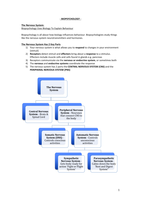
5) The nervous system has 2 parts the CENTRAL NERVOUS SYSTEM (CNS) and the
PERIPHERAL NERVOUS SYSTEM (PNS)
The Nervous
System
Peripheral Nervous
Central Nervous
System - Neurones
System - Brain &
that connect CNS to
Spinal Cord
the body
Somatic Nervous Automatic Nervous
System (SNS) - System - Controls
Controls conscious unconscious
activities activities
Sympathetic Parasympathetic
Nervous System - Nervous System -
Gets body ready for Calms down the body
action 'Fight or Flight 'Rest and Digest
System' System"
1
,The Cells of the Nervous System are Called Neurons:
Ø Neurons transmit information as ELECTRICAL IMPULSES around the body
Ø The cell body has DENDRITES that receive information from other neurons
Ø This info passes along the axon in the form of an ELECTRICAL IMPULSE that ends up
at a SYNAPTIC KNOB
Ø There’s a small gap before the next neuron called a synapse
Ø Neurotransmitters are chemicals that are released from the synaptic knob. They
pass across the synapse to pass on the signal to the dendrites of the next neuron.
Different Types Of Neurons Have Different Roles:
Ø Different types of neuron are involved in the transfer of information to and from
the CNS.
Ø The structure of the neurons differs:
2
, Sensory Neurons:
The nerve cells that transmit electrical impulses from receptors to the CNS.
Relay Neurons:
The nerve cells that transmit electrical impulses between sensory neurons and motor
neurons.
Motor Neurons:
The nerve cells that transmit electrical impulses from the CNS to effectors.
Transmission of information to and from the CNS is shown below:
Stimulus -> Receptors -> CNS -> Effectors -> Response
Reflexes Help Prevent Injury:
Reflexes are fast, automatic responses to certain stimuli. They bypass your conscious brain
completely – instead go through the spinal cord or through an unconscious part of the
brain. These rapid responses help us avoid damage.
Synapses – A Junction Between a Neuron and the Next Cell
1) A synapse is a junction between a neuron and another neuron, or between a
neuron and an effector cell e.g. a muscle or a gland
2) The tiny gap between the cells at a synapse is called the SYNAPTIC CLEFT
3) The presynaptic neuron (the one before the synapse) has a swelling called a
SYNAPTIC KNOB. This contains SYNAPTIC VESICLES filled with
NEUROTRANSMITTERS
3
The Nervous System:
Biopsychology Uses Biology To Explain Behaviour
Biopsychology is all about how biology influences behaviour. Biopsychologists study things
like the nervous system neurotransmitters and hormones.
The Nervous System Has 2 Key Parts
1) Your nervous system is what allows you to respond to changes in your environment
(stimuli)
2) Receptors detect stimuli and effectors bring about a response to a stimulus.
Effectors include muscle cells and cells found in glands e.g. pancreas
3) Receptors communicate via the nervous or endocrine system, or sometimes both
4) The nervous and endocrine systems coordinate the response
5) The nervous system has 2 parts the CENTRAL NERVOUS SYSTEM (CNS) and the
PERIPHERAL NERVOUS SYSTEM (PNS)
The Nervous
System
Peripheral Nervous
Central Nervous
System - Neurones
System - Brain &
that connect CNS to
Spinal Cord
the body
Somatic Nervous Automatic Nervous
System (SNS) - System - Controls
Controls conscious unconscious
activities activities
Sympathetic Parasympathetic
Nervous System - Nervous System -
Gets body ready for Calms down the body
action 'Fight or Flight 'Rest and Digest
System' System"
1
,The Cells of the Nervous System are Called Neurons:
Ø Neurons transmit information as ELECTRICAL IMPULSES around the body
Ø The cell body has DENDRITES that receive information from other neurons
Ø This info passes along the axon in the form of an ELECTRICAL IMPULSE that ends up
at a SYNAPTIC KNOB
Ø There’s a small gap before the next neuron called a synapse
Ø Neurotransmitters are chemicals that are released from the synaptic knob. They
pass across the synapse to pass on the signal to the dendrites of the next neuron.
Different Types Of Neurons Have Different Roles:
Ø Different types of neuron are involved in the transfer of information to and from
the CNS.
Ø The structure of the neurons differs:
2
, Sensory Neurons:
The nerve cells that transmit electrical impulses from receptors to the CNS.
Relay Neurons:
The nerve cells that transmit electrical impulses between sensory neurons and motor
neurons.
Motor Neurons:
The nerve cells that transmit electrical impulses from the CNS to effectors.
Transmission of information to and from the CNS is shown below:
Stimulus -> Receptors -> CNS -> Effectors -> Response
Reflexes Help Prevent Injury:
Reflexes are fast, automatic responses to certain stimuli. They bypass your conscious brain
completely – instead go through the spinal cord or through an unconscious part of the
brain. These rapid responses help us avoid damage.
Synapses – A Junction Between a Neuron and the Next Cell
1) A synapse is a junction between a neuron and another neuron, or between a
neuron and an effector cell e.g. a muscle or a gland
2) The tiny gap between the cells at a synapse is called the SYNAPTIC CLEFT
3) The presynaptic neuron (the one before the synapse) has a swelling called a
SYNAPTIC KNOB. This contains SYNAPTIC VESICLES filled with
NEUROTRANSMITTERS
3