
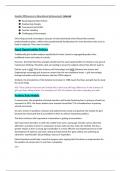
Gender Differences in Educational Achievement: Internal
Equal Opportunities Policies
Positive Role Models
Coursework and GCSE’s
Teacher Labelling
Challenging of Stereotypes
Girls trying to break stereotypes, because of male dominated school hierarchies (women
predominantly teachers, whilst males predominantly headteachers/in more dominant roles such as
head of subjects). They may try harder.
Equal Opportunities Policies
Traditionally girls studied subjects specifically for them, based on segregated gender roles,
traditional norms and values in society.
However, the belief that boys and girls should have the same opportunities in schools is now part of
mainstream thinking. Therefore, girls are starting to exceed in subjects where they did not used to.
Policies such as GIST (Girls into Science and Technology) and WISE (Women into Science and
Engineering) encourage girls to pursue careers into the non-traditional areas -> girls increasingly
leaving humanities and social sciences and into STEM subjects.
Similarly, the introduction of the National Curriculum in 1988 meant that boys and girls had to study
the same things.
A03: These policies have had only limited effect, there are still huge differences in the numbers of
girls and boys taking science. For example over 90% of students who take computing are male.
Positive Role Models
In recent years, the proportion of female teachers and female head-teachers in primary schools has
increased. In 2019, the future leaders trust research found that 71% of headteachers in primary
schools are female.
As such, women in positions of power and authority have acted as important role models for girls
because they show girls that it is possible for them to achieve important positions.
This then reinforces the importance of education in gaining such positions.
Girls may hence do better as with role models from such a young age, females can be adversely
affected in a positive manner in comparison to boys (who see less male role models), this has a
greater impact as from a young age socialisation is a more effective and important process in the
development of opinions and work. Seeing a female break the ‘glass-ceiling’ and achieving an
otherwise ‘unachievable’ job providing a source of inspiration.
Liberal feminists would take a march of progress view arguing that this shows an improvement for
the position of women but it is not there completely.
A03:
Equal Opportunities Policies
Positive Role Models
Coursework and GCSE’s
Teacher Labelling
Challenging of Stereotypes
Girls trying to break stereotypes, because of male dominated school hierarchies (women
predominantly teachers, whilst males predominantly headteachers/in more dominant roles such as
head of subjects). They may try harder.
Equal Opportunities Policies
Traditionally girls studied subjects specifically for them, based on segregated gender roles,
traditional norms and values in society.
However, the belief that boys and girls should have the same opportunities in schools is now part of
mainstream thinking. Therefore, girls are starting to exceed in subjects where they did not used to.
Policies such as GIST (Girls into Science and Technology) and WISE (Women into Science and
Engineering) encourage girls to pursue careers into the non-traditional areas -> girls increasingly
leaving humanities and social sciences and into STEM subjects.
Similarly, the introduction of the National Curriculum in 1988 meant that boys and girls had to study
the same things.
A03: These policies have had only limited effect, there are still huge differences in the numbers of
girls and boys taking science. For example over 90% of students who take computing are male.
Positive Role Models
In recent years, the proportion of female teachers and female head-teachers in primary schools has
increased. In 2019, the future leaders trust research found that 71% of headteachers in primary
schools are female.
As such, women in positions of power and authority have acted as important role models for girls
because they show girls that it is possible for them to achieve important positions.
This then reinforces the importance of education in gaining such positions.
Girls may hence do better as with role models from such a young age, females can be adversely
affected in a positive manner in comparison to boys (who see less male role models), this has a
greater impact as from a young age socialisation is a more effective and important process in the
development of opinions and work. Seeing a female break the ‘glass-ceiling’ and achieving an
otherwise ‘unachievable’ job providing a source of inspiration.
Liberal feminists would take a march of progress view arguing that this shows an improvement for
the position of women but it is not there completely.
A03:



